Trailing Stop — How It Works and When to Use It
A trailing stop is a stop order that follows price to lock in gains. Learn how it works, where to place it, and when it quietly works against you.
A trailing stop is a stop order that follows price as a trade moves in your favor and holds its ground when price reverses. It stays a fixed distance behind the best price reached, so it locks in gains without forcing you to watch the screen. Set the distance once and the exit manages itself.
That is the mechanic. The harder question is whether it fits the trade in front of you. The trailing stop is not a profit machine. It is a trade-management tool with specific conditions where it helps and specific conditions where it quietly works against you.
Trailing stop meaning, stated plainly
The trailing stop meaning comes down to one rule: the stop moves in one direction only. On a long position, it ratchets up as price makes new highs and never moves down. The gap between the stop and the high stays constant, set either as a fixed amount or as a percentage.
A fixed stop loss sits at one price and stays there. A trailing stop is dynamic. It converts unrealized gains into a defined exit level as the move develops, which is why it appeals to traders holding momentum rather than scalping a single level.
How does a trailing stop work in trading
Mechanically, the platform tracks the highest price reached since entry and keeps the stop a set distance below it. Each new high drags the stop higher. A lower high does nothing. Price has to fall by the full trail amount from the peak before the order triggers.
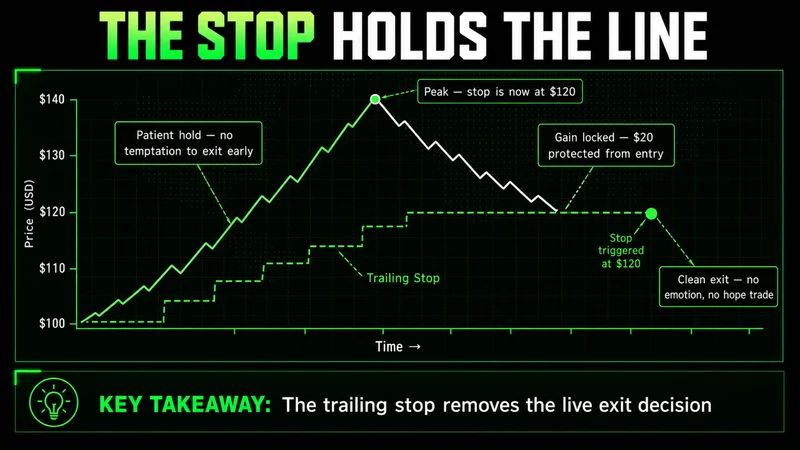
Here is a trailing stop example. You go long at 100 with a 10-point trail. Price runs to 130, so the stop has climbed to 120. Price stalls and slips to 120. The order fires and you exit at roughly 120, banking the move instead of riding it back to entry. Note the word "roughly" — the trigger becomes a market order, so the fill can land above, at, or below 120 depending on liquidity at that moment.
The trail can be expressed two ways, and the choice matters more than most beginners expect.
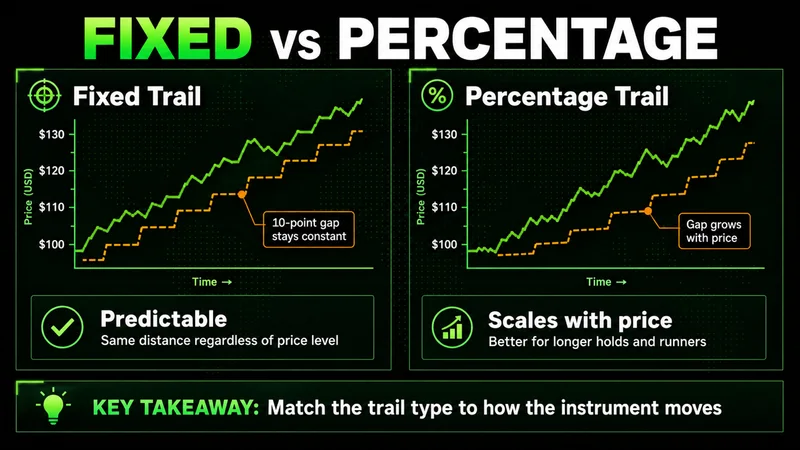
- A fixed trail uses a set distance in dollars, points, or ticks. It is predictable but ignores how the instrument is actually moving that session.
- A percentage trail scales with price. It widens as the position grows, which suits longer holds and instruments that travel in percentage terms rather than fixed increments.
Trailing stop placement: size it to volatility, not to comfort
This is where most of the edge lives, and where most explanations stop short. Fixed versus percentage is the wrong first question. The first question is how much noise the instrument produces on your timeframe.
Place the trail too tight and normal retracements take you out before the real move happens. Place it too wide and you hand back a large share of the gain on every exit. Proper trailing stop placement starts from the instrument's recent range, not from a round number that feels safe.
A practical method is to anchor the distance to average range — a multiple of the recent average true range, or the depth of recent pullbacks that did not break structure. On NQ, where volatility expands fast, a trail that worked in the morning can be far too tight by the afternoon. The distance should reflect current conditions, not the number you typed at entry.
Trailing stop vs fixed stop loss
Both define risk. They behave differently once the trade moves.
| Dimension | Fixed stop loss | Trailing stop |
|---|---|---|
| Stop level | Stays at one price | Ratchets toward price, never back |
| Main job | Caps the initial loss | Protects gains as the move runs |
| Best fit | Defined-target trades, ranges | Trending, momentum-driven moves |
| Weakness | Locks no profit on a runner | Cut short by normal pullbacks if too tight |
The honest framing is that they solve different problems. A fixed stop answers "how much am I risking on this idea." A trailing stop answers "how much of an open gain am I willing to give back to stay in." Many traders run both: a fixed stop for invalidation, switched to a trail only after price clears a meaningful level.
Trailing stop risk control and what it does to your numbers
A trailing stop is risk control applied to the profit side of the trade. It caps how much of an unrealized gain converts back into nothing. Used well, it lets winners run while removing the real-time exit decision that emotion tends to ruin.
The market rewards patience more than activity, and a trailing stop is one of the few tools that enforces it for you. Once the trade is working, the stop holds the line so you are not tempted to close early out of discomfort or sit through a full reversal hoping it comes back.
When should traders use a trailing stop
A trailing stop fits a directional move with room to run. It is built for trends, not for chop. When price grinds sideways inside a range, the trail gets clipped on every swing and you pay the spread repeatedly for nothing.
It also fits traders who cannot monitor positions continuously. The stop does the watching. That is a real benefit, as long as the distance was set with thought rather than convenience.
Here is when this does not work. In thin overnight liquidity or on a gap open, the trigger can fill well past the level you intended, so the protection you assumed is partly an illusion. Gold trades cleanly for hours and then, on a macro headline, jumps straight through any reasonable trail. In those conditions the mechanic does not fail because it is broken — it fails because price did not stop to honor it.
Common trailing stop mistakes beginners make
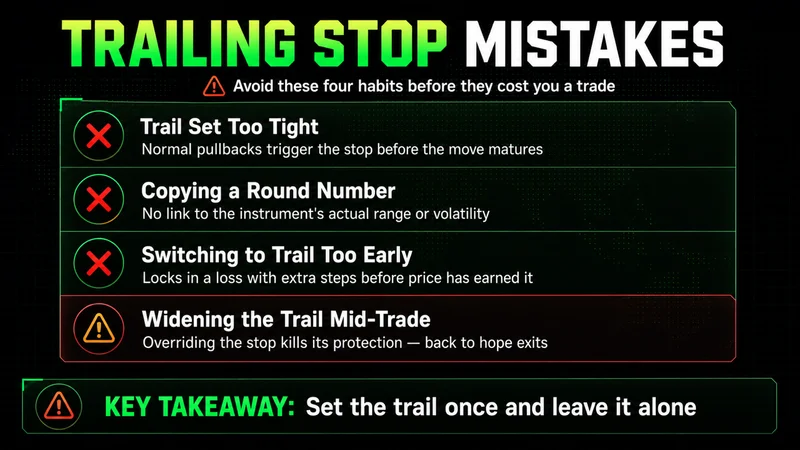
The pattern behind most trailing stop mistakes is treating the trail as a setting rather than a decision.
- Setting it too tight, so routine noise closes the trade before the move matures.
- Copying a round number with no relationship to the instrument's range.
- Switching to a trail before price has earned it, which just locks in a loss with extra steps.
- Mentally widening the trail mid-trade to avoid getting stopped, which defeats the entire point.
That last one is the dangerous habit. The trailing stop is supposed to remove the live exit decision. The moment you start overriding it because you do not like where it sits, you are back to discretionary exits driven by hope, and the tool is no longer protecting anything.
A trailing stop strategy and a checklist for new traders
A simple trailing stop strategy is to enter with a fixed stop at structural invalidation, then convert to a trail only after price clears the first meaningful level in your favor. The fixed stop defines the risk. The trail manages the reward once the idea is proven.
Run this trailing stop checklist before you rely on one:
- Is the instrument trending or ranging right now? Trails belong in trends.
- Is the distance anchored to recent range, not a round number?
- Have I confirmed the trade is working before switching from fixed to trail?
- Do I accept the fill could slip on a gap or thin liquidity?
- Will I leave the trail alone once it is set?
A trailing stop is important for beginners precisely because it builds the habit of defining the exit before emotion enters. It does not promise a good outcome on any single trade. It enforces a process, and over enough trades the process is what survives.
FAQs
What is a trailing stop in trading? It is a stop order that follows price by a set distance as a trade moves in your favor and stays put when price reverses. On a long, it ratchets up with new highs and never moves down, locking in gains until price pulls back to it.
What is the difference between a trailing stop and a fixed stop loss? A fixed stop loss sits at one price and caps your initial risk. A trailing stop moves with price to protect gains as the move develops. Many traders use a fixed stop for invalidation and switch to a trail only after the trade clears a meaningful level.
How far should a trailing stop be placed? Anchor the distance to the instrument's recent range, not a round number. Too tight and normal pullbacks stop you out early; too wide and you give back a large share of the gain. A multiple of average range is a more reliable starting point than a fixed dollar figure.
Do trailing stops work during gaps or after hours? The trigger becomes a market order, so on a gap or in thin liquidity the fill can land well past your intended level. The stop still executes, but the price protection is weaker than it looks. Size the trade with that slippage in mind.
Worth the read?