Breakouts and False Breakouts Explained
Breakouts and false breakouts explained — what separates a real break from a liquidity sweep, how volume confirms the move, and when the playbook breaks.
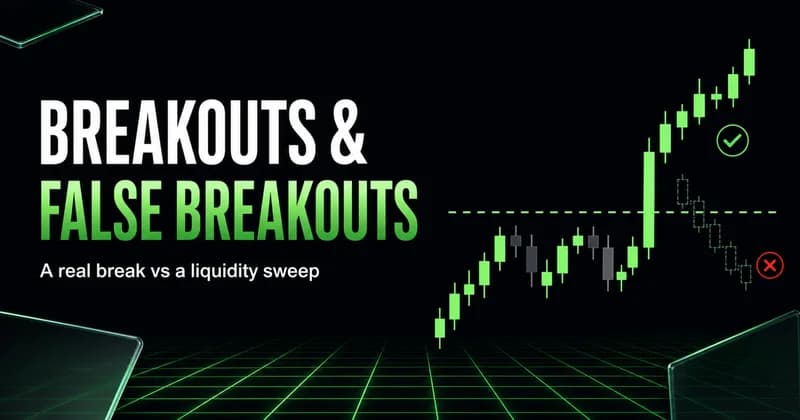
Breakouts and false breakouts explained in one line: a breakout is price leaving a range with conviction, and a false breakout is price leaving the same range without it. The level is identical. The behaviour after the level is what separates the two, and most traders only learn the difference after taking the wrong side of it several times.
A clean break is a structural event. A fake break is a liquidity event. They look similar on the wick and almost never look similar on the close.
What a breakout actually is
A breakout is the moment price moves through a defined level — a swing high, a swing low, a range boundary — and the market accepts that new area. Acceptance means trade is happening on the other side, not just a single candle poking through.
Traders treat a resistance breakout as a signal that supply at that level has been absorbed. A support breakout signals the opposite — demand below failed to hold. In both cases the level only matters because participants treated it as meaningful before the move; the break tells us something about who was defending it and who gave up.
The components of a useful breakout level are simple:
- A defined boundary visible on more than one timeframe.
- Multiple prior touches that produced a reaction.
- A clear reason it mattered — a swing point, a session high or low, a range edge.
Price action work begins here. The level is data, the reaction to the level is the signal.
What a false breakout is and why it happens
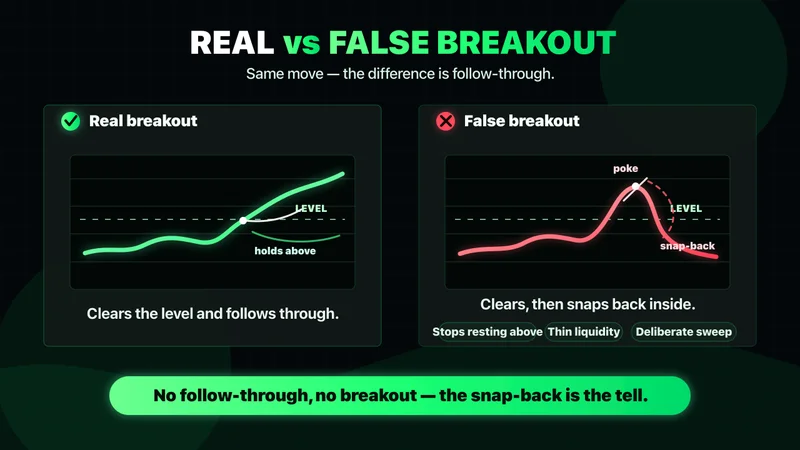
A false breakout is the same move without follow-through. Price clears the level, traders react as if the breakout is real, and price returns inside the range — often within the same session.
The mechanics are usually some mix of three things:
- Stops resting just beyond the level get triggered, providing liquidity for the opposite side.
- The participants needed to continue the move are not there. Volume is thin, conviction is weak.
- A short-term order flow imbalance pushes price through, but nothing structural changes.
Most failed breakouts are not random. They happen at obvious levels because obvious levels are where stops cluster. Banks, funds, and algorithmic desks need counterparties to fill size; the easiest counterparties are the stops sitting beyond a level every retail chart shows.
How volume confirms a breakout
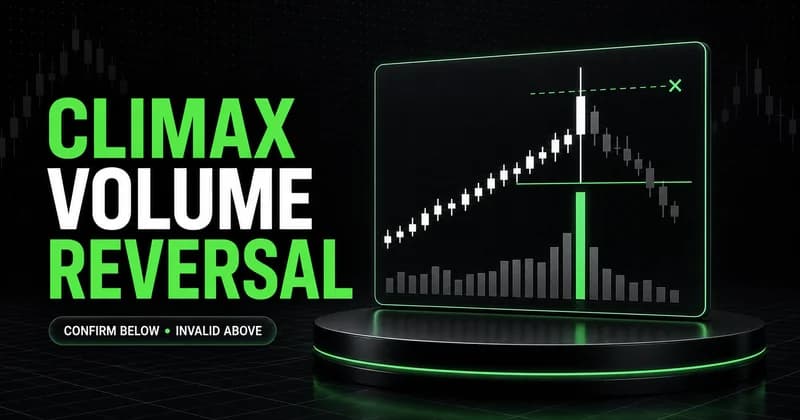
Volume is the cleanest filter most traders ignore. A real breakout typically prints expanding volume into and through the level. A false breakout typically prints the opposite — the spike happens on thinning participation, then volume picks up as price reverses.
There is no fixed multiplier that defines "confirmation." What matters is relative behaviour:
- Is the breakout candle's volume higher than the recent average for that session and timeframe?
- Does volume continue on the next one or two candles, or does it collapse?
- Is participation increasing in the direction of the break, or are the loudest candles the reversal candles?
Volume alone is not a system. Volume plus a clean close beyond the level, on a timeframe high enough to filter noise, gets close to one.
Practical reads on breakout volume:
- Expanding volume on the break, holding on the next bar: continuation read.
- Single spike on the break, immediate collapse: low-quality breakout, high reversal risk.
- Quiet break followed by expanding volume only on the reversal: false breakout already in motion.
Breakout vs false breakout — read the close, not the spike
The single most useful habit when reading a potential breakout is to stop watching the wick and start watching the close.
A wick beyond a level proves only that someone hit a market order through it. A close beyond the level, on the timeframe being traded, means buyers or sellers were willing to hold that price into the next bar. Acceptance is a closing behaviour.
A practical filter most professional traders use:
- Mark the level on a higher timeframe than the one being traded.
- Wait for at least one full close beyond it on that higher timeframe.
- Require a second test — either a retest that holds, or continuation that does not reclaim the level.
This loses some moves. It also removes most of the worst ones. The trade-off is acceptable for anyone trading with defined risk, because the trades that survive this filter tend to extend rather than reverse immediately.
Liquidity sweeps and why most false breakouts are deliberate
A liquidity sweep is a deliberate push beyond a level whose only purpose is to trigger resting orders and then reverse. The market needs liquidity to move size; the cleanest place to find it is exactly where amateur stop placement is most predictable — a few ticks above an obvious swing high, a few ticks below an obvious swing low.
From that frame, the question changes. Instead of asking "did the breakout work," the question becomes "was that move a continuation or a sweep?" The answer is almost always in the speed and shape of the return.
- A breakout that fails slowly, drifting back into the range, is usually structural — buyers were not there.
- A breakout that fails violently, snapping back through the level inside one or two candles, is usually a sweep.
Liquidity sweep vs breakout is not a binary the market labels for you in real time. It is a read formed after the close prints. The strongest reversal trades in NQ and ES often start with a clean sweep of an obvious swing point, immediately followed by a displacement candle in the opposite direction. Most breakouts fail because traders enter emotionally instead of structurally; the sweep is the structural reason the failure was set up in the first place.
How to avoid false breakouts in practice
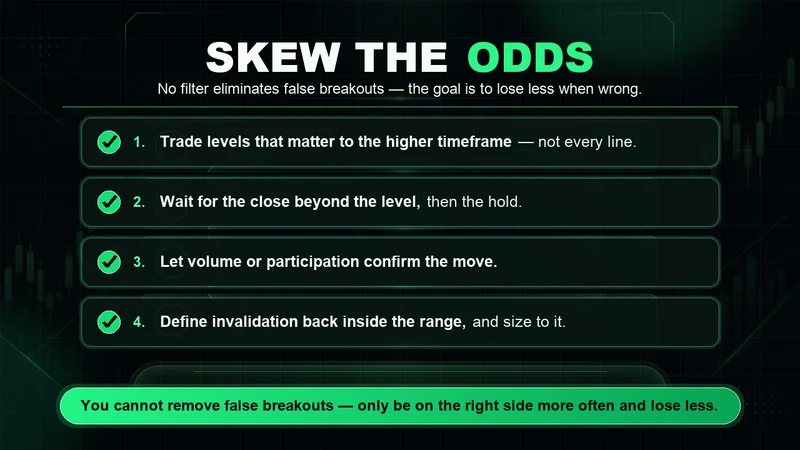
No filter eliminates false breakouts. The goal is to skew the distribution — to be on the right side of the level more often than not, and to lose less when the read is wrong.
A workable checklist:
- Trade levels that matter to the higher timeframe, not every minor pivot.
- Require a close beyond the level on the executing timeframe before entering.
- Look for expanding participation through the level, not into the reversal.
- Use a retest entry when it is available; the second test filters out most one-candle fakes.
- Place invalidation beyond the structural reason for the trade — beyond the swing that defined the level, not one tick past the wick.
- Size so a single false break is an operational cost, not an account event.
Defined invalidation is the difference between participating in breakouts and being a stop-loss donation. If a fake breakout cannot stop the strategy from being run cleanly the next session, position size and invalidation are doing their job.
When this playbook breaks
Every framework on this page assumes a cooperating tape. Outside those conditions the rules invert, and pretending otherwise is how strategies that work on a good week destroy an account on a bad one.
The breakout playbook breaks under predictable conditions:
- Overnight on thin liquidity. ES and NQ between roughly 4 p.m. and 6 p.m. Eastern can manufacture clean-looking breaks that mean almost nothing because the participants needed to continue them are not at the screen.
- Through major scheduled news. The initial reaction to CPI, FOMC, or NFP frequently retraces before structure has any chance to form. Volatility expands faster than the level itself can be confirmed, and breakouts in either direction can reverse twice inside a minute.
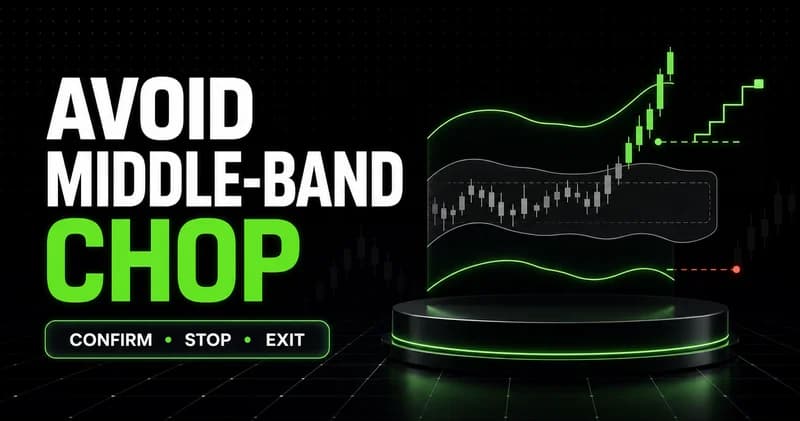
- Mid-session chop. Between the New York open's first hour and the early-afternoon push, breakouts inside small intraday ranges fail at a high rate. The level is real, the participation is not.
- Macro-driven sessions in GC. Gold can trade technically for hours and then invalidate the entire structure within minutes when a headline moves it; breakouts that looked clean become unrelated to whatever happened pre-headline.
Reading this is partly experience. The simple version: if liquidity is thin, if a known event is pending, or if the higher timeframe is mid-range with no clear control, breakouts are statistically lower-quality and should be treated as such or skipped.
FAQs
What is a breakout in trading? A breakout is a move through a defined level — a swing high, a swing low, or a range boundary — where price accepts the new area rather than rejecting back inside. The break only matters if the close beyond the level holds and participation supports the move.
What is a false breakout? A false breakout is a move beyond a level that does not hold. Price clears the level, often triggers stops, and then returns inside the prior range. The wick says a breakout happened. The close says it did not.
What is the difference between a breakout and a liquidity sweep? A breakout is a structural event — supply or demand at the level was genuinely absorbed. A liquidity sweep is a deliberate push beyond the level to trigger resting orders and reverse. Sweeps tend to fail violently and quickly; structural failures tend to fade slowly.
How does volume confirm a breakout? Real breakouts usually print expanding volume through the level and on the next one or two candles. False breakouts often print a volume spike on the breakout candle followed by a collapse, with participation returning only as price reverses.
How do you avoid false breakouts as a beginner? Wait for a close beyond the level on the executing timeframe, prefer levels that matter on the higher timeframe, require volume to expand into and through the move, and place invalidation beyond the structural reason for the trade rather than one tick past the wick.
Worth the read?