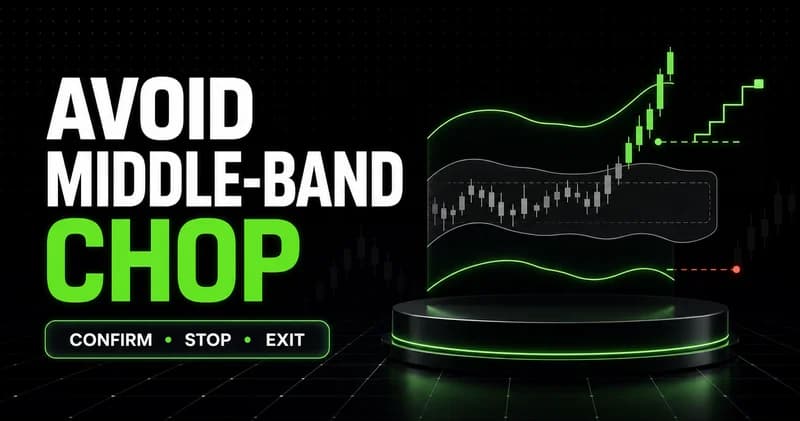
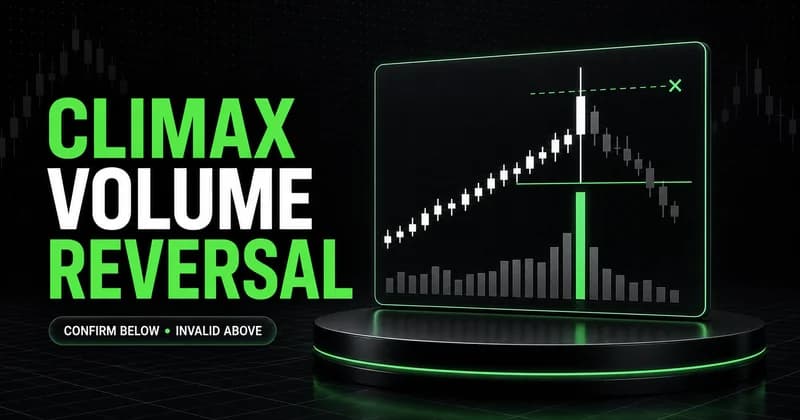
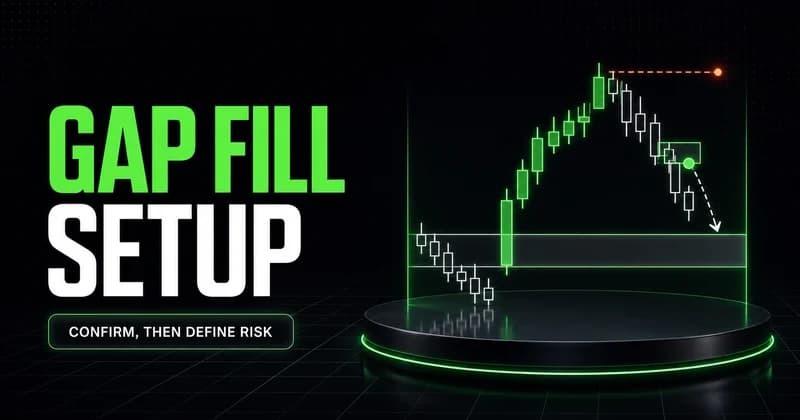
Engulfing Pattern Explained — A Two-Candle Reversal
An engulfing pattern is a two-candle reversal signal. Here is how to read it, confirm it, and trade it with context and defined risk.
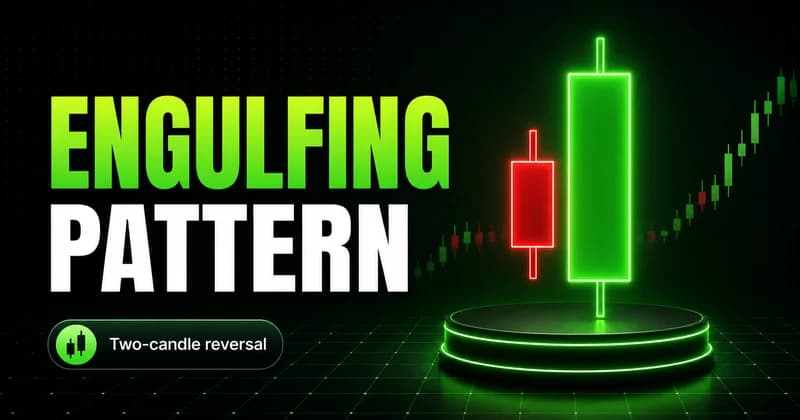
An engulfing pattern is a two-candle reversal signal where the second candle's body fully covers the first candle's body, showing that one side of the market absorbed the other and took control. It is not a prediction. It is a snapshot of a momentum shift, and it only carries weight when the location and the context behind it line up.
Most traders treat the engulfing pattern as a green light on its own. That is where the trouble starts. The shape is easy to spot, which is exactly why it gets traded badly. The pattern marks where pressure changed hands, but the chart still has to confirm that the change held.
What is an engulfing pattern?
The engulfing pattern meaning is straightforward. Two candles, side by side. The first is smaller. The second opens near the first candle's close and closes beyond the first candle's open, so its body engulfs the prior body completely. The wicks do not need to be covered, only the open-to-close range.
There are two versions. A bullish engulfing forms after a move down: a small down candle, then a larger up candle that swallows it. A bearish engulfing forms after a move up: a small up candle, then a larger down candle that swallows it. In both cases the second candle is the tell. It shows that the side in control during the first candle lost the argument by the close of the second.
That is the whole reversal signal. Sellers were pushing, then buyers absorbed the supply and closed the candle higher, or the reverse. The pattern captures the moment positioning flipped. What it does not tell you is whether the flip will last. That depends on where it printed.
How to identify an engulfing pattern on a chart
Knowing how to identify an engulfing pattern on a chart comes down to four reads, in order.
- Direction first. Is the market trending up, trending down, or ranging? A bullish engulfing means something after a clear move down. A bearish engulfing means something after a clear move up. The same shape inside chop is noise.
- Body coverage. The second candle's real body must cover the first candle's real body open to close. A partial cover is not an engulfing pattern, even if it looks close.
- Location. Did it print at a prior swing low, a swing high, a support shelf, or a resistance level? A pattern at a level the market already respects is worth more than the same pattern in open space.
- Size and close. A large second candle that closes near its extreme shows conviction. A small one that barely engulfs and closes mid-range shows hesitation, even if the definition is technically met.
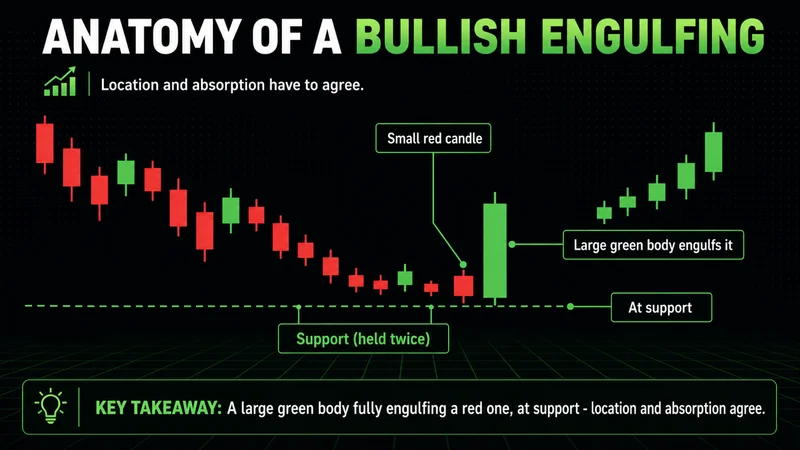
Work through a quick engulfing pattern chart example. Price drops into a level that held twice before. A small red candle prints, then a large green candle opens near that red close and closes above the red open. That is a bullish engulfing at support. The location and the absorption agree. That is the kind of read worth acting on, not a green candle floating in the middle of a range.
Bullish vs bearish: what actually shifts
The difference between the two patterns is direction, but the mechanic underneath is identical. Both show absorption. In a bullish engulfing, buyers absorb the selling that drove the first candle and reverse it. In a bearish engulfing, sellers absorb the buying.
The context requirement is symmetric. A bullish engulfing needs a downtrend or a pullback into support behind it to mean reversal. A bearish engulfing needs an uptrend or a rally into resistance. Strip the context away and the color of the candles tells you nothing about what happens next.
This is where liquidity matters more than the shape. The strongest engulfing patterns print where the prior move ran into a pool of orders, swept a level, and then reversed. The candle is the visible part. The order flow underneath it is what actually moved price.
How to confirm an engulfing pattern before entering a trade
Learning how to confirm an engulfing pattern before entering a trade is what separates a setup from a guess. The engulfing pattern confirmation is not the candle itself. It is what the market does immediately after.
Wait for the engulfing candle to close. An intrabar engulfing can erase itself before the period ends, so acting early means acting on a shape that may not exist by the close.
Then look for one of these to follow:
- A follow-through candle that continues in the engulfing direction and holds the new ground.
- A retest that comes back toward the engulfing candle's body and rejects, leaving the level intact.
- Acceptance above or below the level the pattern broke, rather than an immediate reclaim by the other side.
If price reclaims the engulfing candle and closes back through it, the signal failed. That reclaim is the invalidation, and it should be defined before the entry, not rationalized after. A bullish engulfing is wrong the moment price closes back below its low; a bearish engulfing is wrong once price closes back above its high.
Engulfing pattern vs pin bar — reading absorption against rejection
The engulfing pattern vs pin bar comparison confuses a lot of newer traders because both are reversal signals at levels. They are not the same read.
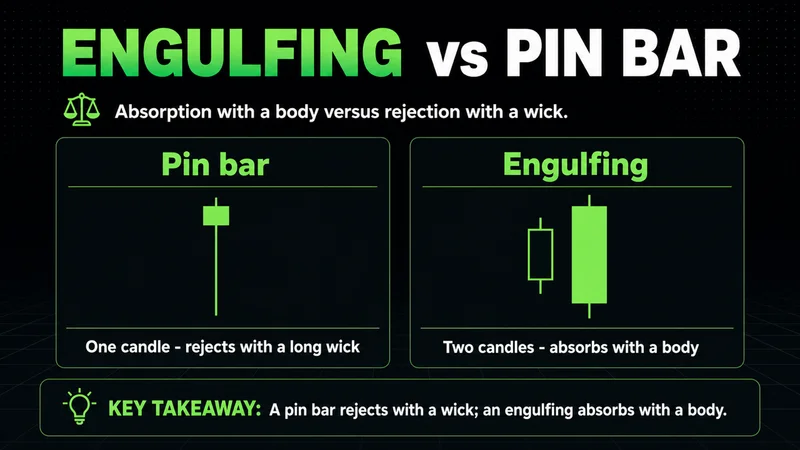
A pin bar is a single candle. It rejects a level with a long wick and closes back where it came from, leaving a visible tail. It says price probed past a level and got pushed out within one period.
An engulfing pattern is two candles. It does not reject with a wick; it absorbs with a body. The first candle commits in one direction, then the second candle overwhelms it and closes through. The pin bar is a fast rejection. The engulfing pattern is a slower flip in control that took two periods to confirm.
In practice the pin bar tends to read cleaner at a sharp level touch, while the engulfing pattern reads better when momentum is genuinely changing hands rather than just being swatted away. Neither is superior. They describe different order-flow events, and treating them as interchangeable leads to entering one when the chart is telling you the other.
Best timeframe for engulfing pattern analysis and the context that decides the edge
The best timeframe for engulfing pattern analysis is the one where the pattern aligns with the structure you are actually trading. Higher timeframes, the daily and the four-hour, produce fewer engulfing patterns but each one represents more participation and more committed positioning. Lower timeframes produce far more, and most of them are noise.
This is the angle the textbooks skip. The same engulfing shape does not mean the same thing in every condition. Structure reads cleanly in active cash-session hours when real volume is behind the candles. Overnight on thin liquidity, the identical two-candle sequence can print on almost no participation and means close to nothing the next session.
The pattern is only as good as the liquidity behind the candle that formed it. A clean shape on no participation is just a picture.
That is the part most setups ignore. A bullish engulfing on the daily, at a tested support, during a high-volume session, is a different instrument than the same shape on a five-minute chart at 2 a.m. The shape is identical. The edge is not. Match the timeframe to where the liquidity and the structure actually live, and the pattern starts behaving the way the books claim it does.
Common engulfing pattern mistakes beginners make
Most of the common engulfing pattern mistakes beginners make come from trading the shape and ignoring everything around it.
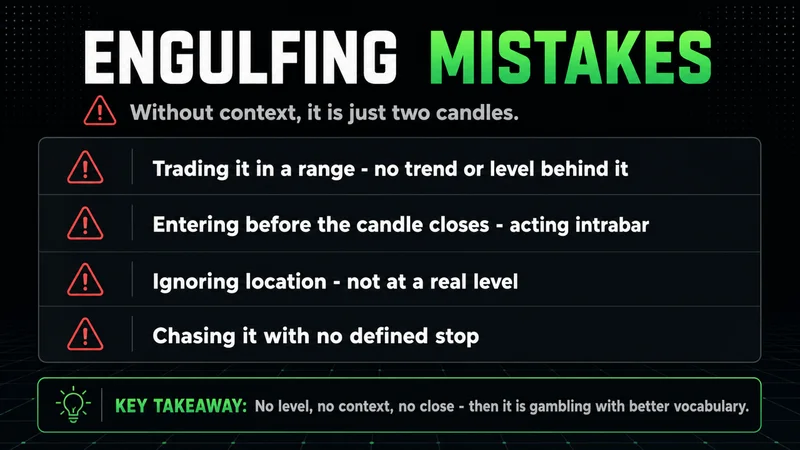
- Trading it in a range. An engulfing pattern with no trend or level behind it is just two candles. Without context it is closer to gambling with better vocabulary than a setup.
- Entering before the close. The pattern is not confirmed until the engulfing candle closes. Acting intrabar means acting on a shape that may vanish.
- Skipping the level. A pattern in open space has nothing to lean on. The strongest ones print at structure the market already respects.
- Ignoring invalidation. If you cannot say where the idea is wrong before you enter, the position size is a guess. A reclaim of the engulfing candle is the line.
- Oversizing the entry. The pattern's reliability is moderate, not high. One losing engulfing trade should never affect the next decision. If it does, the size was too large.
The pattern does not fail because it is a bad pattern. It fails because it gets traded without the context that gives it meaning.
A simple engulfing pattern checklist for new traders
This engulfing pattern checklist for new traders keeps the read disciplined and the risk defined before any entry.
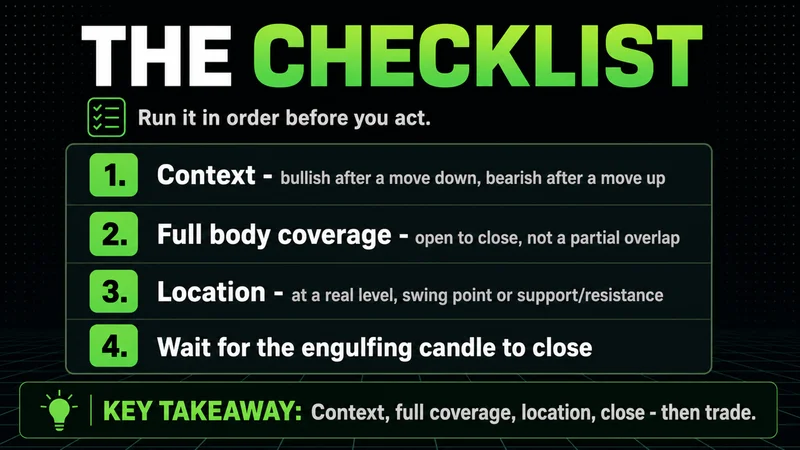
- Confirm the trend or pullback context. Bullish after a move down, bearish after a move up.
- Confirm full body coverage open to close, not a partial overlap.
- Confirm the location at a real level, a swing point, support, or resistance.
- Wait for the engulfing candle to close before doing anything.
- Wait for confirmation: follow-through, a clean retest, or acceptance through the level.
- Define invalidation at the reclaim of the engulfing candle, and size the position so that line costs a controlled amount.
- Use prior structure for the exit, since the pattern itself gives no target.
Run the list in order. If any step fails, there is no trade. A skipped step is usually where the loss comes from.
FAQs
What is an engulfing pattern in trading? It is a two-candle reversal signal where the second candle's body fully covers the first candle's body. A bullish engulfing forms after a move down and a bearish engulfing forms after a move up, marking the point where one side absorbed the other and took control.
Is the engulfing pattern reliable on its own? No. The shape alone is only moderately reliable. It gains meaning from context: a clear trend or pullback, a respected level, and confirmation after the candle closes. Traded in a range or in open space, it is closer to noise.
What is the best timeframe for engulfing pattern analysis? Higher timeframes such as the daily and four-hour produce fewer patterns but each carries more participation and weight. Lower timeframes produce more signals and far more noise. The best choice is the timeframe that aligns with the structure you are trading.
How do I confirm an engulfing pattern before entering? Wait for the engulfing candle to close, then look for follow-through, a clean retest of the candle's body, or acceptance through the level it broke. If price reclaims and closes back through the engulfing candle, the signal has failed.
What is the difference between an engulfing pattern and a pin bar? A pin bar is a single candle that rejects a level with a long wick. An engulfing pattern is two candles where the second absorbs the first with its body. The pin bar is a fast rejection; the engulfing pattern is a slower shift in control.
Where do I place the invalidation on an engulfing trade? At the reclaim of the engulfing candle. A bullish engulfing is wrong once price closes back below its low, and a bearish engulfing is wrong once price closes back above its high. Define that line before entering and size the position around it.
Worth the read?