Exit Price in Trading — What It Is and Why It Matters
Exit price is where a trade is settled into profit or loss. Learn what it means, how to place it against your entry, and the mistakes to avoid.
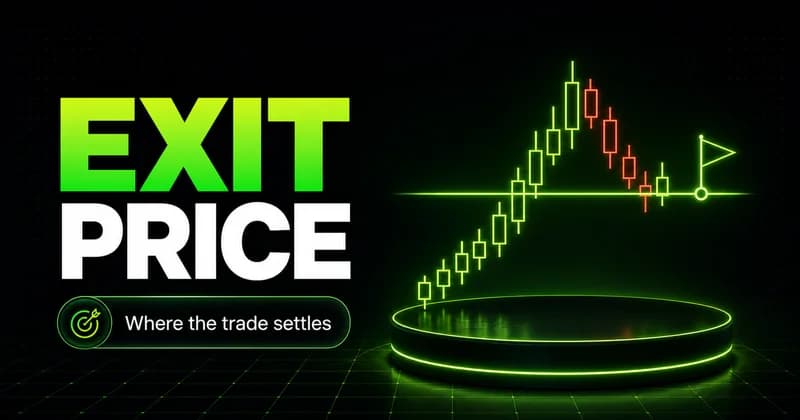
Your exit price is the price at which you close a position and lock in the outcome of a trade. It is the level where a paper gain or loss becomes a realized one. Most beginners obsess over the entry and treat the exit as something they will figure out later. That is backward. The exit price is where the result is actually decided, and deciding it after you are already in the trade is how good entries turn into bad outcomes.
An entry only opens risk. The exit price converts that risk into a number on your statement. The market does not pay you for being right on direction; it pays you for the difference between where you got in and where you got out.
What is exit price in trading?
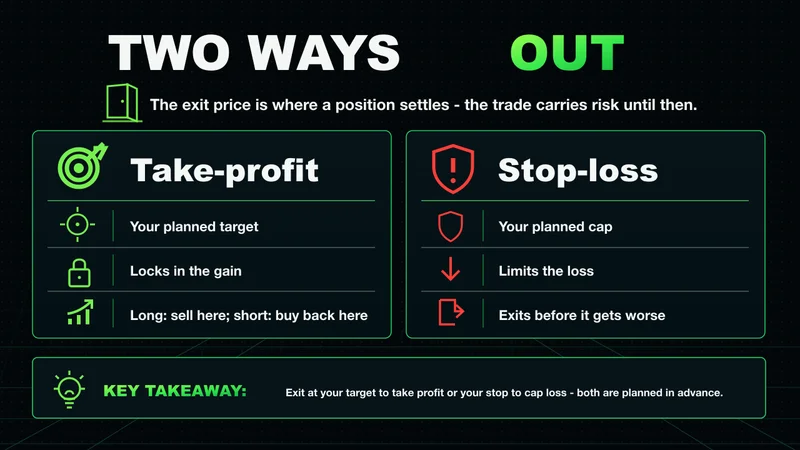
Exit price is the price at which a position is settled. For a long position, it is the price you sell at. For a short position, it is the price you buy back at. The trade is open until that moment, and an open trade carries risk the entire time.
There are two kinds of exit price, and both should exist before you enter:
- A profit exit, often placed as a take-profit order, where you accept the gain and step aside.
- A loss exit, often placed as a stop-loss order, set at the level where your reason for the trade is no longer valid.
The loss exit matters more than most people want to admit. It is not a guess about how much you are willing to lose. It is the price that proves the idea wrong. When price trades there, the structure you entered on has broken, and holding longer is no longer analysis. It is hope.
How exit price works against your entry price
The relationship between entry price and exit price is the trade. If you are long and your exit price is higher than your entry, the trade is profitable. If it is lower, you take a loss. That difference, multiplied by your position size, is your result.
This is why the two have to be planned together. A reasonable entry with a poorly placed exit is still a poor trade. A defined entry paired with a defined exit gives you a known risk before a single dollar is exposed, and lets you decide whether the trade is worth taking at all.
Most traders do not have a strategy problem. They have a discipline problem, and it usually shows up at the exit. The plan is clear before the trade. Then price moves, emotion arrives, and the predefined exit price gets quietly renegotiated in real time.
Where to place your exit price
Exit price placement is structural, not arbitrary. You are not picking a round number that feels safe. You are reading the chart for the level that defines the trade.
For a loss exit, place it beyond the level that would invalidate your idea, not at it. If you went long because price held a support level, your loss exit belongs below that level with a small buffer, far enough that normal noise does not knock you out before the real test. For a profit exit, anchor it to the next meaningful level where price is likely to react, such as a prior high or an area where sellers showed up before. The goal is a risk-defined trade: you know the exact price that ends it for a loss and the exact price that ends it for a gain, both set before you are attached to the position.
A simple exit price example
Say you buy a stock at 50 because it held a support level you trust. You set your loss exit at 48, just below that support, because a break there tells you the level failed. You set your profit exit at 56, the prior high where price stalled last time.
That gives the trade a shape. You are risking 2 points to make 6, a defined three-to-one structure. If price hits 48, you are out for a small, planned loss. If it reaches 56, you take the gain. You make no decisions once the trade is live, because every exit price was set while you were calm. Enter at 50 with no exit in mind, and each tick down toward 46 makes selling harder. That is the failure mode the plan removes.
When a fixed exit price works against you
A predefined exit price is the right default, but it is not a rule that ignores context. There are conditions where a static exit becomes a liability rather than protection.
Around scheduled high-impact events, a normal stop-loss exit can be meaningless. A volatility expansion can blow through your level and fill far worse than where you placed it, so the protection you counted on does not exist at the price you chose. Thin, low-liquidity conditions do the same thing more quietly: the level reads cleanly on the chart, but there is no one there to fill you near it. In those environments, the better decision is often a smaller position or no trade at all. The exit price protects you only when there is enough liquidity to execute it.
Common exit price mistakes beginners make
The mistakes are predictable, and they repeat across almost every new trader.
- Moving the loss exit further away once price approaches it, turning a small planned loss into a large unplanned one.
- Taking profit too early out of fear, exiting well before the level that justified the trade.
- Having no exit price at all and improvising once the position is live.
- Setting the loss exit at the invalidation level instead of beyond it, so normal noise stops you out before the idea is tested.
- Sizing the position so large that the planned exit price feels unbearable, which guarantees the plan gets broken.
Every one of these is an exit decision made under pressure instead of in advance. The fix is the same: decide the exit price before you enter, and treat it as part of the trade, not an afterthought.
An exit price checklist for new traders
Before you take a trade, you should be able to answer these:
- Where is my loss exit, and what level does it sit beyond?
- Where is my profit exit, and what makes that level meaningful?
- What is the distance from entry to each exit, and is the reward worth the risk?
- Is my position size small enough that hitting the loss exit is acceptable?
- Are conditions liquid enough for these exit prices to actually fill?
If you cannot answer all five, the trade is not ready. The exit price is the part of the plan that decides whether the entry was ever worth making.
FAQs
What is exit price in simple terms? It is the price at which you close a trade and turn an open position into a realized profit or loss. Until you exit, nothing about the trade is final.
Is exit price the same as a stop-loss? Not exactly. A stop-loss is the exit price set to cap a loss, and a take-profit is the exit price set to lock in a gain. Both are exit prices serving different purposes.
How is exit price different from entry price? The entry price opens the position and the exit price closes it. The difference between the two, times your position size, is your result.
When should a trader set the exit price? Before entering. Deciding the exit while a position is live invites emotion into the decision, which is exactly when planning breaks down.
Why does my exit price keep getting hit before the move works? Usually the loss exit is too tight, placed at the invalidation level instead of beyond it, so normal price noise reaches it before the idea is genuinely tested.
Is exit price important for beginners? It is the part of the trade beginners most often skip and most need. Risk management lives at the exit, and an entry without a planned exit is an open-ended bet, not a defined trade.
The takeaway on exit price
The exit price is where a trade is settled, and it deserves more attention than the entry, not less. Plan both the loss exit and the profit exit before you enter, anchor them to structure rather than to round numbers, and size the position so the plan is one you can actually follow. Respect the conditions where a fixed exit price may not fill, and step aside when liquidity cannot support it. Decide the exit while you are calm, and you remove the single decision that costs new traders the most.
Worth the read?