Business Valuation Methods — Three Core Approaches
Business valuation methods come down to three approaches — asset, income, and market. Here is what each measures and where each one breaks down.

A price tag is not a value. The business valuation methods that actually matter answer one question: what is this company worth based on what it owns, what it earns, and what similar companies trade for. There are three core approaches — asset-based, income-based, and market-based — and each one looks at a different part of the same business. Most disagreements about whether a stock is cheap or expensive come down to which method the person is leaning on without saying so.
For a private owner, valuation decides a sale price. For someone analyzing a stock, it does something more useful. It gives you an independent number to set against the market price, so you are reacting to a gap instead of reacting to a headline. The market quotes a price every second. Valuation is the slower work of deciding whether that price is reasonable.
What business valuation methods actually measure
Valuation is an estimate of economic worth, not a single fixed figure. Every method produces a range, and the range widens with uncertainty. That is the part most explanations skip. A clean DCF on a stable utility gives you a tight band. The same model on a pre-profit growth company gives you a number so sensitive to assumptions that it stops being an anchor and becomes a guess dressed up as math.
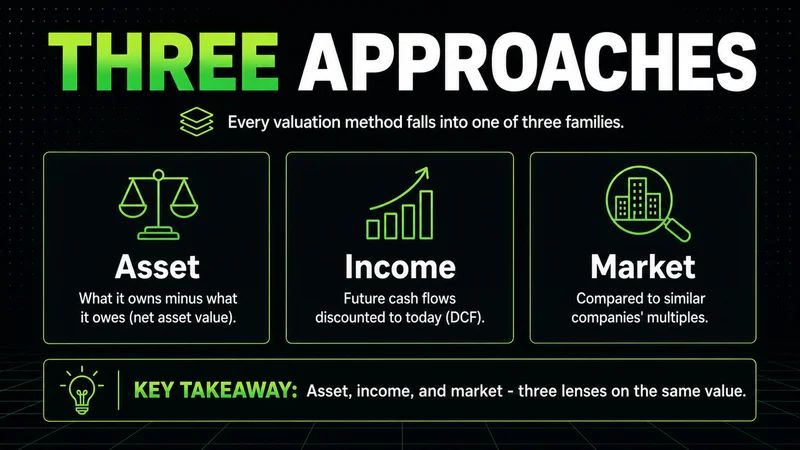
The three approaches differ in where they look:
Asset-based values what the company owns minus what it owes. The floor.
Income-based values the cash the business is expected to generate. The engine.
Market-based values the company against what comparable companies trade for. The reality check.
None of them is the right one. They are three lenses, and serious work uses more than one. When the three disagree sharply, that disagreement is information — it usually means the business is in transition, the assets are mispriced, or the market is pricing a story the cash flows do not yet support.
The asset-based approach and where it sets the floor
The asset-based approach is the most literal. You take the fair market value of the company's assets and subtract its liabilities. What remains is net asset value. For a holding company, a real estate vehicle, or a business heavy in equipment and inventory, this is often the cleanest read on worth.
The asset method also matters in distress. When a business is losing money and continuation is in doubt, future earnings are worth little, and liquidation value becomes the relevant number. In that situation the asset approach is not conservative — it is realistic.
For a stock analyst, net asset value is most useful as a downside reference. If a company trades below the conservative value of its assets, the market is pricing in either hidden liabilities or a belief that management will destroy that value over time. Sometimes that pessimism is correct. The asset floor tells you what is at stake if it is not.
Where it breaks down is asset-light businesses. A software company, a brand, or a services firm holds most of its value in things that never appear cleanly on a balance sheet — code, customer relationships, distribution, reputation. Run an asset-based valuation on a business like that and the number will be far below any sensible estimate of worth, because the method is measuring the wrong thing. The floor is real, but for these companies it sits so far beneath the market price that it tells you almost nothing.
The income approach and the business valuation methods formula traders lean on
The income approach values a business by the cash it is expected to produce. This is where most stock work concentrates, because a publicly traded company is, in the end, a claim on future cash flows.
The most common income-based business valuation methods formula is discounted cash flow. You project the company's free cash flow for a set period, estimate a terminal value for everything beyond it, and discount the whole stream back to today using a rate that reflects risk. The output is an estimate of intrinsic value per share. A business valuation methods example makes the logic concrete: a company expected to generate 100 million dollars of free cash flow next year, growing slowly and discounted at 9 percent, is worth more than one with the same cash flow facing a 14 percent discount rate because its earnings are less certain. Same cash today, different value, because risk is priced into the rate.
A simpler income method is capitalization of earnings, which divides a single normalized earnings figure by a capitalization rate. It suits stable, predictable businesses where next year looks much like last year. It is a poor fit for anything cyclical or fast-growing.
Here is the honest limit. A DCF is only as good as its terminal value, and the terminal value is usually the majority of the total. That figure depends on a long-run growth rate and a discount rate, and small changes in either move the answer by large amounts. On a steady cash generator the model is a genuine anchor. On a cyclical business priced at the top of its cycle, the same model produces a confident number built on earnings that are about to fall. The math does not warn you. You have to know the context the inputs came from.
The market approach and using comparables as a benchmark
The market approach values a company by comparison. You find similar businesses — public companies, or recent acquisitions — and apply their valuation multiples to the company you are studying. Price-to-earnings, EV/EBITDA, and price-to-sales are the common ratios. The logic is that the market has already done pricing work on comparable firms, and that work transfers if the businesses are genuinely alike.
This is the most practical of the business valuation methods for stock analysis because it is fast and it reflects what buyers are actually paying right now. Used as a benchmark, a multiple tells you whether a stock is priced richly or cheaply relative to its peer group. A company trading at 12 times earnings inside a group that averages 20 is either a bargain or a business the market expects to deteriorate.
The weakness is in the word "comparable." No two companies are identical, and the multiple you apply already contains the market's mood. In a euphoric market, every comp is expensive, so the target looks fairly priced against peers that are all overvalued together. The market approach measures relative value well and absolute value poorly. It tells you whether a stock is cheap against its neighbors, not whether the whole neighborhood is overpriced.
Business valuation methods versus financial ratio analysis
These two get confused, and the distinction is worth holding clearly. Financial ratio analysis examines the health of a business — margins, leverage, liquidity, return on capital. It tells you how well the company operates. It does not, by itself, produce a value.
Valuation takes the next step. It converts that operating picture into a number you can set against a price. Ratios are an input to valuation, not a substitute for it. A company can show excellent ratios and still be a poor investment if the price already reflects all of that quality and more. Ratio analysis answers "is this a good business?" Valuation answers "is this a good price?" Both questions matter, and they are not the same question.
How investors use business valuation methods to judge a stock
In practice you triangulate. You build an income-based estimate for intrinsic value, sanity-check it against market multiples, and keep the asset value in view as a floor. Three methods, three numbers, then judgment about which deserves the most weight given the kind of business in front of you.
The discipline is in what you do with the gap. Valuation gives you a reference price; the market gives you a quote. When the quote sits far below your range with no deterioration in the business, that is the kind of mispricing worth acting on. When the quote sits far above, the burden of proof is on the optimist. The reference does not tell you when to act. It tells you whether the price you are being offered is reasonable, which is a different and more durable kind of information than a chart can give you.
This is where most analysis quietly goes wrong. Many investors reverse-engineer the valuation to justify a price they already like, picking the discount rate and growth assumptions that produce the answer they wanted. The method looks rigorous and the conclusion was decided in advance. A valuation only protects you if you build it before you fall in love with the position, and if you are willing to let the number talk you out of the trade.
What these methods cannot do
Every valuation rests on assumptions, and the market does not have to respect them. A model can be careful, internally consistent, and still wrong because the future refused to match the inputs. Valuation narrows uncertainty. It does not remove it.
The methods also assume some baseline of stable information. During a liquidity event, a credit shock, or a forced-selling cascade, prices detach from any underlying value for a stretch, and a valuation built on normal-market assumptions gives you a number the market is in no mood to honor. That is not a flaw in the method. It is a reminder that valuation is a tool for normal conditions and a poor guide to what price will do in the middle of a panic. The number tells you what something is worth. It does not tell you what someone will pay for it tomorrow morning.
Putting the business valuation methods together
The three approaches answer three different questions. The asset method asks what the company would be worth broken up. The income method asks what its future cash is worth today. The market method asks what comparable businesses are fetching now. A complete read uses all three and weighs them by fit:
Assets carry the most weight for asset-heavy and distressed businesses.
Income carries the most weight for stable, predictable cash generators.
Comparables carry the most weight for fast checks against a defined peer group.
For stock analysis specifically, the point of valuation is not a precise price target. It is an independent estimate you can hold up against the market's quote, so your decisions come from the gap between value and price rather than from the noise around the price. The methods are the floor, the engine, and the reality check. Knowing which one to trust, and when each one breaks, is the part that takes screen time rather than a formula.
Worth the read?