Corporate Earnings — How to Read Them Like a Trader
Corporate earnings are a company's quarterly profit. Learn the components, the formula, the red flags, and why the market's reaction matters most.

Corporate earnings are the profit a company keeps after every cost is paid, reported each quarter alongside revenue, margins, and management's outlook. That number is where most beginners stop reading. It is also where the actual work starts. The print itself rarely decides what the stock does next. What decides the move is the gap between the result and what the market already expected, and how price behaves once that gap is known.
This is the part the headlines skip. A company can grow earnings by 20 percent and still sell off hard, because the number was already priced in and the guidance disappointed. Understanding corporate earnings means reading the report and the reaction as two separate things.
What corporate earnings actually mean
Earnings are the bottom line of the income statement: total revenue minus the cost of goods sold, operating expenses, interest, and taxes. Revenue is the top line, the money coming in. Earnings are what survives after the business pays to operate. When a report says a company earned a certain amount, it is describing profit, not sales.
Public companies release this in a quarterly earnings report, usually within a few weeks of the quarter closing. The corporate earnings meaning is straightforward on paper. The interpretation is where experience separates a useful read from a guess. A single quarter is a data point, not a verdict. The trend across several quarters, measured against the same period a year earlier, carries far more signal than any one release.
The components of corporate earnings
Most of a report comes down to a handful of figures. These are the corporate earnings components worth your attention before anything else:
Revenue — the top line. Total sales for the quarter, before any costs are removed.
Net income — the bottom line. Profit after all expenses, interest, and taxes.
Earnings per share (EPS) — net income divided by shares outstanding. This is the number analysts forecast and the market reacts to.
Operating margin — operating income as a share of revenue. It shows whether the business is getting more or less efficient.
Guidance — management's forecast for upcoming quarters. Forward-looking, and often more market-moving than the quarter just reported.
The corporate earnings formula at its simplest is revenue minus total expenses equals net income. EPS then divides that net income across the share count. Two companies can post identical net income and very different EPS if one has far more shares outstanding, which is why per-share figures matter more than raw profit for comparison.
Corporate earnings vs revenue, and why the distinction matters
Revenue and earnings answer different questions. Revenue tells you how much business a company is doing. Earnings tell you how much of that business turns into profit. A corporate earnings vs revenue analysis exposes the quality of growth, not just its existence.
A company can grow revenue every quarter and still see earnings shrink, usually because costs are rising faster than sales. That pattern shows up when a business buys growth through heavy spending or discounting. Strong revenue with weak earnings is a margin problem. Flat revenue with rising earnings often means cost discipline, which can be healthy or can signal a business cutting into its own future. Neither reading is complete without the other.
How to read corporate earnings against expectations
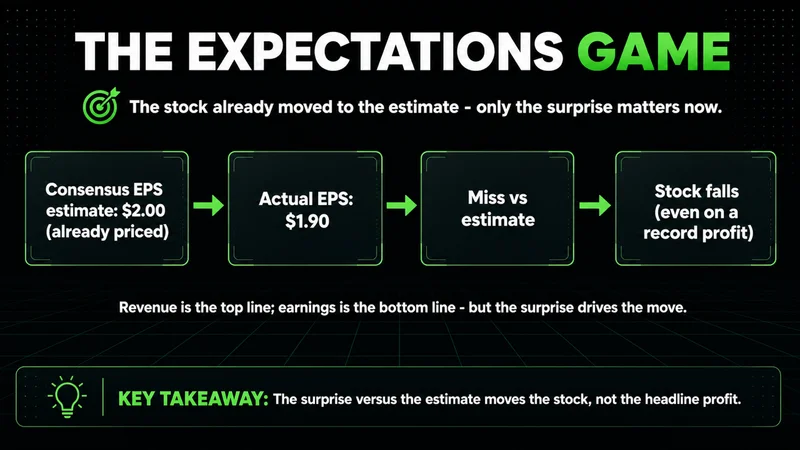
Here is the core of corporate earnings interpretation, and the part the textbooks underweight. Analysts publish estimates before the report. The stock has already moved to reflect those estimates. So the result that matters is not the absolute number. It is the surprise: how far actual EPS and revenue land from consensus, and whether guidance confirms or breaks the story the market was telling itself.
This is why a strong report can be sold. If expectations ran ahead of even a good quarter, the print disappoints relative to positioning, and the unwind is the trade. The reverse happens too. A mediocre quarter can rally if the result clears a low bar and guidance steadies nerves. The number is context. The reaction is the information.
This lens has a limit worth naming. Reading earnings against expectations works for liquid, widely covered stocks where consensus is real and positioning is heavy. On a thinly covered small cap with two analysts and light volume, there is no meaningful consensus to beat and the reaction is noise as often as signal. The framework holds where the crowd is watching. It tells you almost nothing where it is not.
Common corporate earnings red flags
Reports are written by people who want them to read well. Part of analyzing corporate earnings is separating operational quality from cosmetic presentation. These are the corporate earnings red flags worth checking before you trust a headline beat:
Adjusted earnings far above GAAP earnings. Companies highlight "adjusted" figures that strip out costs they call one-time. When the adjusted number is consistently and substantially better than the reported one, ask what is being excluded and why it keeps recurring.
Revenue growth without cash flow. Profit is an accounting figure; cash is not. Earnings that rise while operating cash flow stalls can mean sales are booked before money arrives.
One-time gains propping up the quarter. An asset sale or tax benefit can lift net income once. It does not repeat, so it tells you nothing about the underlying business.
Margins narrowing while revenue grows. Growth that costs more to produce each quarter is growth on borrowed time.
Guidance quietly walked back. A lowered forecast buried under an upbeat headline is the part the market eventually prices, often after the initial pop fades.
None of these are automatic disqualifiers. They are questions. The job is to find out whether the quarter reflects a durable business or a well-managed presentation.
How corporate earnings help your stock analysis
For a longer-term view, earnings are the foundation of valuation. Price relative to earnings, the consistency of profit growth, and the direction of margins all feed the question of what a business is worth. A single quarter rarely changes that picture. A multi-quarter trend can.
For anyone trading the event itself, the priority inverts. Risk comes first. Earnings releases produce some of the widest, fastest price swings in the market, and the direction is not knowable in advance regardless of how clean the analysis looks. The most useful discipline around earnings is often restraint: sizing down, defining invalidation before the print, or simply standing aside until the reaction resolves and structure becomes readable again. Most traders do not have an analysis problem at earnings. They have a discipline problem, and oversized positions into a binary event are where it shows up first.
A practical checklist for reading corporate earnings
Before you act on any report, walk through a corporate earnings checklist for beginners:
Did revenue and EPS beat, meet, or miss consensus, and by how much?
How does this quarter compare to the same quarter a year ago, not just the prior quarter?
What did guidance say, and did it confirm or contradict the headline result?
Are adjusted and GAAP figures close, or is the gap doing the heavy lifting?
Did operating cash flow move in the same direction as reported profit?
How is the stock reacting relative to where expectations already sat?
The answers, taken together, tell you more than any single figure ever will.
FAQs
What is corporate earnings in simple terms? Corporate earnings are a company's profit for a period, equal to revenue minus all costs including operating expenses, interest, and taxes. They appear as the bottom line of the income statement and are reported each quarter.
What is the difference between corporate earnings and revenue? Revenue is total sales before costs, the top line. Earnings are what remains after every cost is paid, the bottom line. A company can grow revenue while earnings shrink if expenses rise faster than sales.
Why does a stock sometimes fall on strong corporate earnings? Because the market prices in expectations before the report. If a good quarter still lands below what investors already expected, or guidance disappoints, the stock can sell off even as earnings grow.
What are the most important corporate earnings components to check? Revenue, net income, earnings per share, operating margin, and forward guidance. Reading them against analyst estimates and the same quarter a year earlier matters more than any figure on its own.
Key takeaways on corporate earnings
Corporate earnings are profit, not sales, and a single quarter is a data point rather than a verdict. The components worth knowing are revenue, net income, EPS, margins, and guidance. The result that moves price is the surprise against expectations, not the raw number, and that lens works best where coverage and volume are heavy. Red flags live in the gap between adjusted and reported figures, in profit without cash, and in quietly lowered guidance. Read the report and the reaction as two things, keep risk defined around the event, and let the multi-quarter trend carry more weight than any headline beat.
Worth the read?