Consumer Price Index — What It Is and Why Markets Watch It
The consumer price index is the government's main inflation gauge. Here is what it measures, how it is calculated, and why it moves the stock market.
The consumer price index is the government's measure of how much a fixed basket of goods and services costs over time, and it is the most-watched inflation gauge in U.S. markets. Each month the Bureau of Labor Statistics prices the same basket again, compares it to a reference period, and reports the change. That single number shapes interest-rate expectations, which is why a CPI report can move stocks, bonds, and futures within minutes of release.
Most explanations stop at the definition. For a trader, the definition is the easy part. What matters is how the print lands against what the market already expected, and what price does in the hours after the headline crosses.
What the consumer price index actually measures
The consumer price index tracks the average price of a representative basket of consumer goods and services. Housing, food, energy, transportation, medical care, apparel, and recreation all sit inside that basket, each weighted by how much a typical household spends on it. Shelter carries the largest weight, which is one reason the headline figure can lag what people feel at the store.
The BLS collects prices from thousands of retail outlets and from landlords and tenants across the country. It then sets the basket's cost against a reference period and multiplies by 100 to produce the index level. An index of 110 means the basket costs 10 percent more than it did in the reference period. The annual percentage change in that level is what gets reported as the inflation rate.
There is also a distinction worth holding onto. Headline CPI includes everything, while core CPI strips out food and energy, the two most volatile components, to show the underlying trend. The Federal Reserve pays close attention to core because it filters out the noise that food and fuel prices add.
How the consumer price index is calculated
The calculation is a weighted average, not a simple one. Each item in the basket contributes in proportion to its share of household spending, so a 1 percent move in rent matters far more than a 1 percent move in a minor category. The BLS gathers the current prices, compares the total basket cost to the previous period, and expresses the difference as a percentage.
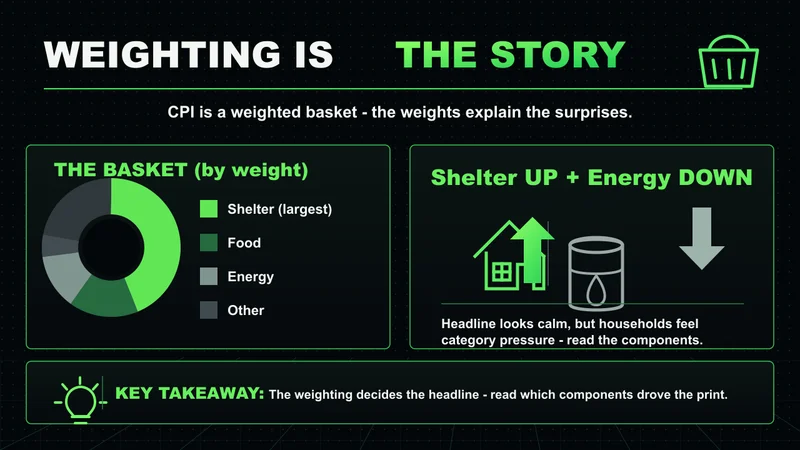
The weighting is the part most casual readers skip, and it is the part that explains surprises. When shelter costs rise while energy falls, the headline can look calm even though households feel pressure in specific categories. Reading which components drive the print tells you more than the headline alone.
Why the consumer price index works as an economic indicator
The consumer price index is the primary read on inflation, and inflation drives monetary policy. When the index runs hot, the Federal Reserve has reason to hold rates higher or delay cuts. When it cools, the path to lower rates opens. Government agencies use the same data to adjust Social Security payments and tax brackets.
For markets, the chain is direct. Rate expectations set the discount rate applied to future earnings, and that rate prices risk across every asset class. A change in the inflation outlook is a change in the cost of money. That is why a report on last month's prices can reprice equities that trade on next year's earnings.
How the consumer price index moves the stock market
The market does not react to the level. It reacts to the surprise. Traders and economists build a consensus estimate before the release, and price already reflects that estimate. What moves stocks is the gap between the print and the expectation.
An upside surprise, where inflation comes in hotter than expected, tends to push yields up and pressure equities, since it signals tighter policy ahead.
A downside surprise, where inflation cools faster than expected, tends to lower yields and support risk assets, since it opens room for the Fed to ease.
A print in line with consensus often produces a muted reaction, because the number was already in the price.
Rate-sensitive sectors react first and hardest. Growth and technology names, valued on distant earnings, move more on a rate shift than defensive sectors do. This is the mechanism behind the volatility you see on CPI mornings.
How traders position around a consumer price index release
This is where most explanations go quiet, and where screen time matters. The release is scheduled, the consensus is public, and the reaction is fast. None of that makes it easy to trade.
The first move after the print is frequently not the cleanest opportunity. Volatility spikes as algorithms react to the headline, spreads widen, and the initial direction often reverses once the market digests the components beneath the surface. A hot headline driven entirely by energy reads differently than a hot core number, and it can take several minutes for that distinction to settle into price.
A disciplined approach waits for structure to form rather than chasing the first candle. The reaction matters more than the number. If price sweeps liquidity above a prior high on a soft print and then fails to hold acceptance, that rejection tells you more than the headline did. Risk has to be defined before the release, not improvised after it. Position sizing decided in the middle of a volatility spike is rarely sized well.
There is a clear condition where this framework breaks down. On a print that lands far outside the entire range of expectations, the usual mean-reversion in the first move does not apply. The market repositions in one direction and keeps going, and waiting for a clean retracement means watching the move leave without you. Knowing which kind of print you are in front of is the difference between patience and hesitation.
Consumer price index vs producer price index
The consumer price index and the producer price index measure inflation at two different points in the supply chain. CPI tracks the prices households pay. PPI tracks the prices producers receive at the wholesale level, before goods reach the consumer.
Because producer costs often flow through to consumer prices later, PPI can act as an early read on where CPI may head. Traders watch both as a sequence rather than two isolated reports. A rising PPI that has not yet shown up in CPI can hint at pressure still in the pipeline. Treating them as a pair, rather than reacting to each in isolation, gives a fuller picture of the inflation trend.
What the consumer price index leaves out
No single index captures inflation perfectly, and the consumer price index has known limitations. The fixed basket adjusts slowly, so it can miss how quickly people substitute cheaper goods when prices rise. It reflects an average household, so individual experiences vary widely. Quality changes in products are also hard to separate from pure price changes.
These are not reasons to ignore the data. They are reasons to read it with context. A common mistake is treating one month's print as a trend. The trend across several reports carries the signal; any single report carries mostly noise.
The consumer price index in practice — what to remember
The consumer price index is the headline inflation gauge, built from a weighted basket of consumer goods and priced monthly by the BLS. As an economic indicator, it drives rate expectations, and rate expectations drive markets. For a trader, the level is context and the surprise is the catalyst. Read the components, not just the headline. Watch the reaction, not just the number. And remember that one print is data, while the trend across prints is the actual signal.
FAQs
What is the consumer price index in simple terms? It is the government's measure of how much a fixed basket of everyday goods and services costs over time. The monthly change in that basket is reported as the inflation rate.
What does a high consumer price index mean? A high or rising index means prices are climbing and inflation is running hot. For markets, that often signals tighter monetary policy ahead, which pressures rate-sensitive stocks.
How does the consumer price index affect the stock market? Markets react to the gap between the print and the consensus estimate. A hotter-than-expected reading tends to push yields up and weigh on equities, while a softer reading tends to support risk assets.
What is the difference between the consumer price index and the producer price index? CPI measures the prices households pay, while PPI measures wholesale prices producers receive earlier in the supply chain. PPI can act as an early read on where CPI may head.
Worth the read?