Momentum Trading Strategy for Beginners — Read the Move
A momentum trading strategy for beginners means joining a confirmed strong move on the pullback, not chasing the breakout. Read strength, define risk.

A momentum trading strategy for beginners is a process for trading the continuation of a strong price move, not for predicting where the move will start. You wait for clear strength, confirm it with structure and volume, define your risk, and let the existing trend carry the position. Most new traders invert that order. They try to call the turn, buy because a chart looks like it is going up, and then wonder why the move stalls the moment they enter.
Momentum is not a feeling. It is a measurable condition in the market, and it can be read. The hard part is not finding strength; strength is obvious after the fact. The hard part is participating in it without chasing, and stepping aside when the same setup quietly stops working.
What is a momentum trading strategy?
Momentum trading means buying strength and selling weakness, on the premise that a price already moving with force tends to keep moving in that direction until something changes. The strategy uses price behavior, volume, and a small set of indicators to decide when a move is worth joining and where the idea is wrong.
This is momentum trading in its plainest form. An asset breaks higher with conviction, pulls back without giving up its gain, and then continues. Your job is to identify that sequence early enough to participate and late enough to have confirmation. The trade is reactive, not predictive. You are not deciding the market should go up. You are responding to the fact that it already is, with size that survives being wrong.
Price momentum shows up the same way across instruments and timeframes: a series of higher highs and higher lows, candles expanding in the direction of the move, and shallow pullbacks that get bought quickly. Trend momentum is simply that condition holding across a longer stretch of the chart. Beginners often overcomplicate this. The structure is usually visible before any indicator confirms it.
How to identify strong momentum in trading
Strong momentum has a signature. Identifying it is a matter of reading a few things in order rather than searching for one magic signal.
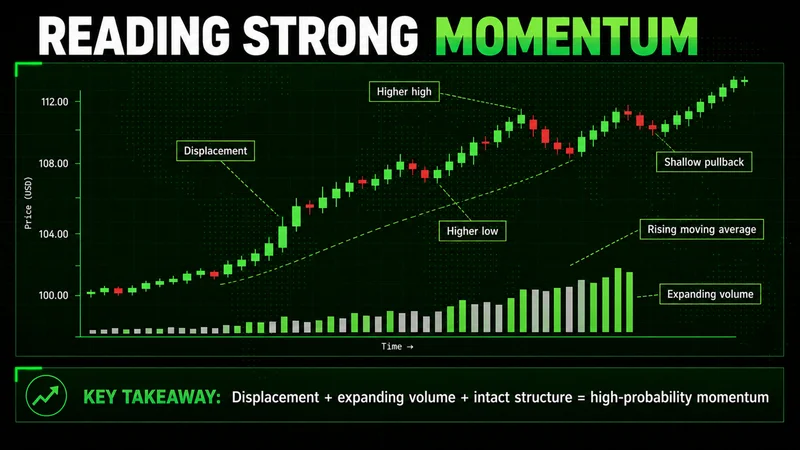
- Displacement. Price moves a meaningful distance in one direction with large, full-bodied candles and little overlap. A strong move trades through prior levels without immediate rejection.
- Structure. Higher highs and higher lows on the timeframe you trade, with the asset holding above its rising moving averages rather than slipping back under them.
- Volume. Participation expands as price advances. A move on rising volume reflects real positioning; a move on fading volume is often the late stage of a run, not the start.
- Shallow pullbacks. When price retraces and buyers step in quickly without giving back most of the advance, demand is still in control.
Read those four together, not in isolation. One full-bodied candle is noise. Displacement plus expanding volume plus intact structure is a high-probability environment worth your attention. The goal is not certainty. The goal is to stack conditions until the odds justify defined risk.
How to trade momentum in the market without chasing
This is where most beginners lose money. They see strength, feel the fear of missing the move, and buy the extension at its most stretched point. The entry is the breakout itself, taken emotionally, with no plan for being wrong.
There is a more disciplined sequence. The entry is rarely the initial break; it is the continuation after the move confirms. The order that keeps you out of bad prices is simple:
- Wait for the break on strong volume. The level gives way with conviction, not on a single thin candle.
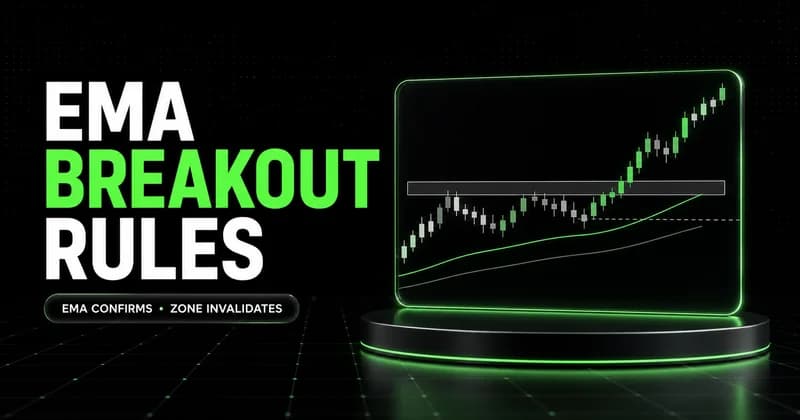
- Let price pull back. A controlled retrace into the breakout zone or a rising short-term moving average is the setup, not the breakout itself.
- Enter on the resumption. Take the position when price turns back up in the trend's direction, into structure rather than into a vertical candle.
You are joining the move at a point where risk is defined and close, not at its most stretched extension.
Most breakouts fail because traders enter emotionally instead of structurally. The move is real; the timing is not.
That distinction is the whole game. A momentum breakout you join on a confirmed pullback gives you a defined invalidation a short distance away and room for the trend to work. The same momentum breakout you chase at the top gives you a wide stop, a bad price, and a position that is underwater the moment momentum pauses. Same setup, opposite outcome, decided entirely by execution and patience.
Define the exit before you enter. A reasonable invalidation is a close back below the breakout level or below the moving average that contained the pullback. If price closes back through the structure and holds, the momentum read was wrong and you are out. That is an operational cost, not a failure.
A simple momentum indicator strategy for confirmation
Indicators are tools, not decision-makers. They confirm what price is already showing; they do not replace reading the chart. A clean momentum indicator strategy uses two or three at most, and treats them as a second opinion rather than a trigger.
- Moving averages for trend context. Price holding above a rising 20-period and 50-period average defines the side you trade. When price is stacked above both and they slope up, momentum has structural support.
- RSI for strength, read in context. The relative strength index measures the speed of a move. In a strong trend, RSI holding above the midline reflects sustained demand. A reading above 70 is not an automatic sell; in a powerful trend it can stay elevated for a long time. Treat a drop back below the midline after holding high as a loss of momentum, not the high tick itself.
- MACD for momentum shifts. A MACD line crossing above its signal line as price breaks higher is momentum confirmation. The crossover supports the structure; it does not lead it.
Momentum confirmation is the agreement between price, volume, and these readings. When the chart shows displacement, volume expands, and the indicators line up behind the move, the conditions are aligned. When price says one thing and the indicators say another, the read is low quality and the correct decision is usually to wait.
Momentum trading vs trend following
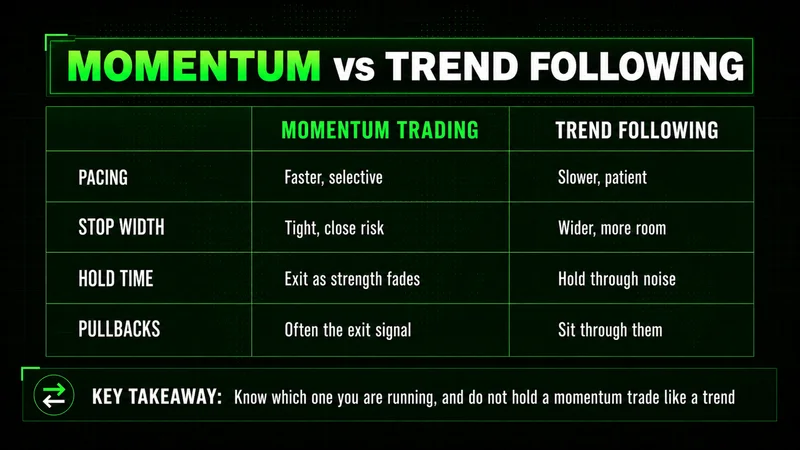
These two are related but not the same, and beginners blur them. The core distinctions are worth keeping straight:
- Pacing. Trend following is slower and holds an established trend through noise; momentum trading is faster and more selective about the moves it joins.
- Stops and tolerance. A trend follower accepts wider stops to capture a large directional move; a momentum trader keeps risk tight and exits as strength fades.
- What triggers an exit. A trend follower sits through a shallow pullback; a momentum trader often treats that same pullback as the signal to step out.
The practical difference is timeframe and tolerance. A trend follower can sit through a pullback that a momentum trader treats as an exit signal. Neither is superior. They suit different temperaments and different market conditions. What matters is knowing which one you are running, because mixing them — entering on momentum and then holding like a trend follower after the momentum is gone — is how a controlled trade turns into an oversized loss.
When a momentum trading strategy stops working
No strategy works in all market conditions, and momentum has specific environments where it inverts. This is the part generic guides leave out.
Momentum reads cleanly in trending, liquid, high-participation conditions. The regimes where it inverts are specific:
- Range-bound chop. The breakout that should run instead reverses, because there is no continuation behind it. Price pushes past a level, traps the breakout buyers, and snaps back. Chasing strength in a range is one of the most reliable ways to bleed an account.
- Thin overnight liquidity. A move that looks like displacement means almost nothing when only a handful of participants are active, and it reverses the moment real volume returns.
- The first reaction to major news. Volatility spikes and candles expand, but the initial move is often the least clean opportunity on the chart.
That last one catches new traders constantly. Many lose money reacting to a news spike instead of waiting for structure to develop after the dust settles. The discipline across all three regimes is the same: recognize the condition before you apply the strategy. When the factors that make momentum work are absent, the highest-quality decision is frequently no trade at all.
Common momentum trading mistakes beginners make
The errors are consistent and avoidable. Most are discipline problems, not analysis problems.
- Chasing the extension. Buying the vertical candle instead of waiting for the pullback. The price is bad, the stop is wide, and the position is immediately stressed.
- Trading momentum without context. Taking a breakout with no read on the broader structure or the market regime. Entries only matter when they align with conditions.
- Oversizing on conviction. Increasing size because a move looks obvious. If one losing trade affects your decision-making, the position was too large.
- Ignoring the exit. Entering with no defined invalidation, then holding a losing trade hoping momentum returns. Small losses are operational costs; large losses are usually emotional decisions.
- Confusing volatility with opportunity. Mistaking a news spike or a thin-liquidity move for genuine momentum.
The best momentum strategy for a beginner is a simple one executed with discipline. Clear structure, confirmed strength, defined risk, and the patience to wait for high-probability conditions will outperform a complex system run without emotional control. Fewer, better trades beat a constant search for the next setup.
FAQs
What is a momentum trading strategy in simple terms? It is a method for joining a strong, already-moving price and riding its continuation, rather than predicting where a move will begin. You confirm strength with structure, volume, and a few indicators, define your risk, and exit when the momentum fades.
How do I identify strong momentum? Look for displacement, large directional candles moving cleanly through prior levels, a structure of higher highs and higher lows above rising moving averages, expanding volume on the advance, and shallow pullbacks that buyers step into quickly. Read those signals together, not one in isolation.
How do I avoid chasing momentum trades? Stop entering on the breakout candle itself. Wait for the first controlled pullback into the breakout zone or a rising moving average and enter when price resumes in the trend's direction. This gives you a better price and a defined invalidation a short distance away.
What is the difference between momentum trading and trend following? Trend following holds an established trend through noise with wider stops and a longer horizon. Momentum trading is faster and more selective, targeting the strongest active moves and exiting when strength fades rather than sitting through every pullback.
Which indicators confirm momentum? Moving averages define trend context, the relative strength index measures the speed of the move, and MACD signals momentum shifts through line crossovers. Use two or three at most, and treat them as confirmation of what price already shows, not as standalone triggers.
When does a momentum strategy stop working? In range-bound chop, thin overnight liquidity, and the first volatile reaction to major news. In those regimes breakouts reverse and apparent strength traps buyers. Recognizing the condition before applying the strategy matters more than the entry itself.
Worth the read?