Trend Following Strategy for Beginners — Ride, Don't Predict
A trend following strategy for beginners means joining a confirmed trend on the pullback, not predicting reversals. Read structure, define your risk.

A trend following strategy for beginners is a process for trading in the direction of a move that already exists, not for predicting where the next move will begin. You wait for a clear trend, confirm it with structure, define your risk, and let the existing direction carry the position. You are not trying to call the top or the bottom. You are responding to what price is already doing, with size that survives being wrong.
Most new traders invert that. They try to buy the exact low, sell the exact high, and fight the prevailing direction because a chart "looks due" for a reversal. Trend following asks for the opposite discipline. The trend is your evidence. The job is to join it late enough to have confirmation and early enough to capture the main body of the move, then step aside when the conditions that made it work quietly disappear.
What is a trend following strategy?
Trend following means buying a rising market and selling a falling one, on the premise that a market already moving with force tends to keep moving in that direction until something changes. The strategy reacts to price; it does not forecast. A trend follower does not need to know why the market is moving. The move itself is the signal.
This is trend following trading in its plainest form, and it is the foundation of any trend trading strategy. Price establishes a direction, pulls back without giving up that direction, and then continues. Your task is to identify that sequence, define where the idea is wrong, and hold while the trend remains intact. The trade is reactive, not predictive. You are not deciding the market should go up. You are participating in the fact that it already is.
A trend shows up the same way across instruments and timeframes. The two cases are mirror images:
- Uptrend. Price prints higher highs and higher lows, holds above its rising moving averages, and gets bought on shallow pullbacks.
- Downtrend. Price prints lower highs and lower lows, holds below its falling moving averages, and gets sold on weak rallies.
Trend direction trading starts with reading that structure correctly, before any indicator is involved. The structure is usually visible before a signal confirms it.
How to identify trend direction before you trade it
Identifying a trend is a matter of reading a few things in order rather than searching for one magic signal. A trend worth trading has a signature, and that signature repeats.
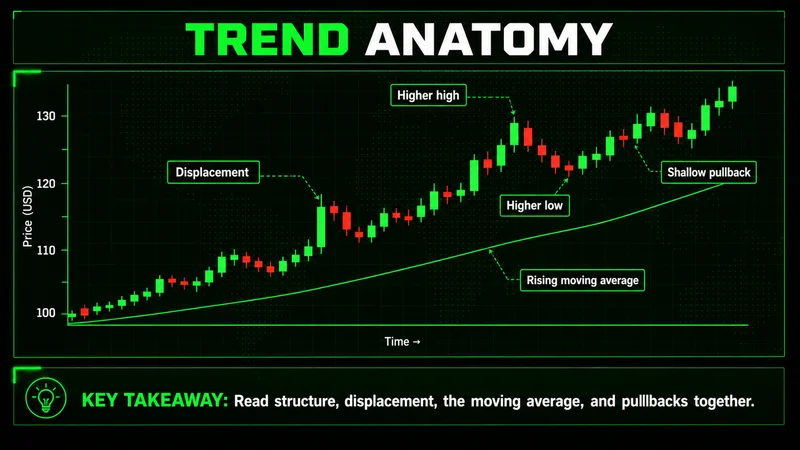
- Structure. Higher highs and higher lows in an uptrend, lower highs and lower lows in a downtrend. This is the single most reliable read. When the sequence of swings stops making progress in one direction, the trend is in question.
- Displacement. Price moves a meaningful distance with large, full-bodied candles and little overlap, trading through prior levels without immediate rejection. Displacement is the market showing intent.
- Moving averages. Price holding above a rising moving average, or below a falling one, defines the side you trade. A common beginner read is the relationship between a faster and a slower average, such as the 50-period and the 200-period. When the faster sits above the slower and both slope up, the trend has structural support.
- Pullback behavior. When price retraces and participants step back in quickly without giving back most of the advance, the trend still has control. Deep retraces that erase the prior move are a warning.
Read those together, not in isolation. One full-bodied candle is noise. Structure plus displacement plus a rising moving average plus shallow pullbacks is a high-probability environment. Moving with the trend means waiting until those conditions stack, then acting, rather than guessing at a turn and hoping the chart agrees.
Why trends persist, and why they eventually fail
Most beginner guides stop at the moving-average mechanics and never explain the reason a trend holds or breaks. The reason is positioning and liquidity, not the indicator. A trend persists because participation keeps building in one direction: buyers keep stepping in on pullbacks, late sellers get squeezed, and resting orders above the market get absorbed as price advances. The move continues as long as new participation arrives to support it.
A trend fails for the same reason, inverted. The flow that powered the move dries up, and the structure breaks because there is no longer enough demand to make a new high. The warning signs are readable before the break:
- Pullbacks stop getting bought. Retraces go deeper and recover more slowly, which means demand is thinning.
- Displacement fades. Candles shrink and overlap instead of pushing cleanly through prior levels.
- Price stalls at a level. The market reaches a high and cannot push through, a sign that resting supply is now absorbing the move.
That is the institutional read behind a trend continuation strategy: you are not betting that the line keeps going up. You are reading whether participation is still arriving to carry it.
This is why context matters more than the entry. A breakout in the direction of a strong, well-participated trend is a different trade from the same breakout in a quiet, directionless market, even though the candle looks identical. The first has flow behind it. The second is a trap waiting to spring.
Trading without context is gambling with better vocabulary. Entries only matter when they align with structure, liquidity, and the broader condition of the market.
That distinction is what separates a process from a guess. The candle is the same; the read behind it is not.
A simple trend following setup without complicated indicators
This is where most beginners lose money. They see a trend, feel they have already missed it, and buy the extension at its most stretched point. The entry is the breakout itself, taken emotionally, with no plan for being wrong. A simple trend strategy removes that impulse with a fixed sequence.
The entry is rarely the initial break. It is the continuation after a pullback confirms the trend is still intact. The order that keeps you out of bad prices is short:
- Confirm the trend. Structure shows higher highs and higher lows, and price holds above a rising moving average. You only take trades in that one direction. No counter-trend guesses.
- Wait for a pullback. A controlled retrace into the moving average or the prior breakout zone is the setup, not the breakout itself. The pullback gives you a defined, nearby level to be wrong against.
- Enter on the resumption. Take the position when price turns back in the trend's direction off that level, into structure rather than into a vertical candle.
- Define invalidation first. A reasonable exit is a close back below the moving average or the swing low that held the pullback. If price closes through it and holds, the trend read was wrong, and you are out for a small loss.
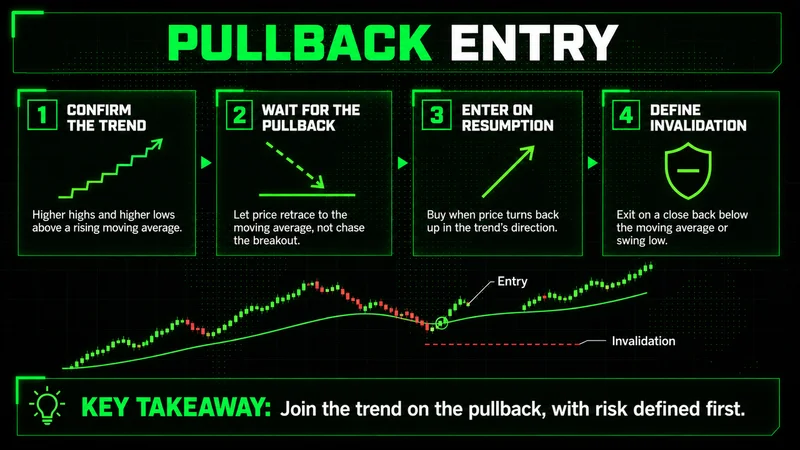
You are joining the move at a point where risk is defined and close, not at its most stretched extension. The same trend, entered by chasing the breakout at the top, gives you a wide stop, a bad price, and a position that is underwater the moment the move pauses. Same trend, opposite outcome, decided entirely by patience and execution. This is the difference between follow the trend strategy as a discipline and "buying because it is going up" as an impulse.
Trend following often runs a lower win rate than people expect, and survives on the size of its winners relative to its losers. The math rests on two habits:
- Cut losers quickly. When invalidation hits, you are out for a small, predefined loss. No averaging down, no waiting for the trade to come back.
- Let winners run. While the trend holds, you stay in. A handful of trends you stay with pay for the many small losses that come from trends that fail early.
That math only works if the losses stay small, which means the invalidation is real and you honor it.
What time frame is best for trend following beginners?
There is no universal answer, but there is a useful default. Higher time frames produce cleaner signals and less noise, which is why they tend to suit beginners:
- The daily and 4-hour charts develop slowly. A trend takes time to form and time to break, so you get room to read structure and plan an entry instead of reacting to every candle.
- Lower time frames generate more noise. The 5-minute and 1-minute charts produce more false signals, more whipsaws, and more decisions, and they punish hesitation immediately.
- Fewer decisions mean fewer mistakes. A higher-time-frame trend may offer only a handful of quality entries over weeks, but each one carries more information and demands less reaction.
For someone learning trend trading for beginners, the slower chart is usually the better teacher. The cost is patience, and that waiting is part of the job, not a flaw in the method. Sitting on your hands through a directionless stretch is doing the work, even when it does not feel like it.
When a trend following strategy stops working
No strategy works in all market conditions, and trend following has specific environments where it inverts. This is the part generic guides leave out. Trend following reads cleanly in trending, liquid, high-participation conditions. Outside those conditions, the same rules start producing losing trades.
- Range-bound chop. When price oscillates inside a range with no directional progress, the breakout that should run instead reverses. You buy strength near the top of the range, the move fails, and price snaps back through your entry. Chasing trends in a range is one of the most reliable ways to bleed an account.
- Low-participation drift. A market grinding sideways on thin volume produces moves that look like trends but have no flow behind them. The displacement is absent, the pullbacks are shallow because nobody is trading, and the move stalls the moment real volume returns.
- Mean-reverting conditions. Some markets and some regimes snap back toward an average rather than extending. In that environment, buying a new high is buying directly into the part of the move most likely to reverse.
- The first reaction to major news. Volatility spikes and candles expand, but the initial move is often the least clean opportunity on the chart. Many traders lose money reacting to a news spike instead of waiting for structure to redevelop after the dust settles.
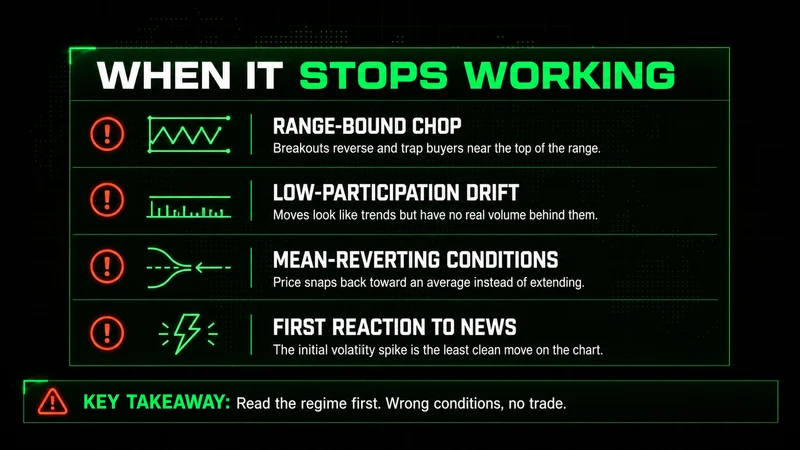
The discipline across all four is the same: recognize the condition before you apply the strategy. A trend following strategy is a tool for a specific environment, not a setting you leave on permanently. When the structure that defines a trend is absent, the highest-quality decision is frequently no trade at all. Sitting out a choppy week is not a missed opportunity. It is risk management.
Common mistakes beginners make with trend following
The errors are consistent and avoidable. Most are discipline problems, not analysis problems.
- Fighting the trend. Trying to call the reversal because a move "feels overextended." A trend can run far longer than it looks like it should. Until structure breaks, the trend is intact, and betting against it is betting against your own evidence.
- Chasing the extension. Buying the vertical candle instead of waiting for a pullback. The price is bad, the stop is wide, and the position is immediately stressed.
- Ignoring the exit. Entering with no defined invalidation, then holding a losing trade and hoping the trend returns. A small, planned loss is just a cost of doing business; the large losses are the ones that come from refusing to take the small one.
- Trading every chart. Applying trend rules in a range because the indicators technically gave a signal. Context decides whether a signal is worth taking.
- Quitting after a string of small losses. Trend following produces clusters of small losing trades between the trends that pay. Abandoning the method during that drawdown, right before a real trend develops, is how beginners give up the edge.
The best trend following approach for a beginner is a simple one executed with discipline. Clear structure, a confirmed trend, a defined risk, and the patience to wait for high-probability conditions will outperform a complex system run without emotional control. Fewer, better trades beat a constant search for the next setup.
FAQs
What is a trend following strategy in simple terms? It is a method for trading in the direction of a move that already exists, rather than predicting where a new move will start. You confirm the trend with structure and a rising or falling moving average, define your risk, hold while the trend continues, and exit when the structure breaks.
How do I identify trend direction in trading? Read the structure first: higher highs and higher lows mean an uptrend, lower highs and lower lows mean a downtrend. Confirm it with displacement, a rising or falling moving average, and pullbacks that get bought or sold quickly. Read those signals together, not one in isolation.
Can a beginner trade a trend following strategy without complicated indicators? Yes. The core read is price structure plus one moving average for trend context. You take trades only in the trend's direction, enter on a pullback to the average, and exit on a close back through it. Additional indicators are optional confirmation, not a requirement.
What is the best time frame for trend following beginners? Higher time frames such as the daily or 4-hour chart produce cleaner signals and less noise, which suits a beginner learning to read structure. They develop more slowly and demand fewer decisions, at the cost of patience between quality setups.
How do I avoid trading against the trend? Define the trend before you look for an entry, and take trades only in that direction. If structure shows higher highs and higher lows, you look for longs and ignore short ideas entirely. Counter-trend guesses are the most common way beginners turn a clear trend into a loss.
When does a trend following strategy stop working? In range-bound chop, low-participation drift, mean-reverting conditions, and the first volatile reaction to major news. In those regimes the breakout reverses and apparent strength traps you. Recognizing the condition before applying the strategy matters more than the entry itself.
Worth the read?