Stop Loss and Take Profit: The Exit Plan
Stop Loss and Take Profit define where a trade is wrong, where reward is enough, and how much risk belongs on the position before entry.
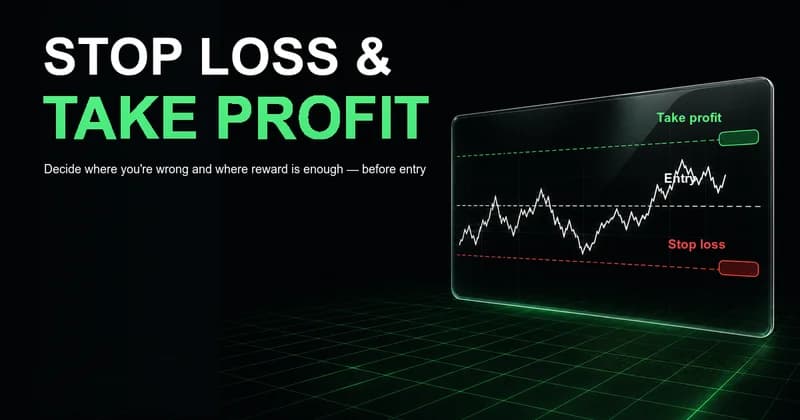
Stop Loss and Take Profit are not decorations on a trade. They are the two prices that decide whether your idea has controlled risk, a defined reward, and enough discipline to survive the first emotional test.
Most traders learn them backwards. They enter first, feel the position move, then start negotiating with the chart. The better process is colder: define where the trade is wrong, define where the reward is worth taking, size the position around that distance, then place both orders before the market has a chance to pull you into improvisation.
Stop Loss and Take Profit start with invalidation
A stop loss is the price where the trade idea has failed enough to close the position. For a long trade, it usually sits below the entry. For a short trade, it usually sits above the entry. The point is not to predict the worst tick of the session. The point is to stop one bad read from becoming a capital problem.
A take profit is the price where the trade has paid enough to close the position. For a long trade, it usually sits above the entry. For a short trade, it usually sits below the entry. It forces the trader to decide what a good exit looks like before the open profit becomes something to protect, defend, or chase.
The SEC's Investor.gov notes that a stop order becomes a market order once the stop price is reached. That matters because the trigger is not a promise of a perfect fill. In fast markets, a stop can execute worse than the stop price. This is why the stop has to be part of position sizing, not just a line on a chart.
The stop belongs where the trade idea is wrong
The cleanest stop is usually not the closest stop. A stop tucked a few ticks behind the entry may feel controlled, but if it sits inside normal market noise, it only proves that the trade was too tightly framed.
Good stop placement usually starts from one of four anchors:
Structure: below support for long positions, above resistance for short positions.
Volatility: outside the normal range measured by ATR or recent candle size.
Time: exiting if the setup does not work within the expected session or holding window.
Account risk: keeping the dollar loss inside the amount you planned to risk.
Structure tells you where the idea is invalid. Volatility tells you how much room price normally needs. Account risk tells you how large the position can be. If those three do not fit together, the answer is usually not to widen the stop and hope. The answer is to reduce size, wait for a better entry, or skip the trade.
A stop is not there to make the trade comfortable. It is there to prove the loss was already decided while the trader could still think clearly.
The take profit should pay for the risk
A take profit is not just a hopeful target. It is the other side of the risk equation. If the stop is 25 points away and the target is 20 points away, the setup needs a very high win rate to make sense. If the stop is 25 points away and the target is 50 points away, the trader has a 1:2 risk-reward profile.
That does not make the trade good by itself. A random target twice as far away is still random. The target should sit near a level where price has a reason to slow down, react, or reverse: prior resistance, prior support, a liquidity pool, a measured move, a session high, or a volatility-based objective.
Here is the basic math most traders should check before entry:
Trade input | Example | Why it matters |
|---|---|---|
Entry price | 100.00 | The planned position price |
Stop loss | 97.50 | 2.50 points of risk |
Take profit | 105.00 | 5.00 points of reward |
Risk-reward | 1:2 | Reward is twice the risk |
Account risk | 1% | Position size must fit this loss |
This is where beginners often make the wrong compromise. They move the stop farther away after the trade starts, but leave position size unchanged. Now the chart may look less stressful, but the account risk has quietly doubled.
How to set both orders before entry
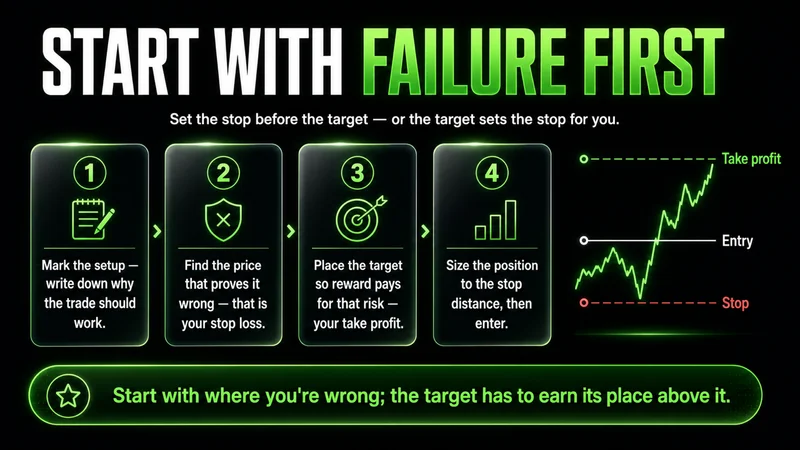
The order is important. If you start with the target because it looks attractive, the stop often becomes whatever makes the trade feel acceptable. Start with failure first.
Mark the setup and write down why the trade should work.
Find the price that proves that idea wrong.
Place the stop beyond that level, allowing for normal volatility.
Measure the distance between entry and stop.
Size the position so a stop-out equals the planned account risk.
Choose a take profit where the market has a realistic reason to react.
Check whether the reward is worth the risk before placing the trade.
If the take profit is too close, the setup may not be worth taking. If the stop is too wide, the size may need to shrink. If the position only works after you ignore one of those facts, it is not a planned trade.
The common mistakes are usually emotional
Stop loss and take profit mistakes rarely look dramatic at first. They look reasonable in the moment. A trader gives the stop a little extra room. A trader cancels the take profit because momentum looks strong. A trader widens the risk because the next candle might recover.
The usual mistakes are simple:
Placing the stop exactly at an obvious support or resistance level with no buffer.
Setting take profit at a round number with no market reason behind it.
Moving the stop farther away after entry.
Taking partial profit too early, then letting the remaining position reach the full stop.
Using the same stop distance on every instrument regardless of volatility.
The dangerous part is that some of these mistakes get rewarded once or twice. A widened stop may avoid a loss. A cancelled target may catch a larger move. That does not make the habit good. It teaches the trader to override the plan right before the sample size turns against them.
When fixed exits do not work cleanly
Fixed stop loss and take profit levels work best when the market has clear structure, normal liquidity, and a setup with a defined invalidation point. They work poorly when price is gapping, spreads are widening, news is hitting, or the instrument is too thin to respect nearby levels.
This is the part most guides soften too much: a stop loss can protect the account and still produce a bad fill. A take profit can close the trade cleanly and still leave money on the table. These orders are not designed to catch perfection. They are designed to remove the worst decision from the worst moment.
In strong trends, a fixed take profit can be too conservative. A trailing stop or partial exit may fit better because it allows the trade to keep working while still defining risk. In choppy ranges, a trailing stop can get chewed up, while a fixed target near the opposite side of the range may be cleaner.
A simple framework for choosing the exit style
Different market conditions need different exit logic. The trader who uses one rule everywhere eventually discovers that the rule was fitted to one regime.
Trending market: use structure stops, trailing stops, or partial profit after the first clean extension.
Ranging market: use stops outside the range edge and targets near the opposite side.
High-volatility market: widen the technical stop only if position size comes down with it.
Low-volatility market: avoid targets that require movement the instrument is not currently producing.
News-driven market: reduce size, wait, or accept that slippage can make hard levels less reliable.
The strongest version of this process is boring. Before entry, the trader can say: if this level breaks, I am wrong; if this level trades, the reward is enough; if neither happens, I know how long I am willing to wait.
FAQs
What is the difference between stop loss and take profit? A stop loss closes a trade when price moves against your position by a level you defined in advance. A take profit closes a trade when price reaches your planned reward target. One controls damage, the other captures the planned gain.
Should I set stop loss and take profit before entering a trade? Yes, that is the cleaner habit. Setting both before entry forces you to judge the trade while you are still neutral. After entry, fear, hope, and open profit make the same decision harder.
What risk-reward ratio should I use? Many traders start by looking for at least 1:2, meaning the potential reward is twice the planned loss. The number is not magic. It only matters if the target is realistic and the stop is placed where the idea is actually invalid.
Can a stop loss fail to close at the exact price? Yes. A stop order can become a market order after the stop price is reached, and fast markets can fill at a worse price. That is why position size and event risk matter as much as the visible stop level.
Is a trailing stop better than a fixed take profit? It depends on the market. A trailing stop can work well in clean trends because it gives winners room to extend. In a noisy range, it can trigger repeatedly before the original target is reached.
Worth the read?