Trading Instruments Explained for Beginners
Trading instruments explained for beginners: how stocks, futures, options, and cryptocurrencies actually behave, and which one to learn on first.
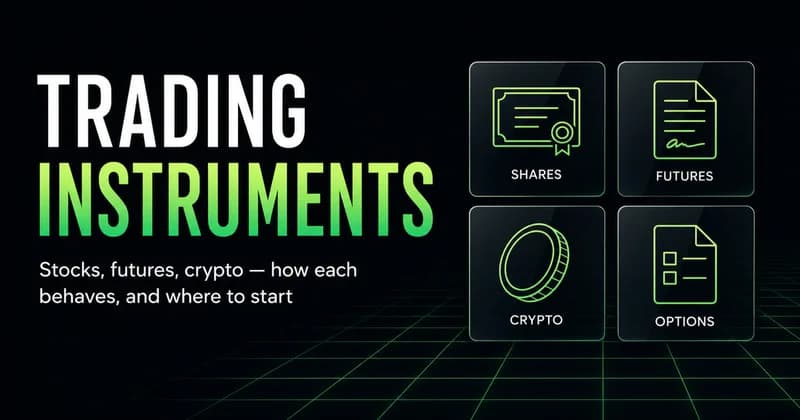
Trading instruments are the contracts and assets you actually buy and sell when you trade — stocks, futures, options, cryptocurrencies, forex pairs, ETFs, bonds. Each one behaves differently, costs different amounts of capital to access, and punishes different kinds of mistakes. Most beginner guides treat them as a flat menu. They are not.
The instrument decides how fast your account can grow and how fast it can disappear. Picking the wrong one early is the most common reason new traders stop trading within a year.
What trading instruments are, in practical terms
A trading instrument is any standardized contract or asset traded on a regulated venue or exchange. The four asset classes a beginner will actually encounter are equities, derivatives, currencies, and digital assets. Everything else — ETFs, indices, bonds, commodities — sits inside or alongside those.
What matters for a beginner is not the textbook definition. It is three things per instrument:
The minimum capital required to take one position.
The size of a typical move, measured against that capital.
How fast the market trades — hours, liquidity, overnight risk.
Those three numbers tell you more about whether an instrument is appropriate than any explanation of how the contract is structured.
Stocks — the simplest place to start
Stocks are the cleanest entry point into financial markets. You buy a share, you own a piece of the company, and your downside is capped at what you paid. There is no expiry, no margin call unless you opt into one, and the regulatory environment in the U.S. is mature.
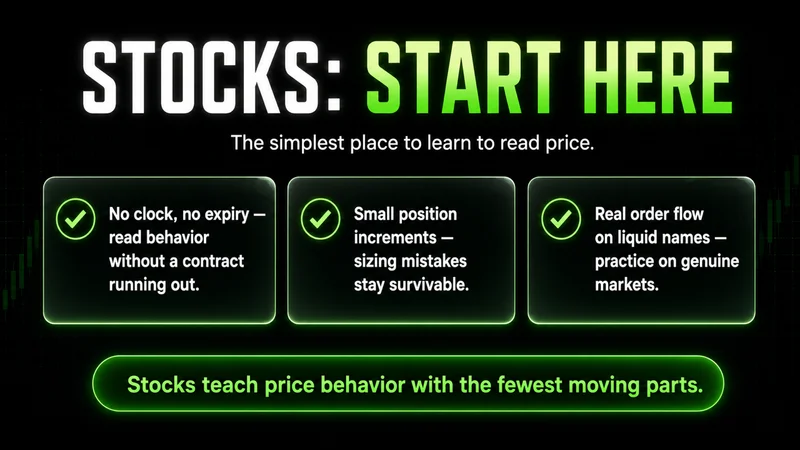
For a beginner, stocks do three useful things:
They teach you to read price behavior without the pressure of a clock or a contract expiry.
They let you size positions in small increments, so position sizing mistakes are survivable.
They expose you to real institutional order flow on liquid names without paying for futures-level volatility.
The weakness is that the cleanest, most liquid stocks — large-cap names with deep order books — also move slowly. New traders confuse that for a problem. It is the opposite. Learning structure on a slow, liquid instrument is the highest-quality environment available.
Futures — standardized contracts and real leverage
Futures are agreements to buy or sell something at a fixed price on a specified date. Index futures like ES (S&P 500) and NQ (Nasdaq) dominate beginner conversations because of low fees, deep liquidity, and near-24-hour access.
Futures are also where beginners are quietly overleveraged. One NQ contract carries notional exposure of roughly 20 times its margin requirement at most brokers. A small adverse move on a single contract can erase a week of work. Most traders are overleveraged without realizing it; the instrument hides it because the margin number looks manageable until the position is open.
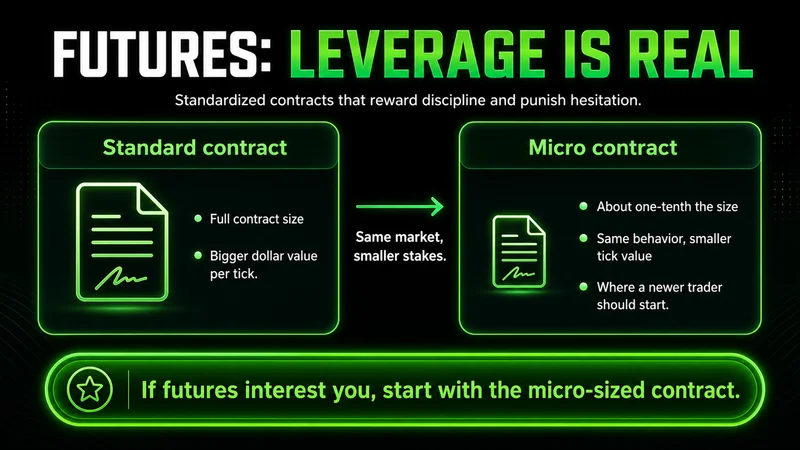
Micro futures — MES, MNQ, MGC — exist specifically to let newer traders engage these markets with one-tenth the contract size. If futures interest you, start there. The instrument behaves identically; only the dollar value per tick changes.
Futures reward discipline and punish hesitation immediately. Nasdaq futures, in particular, do not give second chances on poorly defined risk. If a stop is wide because the entry was rushed, the contract size will find that out before the session closes.
Cryptocurrencies — 24/7 markets and uneven liquidity
Cryptocurrencies trade continuously and have lower minimum position sizes than almost any other instrument. That accessibility is what attracts beginners. It is also what makes them difficult.
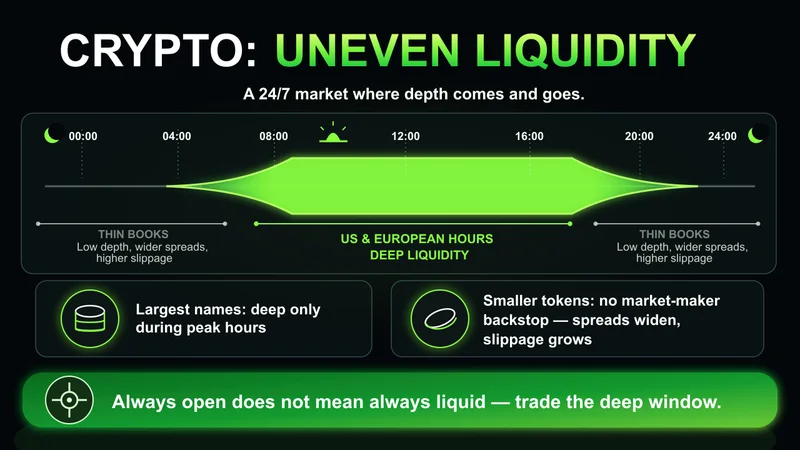
Liquidity in crypto is concentrated in a handful of names — BTC, ETH, a few stablecoin pairs — during U.S. and European hours. Outside that window, even those names trade on thinner books. Mid-cap and small-cap tokens have no equivalent to the U.S. equity market maker structure. Spreads widen, slippage compounds, and what looks like a structural break on a chart is often just one large order against a quiet book.
This is where the framework breaks down most clearly for beginners: a setup that reads cleanly during cash-hour overlap can mean almost nothing at 3 a.m. on a Sunday. The same pattern, on the same instrument, on thin liquidity, is a different trade. Most new crypto traders never separate the two and pay for the confusion.
Options vs futures — which actually fits a beginner
Options and futures are often presented as parallel choices. They are not equivalent for a beginner.
Futures have linear risk. One tick of price change equals one tick of P&L. The contract structure is simple even when the position sizing is dangerous. Options add a second variable — implied volatility — that changes the P&L of a position even when price stays still. A beginner who has not yet learned to read price behavior cleanly is unlikely to disentangle a losing options position from a losing thesis.
For most beginners, the order is: cash equities first, then micro futures, then long options on names you already trade in shares. Multi-leg options strategies belong after several years of screen time, not at the start.
How to pick your first trading instrument
The best trading instruments for beginners are the ones that let you make small, repeated mistakes without ending the account. That ranking is unromantic on purpose.
Liquid large-cap U.S. stocks. Slow enough to learn on, deep enough to size into, transparent enough to study.
Broad-market ETFs. A single position gives diversified exposure; useful for learning context before learning single-name selection.
Micro index futures. Once stock execution is consistent, micros introduce real intraday volatility without full contract size.
Top-tier crypto, cash-hour only. Liquid, but restrict the window until pattern recognition holds across regimes.
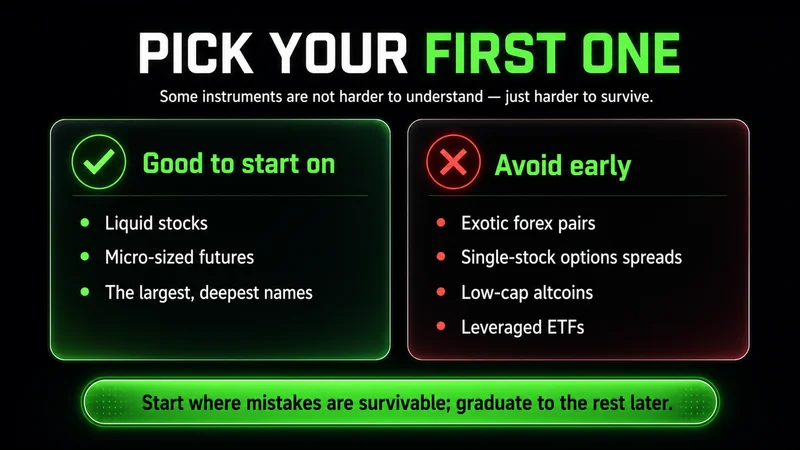
Avoid, early: exotic forex pairs, single-stock options spreads, low-cap altcoins, leveraged ETFs. They are not harder to understand. They are harder to survive.
What changes when volatility expands
Every instrument behaves differently when conditions change. A stock that moves $0.30 a day for a month can move $4 in twenty minutes around an earnings release. Index futures that trade an orderly range during cash hours can invalidate that range entirely on an overnight macro print. Crypto can do both, in either direction, on no scheduled news at all.
Beginners often pick an instrument based on calm-market behavior and then stay in it when conditions change. That is the most expensive habit available. The same chart pattern, on the same instrument, means different things depending on liquidity and volatility context. Capital preservation in higher-volatility periods is what separates traders who continue from traders who do not.
A short summary before you place a trade
Trading instruments are not interchangeable. Stocks teach you to read price. Futures teach you about size. Cryptocurrencies teach you about liquidity. Options teach you that price is not the only variable. Picking the right one to start with — and the right one to stay in while you build screen time — matters more than the strategy you eventually run on it.
If you are new, the instrument list is short on purpose: liquid stocks first, ETFs alongside, micro futures when execution is steady, top-tier crypto in cash hours only. Everything else is available later. The market does not reward speed in this part of the process. It rewards survival.
For a foundation in how to read price once you have chosen an instrument, the companion piece on market structure in trading is the next step. For the mechanics of buying your first shares, stock trading basics covers the execution side. Regulatory definitions of these instruments are published by the U.S. Securities and Exchange Commission.
Worth the read?