Position Sizing and Risk Reward Ratio for Beginners
Position sizing and risk reward ratio for beginners: the formula, the 1 percent rule, R multiples, and where the standard math breaks down live.
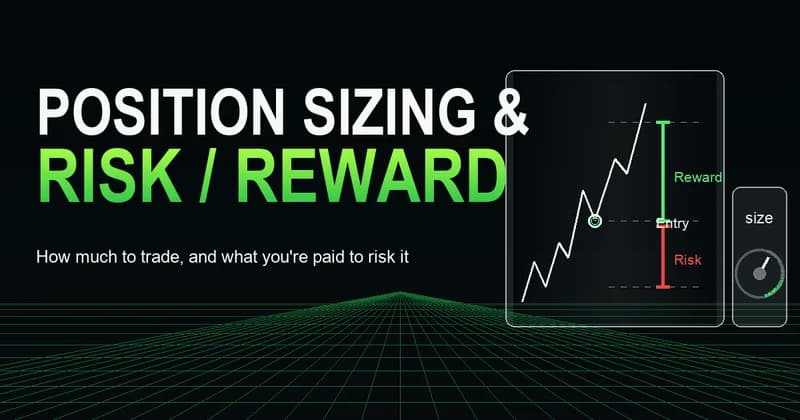
Position sizing and risk reward ratio for beginners are two halves of the same decision. Position size answers how many shares or contracts you take. The risk reward ratio answers how much you stand to make compared with what you are risking on the trade. Most beginners treat them as separate topics. They are not. They are the single decision that determines whether a strategy survives a normal losing streak or quietly destroys an account.
Most failed accounts do not fail because the entries were wrong. They fail because the position sizes were too large for the stops the trader actually used, or because the average winner was not big enough to pay for the average loser. Get sizing and R right and a fifty-percent win rate is profitable. Get them wrong and a seventy-percent win rate still loses money.
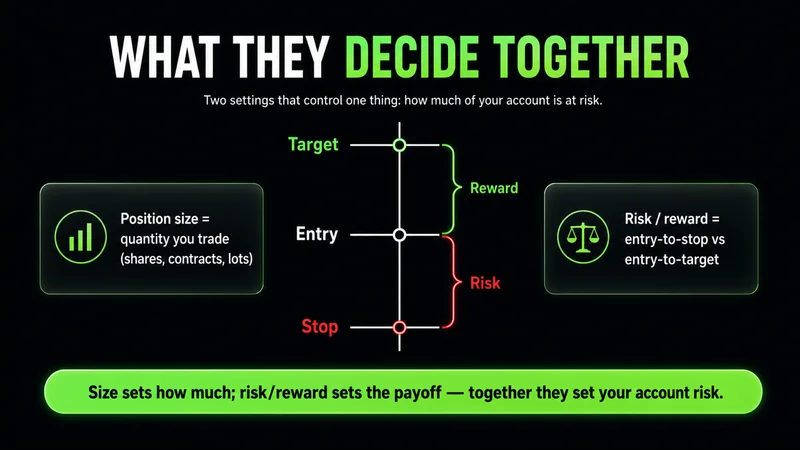
What position size and risk reward ratio actually decide
Position size is the quantity you trade — shares, contracts, lots. The risk reward ratio is the distance from your entry to your stop compared with the distance from your entry to your target. Together they decide one thing: how much of your account is exposed if the idea is wrong, and how much you are paid if the idea is right.
Beginners often think of position size as a function of conviction. That is the wrong frame. Conviction is unreliable. Position size should be a function of two numbers you can measure before the trade: the percent of account you are willing to lose on this idea, and the distance to invalidation. Conviction does not enter the calculation.
The risk reward ratio is the second half of that frame. A two-to-one ratio means the target is twice as far from entry as the stop. Combined with a realistic win rate, that ratio decides whether a strategy makes money over a hundred trades or bleeds slowly.
How to calculate position size — the formula every beginner needs
The position sizing formula every beginner should learn is simple. It has three inputs: account size, the percent you will risk on this trade, and the dollar distance from entry to stop.
The formula:
Account risk in dollars = account size × percent risked per trade
Position size = account risk in dollars ÷ (entry price − stop price)
A worked example. The account is twenty thousand dollars. The risk per trade is one percent, which is two hundred dollars. The entry is fifty dollars. The stop is forty-eight dollars. The dollar risk per share is two dollars. The position size is two hundred divided by two, or one hundred shares.
If the stop is hit, the loss is exactly two hundred dollars — one percent of the account, as planned. The position size adjusts to the stop, not the other way around. Beginners often do the opposite. They pick a position size first, then place a stop wherever it leaves them comfortable. That sequence is backwards and is one of the most common reasons accounts blow up.
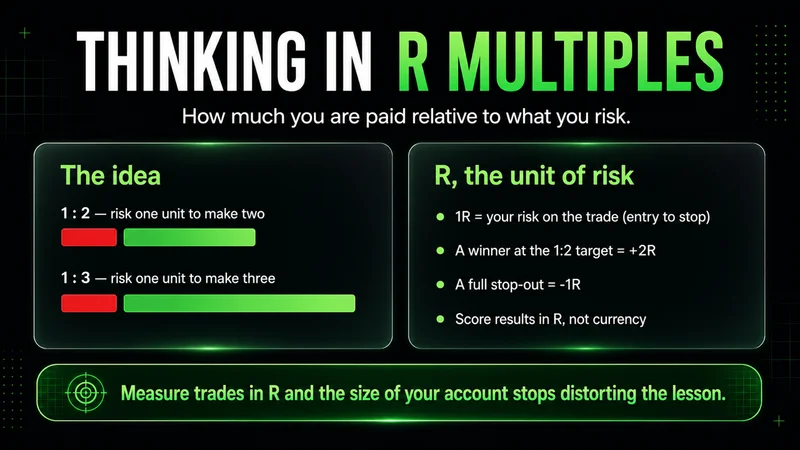
What is risk reward ratio and how to use R multiples
The risk reward ratio expresses how much you are paid relative to what you are risking. A one-to-two ratio means risking one dollar to make two. A one-to-three ratio means risking one dollar to make three.
The R multiple is the same idea expressed in units. One R is the dollar amount you risked on the trade. A trade that hits a two-to-one target returns plus two R. A trade that stops out returns minus one R. Tracking outcomes in R rather than dollars removes account-size noise and makes a small trading record actually readable. A journal that shows +2R, −1R, +3R, −1R, −1R, +2R tells you something about the strategy. A journal that shows wildly different dollar amounts hides whether the issue is the setup or the sizing.
R multiples are the bridge between position sizing and risk reward ratio. Once you size every trade to risk the same R, the ratio of average winner to average loser, multiplied by win rate, is the expectancy of the strategy. That number tells you whether to keep trading the setup or stop.
How much to risk per trade — the 1 percent rule and its limits
The most common rule among professional traders is to cap risk per trade at one to two percent of the account. One percent is the conservative default. Two percent is the upper bound for beginners.
The logic is durability. Risking one percent per trade means ten consecutive losses draw the account down by roughly ten percent — uncomfortable, but recoverable. Risking five percent means ten consecutive losses cut the account by forty percent, and the math of recovery becomes brutal. A forty percent drawdown requires a sixty-seven percent gain just to break even. Most strategies will see a streak of five to seven losses inside a normal hundred-trade sample. Plan for it before it happens.
The two beginner adjustments worth making:
Lower the risk further during the first hundred trades. Half a percent is a reasonable starting point while a new trader is still learning execution. The point of those trades is not to make money; it is to gather a real performance record without doing damage.
Reduce risk after consecutive losses. When down three R or more in a session, cut the next trade size in half. This is not superstition; it is recognition that the conditions producing those losses have not yet changed, and execution quality usually drops with frustration.
Position sizing examples — stocks, futures, and forex
The formula is the same across instruments. The dollar risk per unit changes.
Stocks. Entry sixty, stop fifty-seven, risk per share three dollars. Account twenty-five thousand, one percent risk equals two hundred fifty dollars. Position size is roughly eighty-three shares.
Futures. On NQ (Nasdaq E-mini), one point equals twenty dollars per contract. Entry minus stop equals ten points. Risk per contract is two hundred dollars. With a one percent risk budget of two hundred dollars on a twenty-thousand-dollar account, the size is one contract. Micro contracts (MNQ) at two dollars per point give finer granularity — a ten-point stop costs twenty dollars per contract, allowing ten micros for the same two hundred dollar risk.
Forex. Pip value depends on lot size and pair. On EURUSD, one standard lot is roughly ten dollars per pip. A thirty-pip stop on one standard lot risks three hundred dollars. To risk two hundred, the size is two-thirds of a lot, or sixty-seven thousand units.
The instrument changes the unit math. The percent of account at risk does not.
Where fixed-percent risk management breaks down
Fixed-percent risk works as long as the stop can actually hold. There are three conditions where it cannot, and beginners need to know them before the conditions arrive:
Gappy instruments. Futures that trade through overnight sessions, equities that gap on earnings, currency pairs around central bank decisions — in each case the next print can be ten or twenty stop-distances away from where the trader thought risk ended. The one-percent plan becomes a five-percent loss in a single tick. Position sizing assumed continuous price; the market delivered a gap.
Correlated positions. Three long trades in NQ, ES, and a high-beta tech name are not three independent one-percent risks. They are one position with three labels. When the broader tape sells off, all three stop out together. Beginners who size each leg at one percent are unknowingly running three percent on a single bet.
Volatility regime changes. A stop calibrated to last week's range becomes a coin flip when implied volatility expands. The dollar risk per share looks the same; the probability of getting tagged on noise rather than thesis is much higher. The honest response is to reduce size, widen the stop, or stand aside — not pretend the regime has not changed.
This is the part most beginner guides skip. The formula always works on paper. Live conditions decide whether the paper math holds.
Common beginner mistakes with position sizing and R:R
A short list of mistakes that show up in almost every new trader's journal:
Sizing to conviction instead of to the stop. Doubling up on a trade that feels obvious. Markets do not pay extra for confidence.
Moving the stop to make room. When price approaches the stop, widening it to give the trade more time. This is the same as sizing too large after the fact.
Taking profit at one R out of fear, holding losers past one R out of hope. Asymmetric on the wrong side. The average winner ends up smaller than the average loser regardless of the planned ratio.
Counting open profit as buffer. Treating unrealized gains as a license to add risk. The profit is not real until it is closed; adding size to a winner using paper gains as collateral is a classic blowup setup.
Skipping the math on illiquid instruments. Wide spreads silently expand the real risk per share. A two-cent spread on a tight one-percent setup eats a meaningful share of the R.
Most of these are not strategy problems. They are discipline problems wearing strategy clothing. The fix is to write the position size and the stop in the trading plan before the entry, and to refuse to take the trade if either number cannot be defined cleanly. Tracking these outcomes in a trading journal and performance metrics record is what turns a vague hunch about "I think my R is off" into a number you can act on.
If the instrument itself is unfamiliar, the prior layer of the problem is choosing the right vehicle for the strategy — different trading instruments have different tick values, session hours, and gap risks, and the position sizing formula assumes the trader already knows those.
FAQs
What is position size in trading? Position size is the number of shares, contracts, or lots taken in a trade. It is calculated from the percent of account risked on the trade divided by the dollar distance from entry to stop. The position adjusts to the stop, not the other way around.
How do I calculate position size as a beginner? Multiply the account by the risk percent — one percent is the standard default. Divide that dollar amount by the per-share or per-contract risk between the entry and the stop. The result is how many units to trade. The formula is the same across stocks, futures, and forex; only the per-unit risk math changes.
What is a good risk reward ratio for beginners? A one-to-two ratio is the common starting point. It allows for a sub-fifty-percent win rate while still being profitable. The ratio matters less than consistency; a steady one-to-one with a sixty-percent win rate works, while a one-to-five that is never actually reached does not.
What is R multiple in trading? One R is the dollar amount risked on the trade. A win at two times the risk is plus two R. A loss at the stop is minus one R. Expressing trades in R removes account-size noise and makes the record readable across periods when account size changes.
How much should I risk per trade? One percent is the professional default. Two percent is an aggressive upper bound. New traders are usually better off at half a percent until they have a hundred-trade sample. The right number is the one that lets the trader survive a normal losing streak without breaking the rules.
Worth the read?