Pullback Trading Strategy — Buy Strength, Not Hope
A pullback trading strategy enters a trend during the pause, not the dip. Learn to tell a healthy pullback from a reversal before you buy the retracement.

A pullback trading strategy waits for a trend to pause, then enters as the trend resumes. The idea is simple: join an established move at a better price instead of chasing it after it has already extended. In an uptrend you buy the dip; in a downtrend you sell the bounce. Done with discipline, it is one of the cleaner ways to trade with the trend rather than against it.
Most traders get it backward. They treat every dip as a signal to buy, as if the discount alone is the edge. It is not. The edge is reading whether the trend still controls price after the pause. A pullback is only worth trading when structure says the move survived the pull lower; without that read, buying dips is how accounts catch reversals, not pullbacks.
What a pullback trading strategy actually is
A pullback is a temporary, counter-trend move inside a larger trend. Price pushes in the direction of the trend, runs into short-term exhaustion, retraces part of the prior leg, and then continues. The strategy is built around that retracement. You define the trend first, wait for price to pull back toward a level where buyers or sellers have reason to step in, and enter as the trend reasserts itself.
This is trend-following, not bottom-picking. The distinction matters. Bottom-picking tries to call the exact turn with no trend behind it. A trend pullback strategy only acts when a clear trend already exists and the retracement is a pause within it. The same setup is sometimes called retracement trading, buying the pullback, or a continuation entry. The labels differ; the logic is identical. Find the trend, wait for the counter-move, enter on continuation.
A healthy pullback has a specific character. It is orderly. It gives back a portion of the prior move, often into an area that lined up as support or resistance before the retracement began, and it does so without the urgency of a real reversal. The pullback that crawls lower on fading participation is the one worth watching; the one that drops fast on heavy volume is something else.
A few traits show up again and again in the pullbacks worth trading:
- Orderly retracement. Price drifts back rather than collapsing, holding the broad shape of the trend.
- Fading volume into the pause. Participation thins as price moves against the trend, then returns when the trend resumes.
- Respect for a prior level. The retracement stalls near support, resistance, or a moving average that already mattered.
- Intact structure. The sequence of higher highs and higher lows stays in place throughout the pull lower.
Why a pullback beats chasing the breakout
The reason to buy the pullback rather than the breakout comes down to risk placement. When you chase a breakout, your entry sits far from any level that would tell you the idea was wrong, so your stop is wide and your risk is large. When you wait for the pullback, price comes back to you. Your entry sits close to a defined level, your invalidation is tight, and your reward-to-risk improves without predicting anything new.
There is a second reason, and it is structural. Breakouts attract emotional entries. Traders see price clear a level, feel the fear of missing the move, and buy at the worst possible location. The pullback that follows shakes most of them out. Trading the pullback puts you on the other side of that flush, entering where the chasers exit. Confirmation over chasing momentum is not a slogan; it shows up directly in the location of your entry and the size of your risk.
The advantages stack up in a few specific ways:
- Tighter invalidation. The entry sits near a level, so the stop is close and the loss per trade is small when the read is wrong.
- Better reward-to-risk. A closer stop with the same target means more reward for each unit of risk, without forecasting a bigger move.
- A cleaner read on the trend. Watching how price behaves at the pullback level tells you whether the trend is still in control before you commit.
- A built-in filter. Demanding a pullback means you skip the extended, chase-driven entries that look strong and resolve badly.
None of this guarantees the trade works. A trend pullback strategy is a probability play, not a certainty. What it does is improve the quality of the entries you take and the size of the loss you accept when you are wrong. Over a sample of trades, that combination matters far more than any single setup.
"Most breakouts fail because traders enter emotionally instead of structurally. Confirmation matters. Chasing momentum without context usually ends badly." — MRPNL
Pullback vs reversal: the distinction that decides the trade
Every pullback trade lives or dies on one question: is this a pause, or is the trend over? A pullback is temporary and resumes the trend. A reversal is permanent, at least for the timeframe you are trading, and continues against it. Get the two confused and a pullback entry becomes a position held straight into a new downtrend.
The static definition is easy. The hard part is reading it in real time, before the bar that confirms it has closed. Most explainers tell you a pullback resumes and a reversal does not, which is true and useless in the moment. What you actually watch is structure and behavior as the move forms.
A few signals separate the two while the move is still developing:
- Depth of the retracement. A shallow give-back that holds above the prior swing low (in an uptrend) leans pullback. A move that slices through that swing low and accepts below it leans reversal.
- Pace and participation. A pullback usually drifts on lighter volume. A reversal tends to move with intent and expanding volume, because real selling, not profit-taking, is driving it.
- Reaction at the level. When price reaches former support or a moving average and rejects quickly, the trend is defending itself. When it stalls there and keeps leaking lower, the level is failing.
- Where the structure breaks. As long as the sequence of higher highs and higher lows is intact, the trend is in control. The moment a lower low prints and holds, the structure has shifted, and the pullback thesis is gone.
The table below summarizes the contrast, but treat it as a reference, not a checklist to trade mechanically.
| Characteristic | Healthy pullback | Reversal |
|---|---|---|
| Trend structure | Higher highs and higher lows intact | A lower low prints and holds |
| Retracement depth | Shallow to moderate, holds key level | Deep, breaks through the key level |
| Volume behavior | Thins out, then returns on resumption | Expands as the counter-move develops |
| Reaction at support | Quick rejection, trend defends | Stalls, then keeps leaking through |
| What it means | Pause within the move | The move is over for this timeframe |
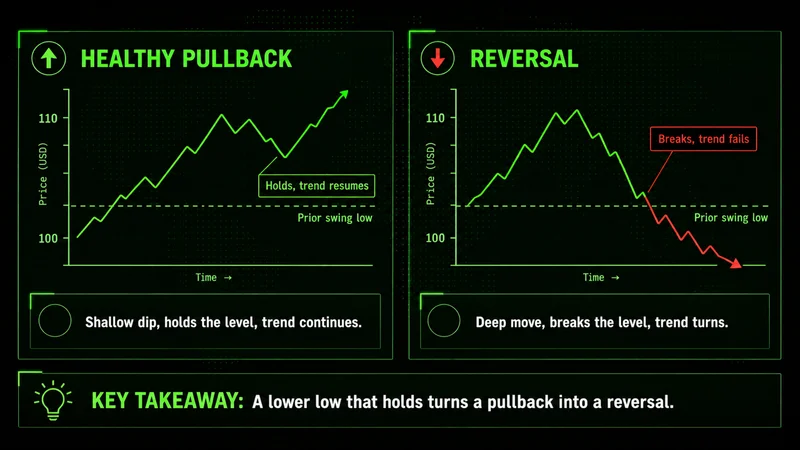
The honest answer is that you will not always know until later. That uncertainty is why the entry rules and the stop matter more than the prediction.
How to identify a good pullback entry
Identifying a pullback entry is a process, not a single trigger. Each layer adds confirmation, and the more layers that agree, the higher the quality of the setup. The goal is to enter where price has the most reason to turn back in the direction of the trend.
Work through it in order:
- Define the trend on a higher timeframe. Drop to a chart one or two steps above the one you plan to trade. This filters noise and tells you which direction you are even allowed to trade. In an uptrend you only look for long pullback entries; in a downtrend, only shorts.
- Mark the level the pullback is targeting. A good pullback setup retraces into an area that already mattered: prior support or resistance, a rising moving average, a trendline, or a Fibonacci retracement zone around the 38.2% to 61.8% band. Confluence of two or more of these is stronger than any one alone.
- Wait for the pullback to reach the level. Do not anticipate the bounce. Let price come into the zone. Anticipation is how traders enter early and watch the retracement run another leg against them.
- Demand confirmation before entry. A candlestick rejection, a momentum indicator turning back up, a return of volume on the resumption, or a small break of the pullback's own minor structure. One clear signal is enough; do not wait for every box to tick or the move leaves without you.
- Define invalidation before you click. Know where the trade is wrong before you take it. In an uptrend pullback, that is usually just below the support being tested or the last swing low.
Support and resistance does more work here than any indicator. A pullback into a level that previously rejected price, in the direction of the trend, is the core of the whole approach. Moving averages and Fibonacci levels are useful because they often line up with that structure, not because the lines themselves are magic. Indicators are tools, not decision-makers; the level is the reason, and the indicator is the timing.
The areas worth marking for a pullback to target are the ones that already carry meaning:
- Prior support or resistance the trend reacted to before the retracement began.
- A rising or falling moving average that has been tracking the trend.
- A trendline connecting the swing points of the move.
- A Fibonacci retracement zone, commonly the 38.2% to 61.8% band of the prior leg.
When two or more of these overlap in the same area, the pullback into that zone carries more weight than any single line on its own.
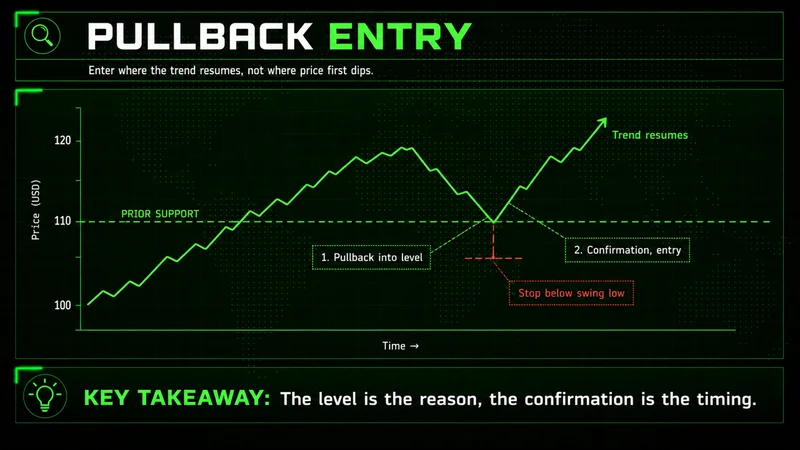
A practical note on entries: the cleaner the trend and the more obvious the level, the more reliable the pullback. Forcing a pullback trade in a market that is chopping sideways with no defined trend is not a pullback strategy at all. It is guessing with better vocabulary.
When to enter — and when to stand aside
Timing the entry is about reaction, not prediction. You are waiting for price to show that the trend is resuming, then acting on that evidence. A few triggers are reliable enough to act on:
- A strong close back in the trend direction, printed off or near the level you marked.
- A reclaim of a minor level the pullback broke, showing the counter-move is failing.
- A clean rejection wick off the zone, with the body closing back in the trend's favor.
- A return of volume on the resumption, confirming participation is back on the trend side.
The point is that price moves first and you respond. Position size and stop come as a pair with the entry. Because the entry sits near a defined level, the stop can be tight, which means the position can be sized properly without risking more than a small, fixed share of the account on the idea. A tighter stop is the entire mechanical advantage of trading pullbacks; throwing it away with a loose, emotional stop gives back the edge you waited for.
Standing aside is also a decision, and often the right one. Not every pullback is worth taking. The setup is better skipped when any of these conditions are present:
- The trend is unclear or absent on the higher timeframe.
- The retracement has already broken structure with a lower low that holds.
- The level the pullback is targeting is vague or untested.
- The broader environment is news-driven and erratic.
Waiting is part of the job. Forcing trades during low-quality conditions is usually expensive, and the trader who takes fewer, cleaner pullbacks tends to keep more than the one who takes every dip.
Where the pullback playbook breaks down
No strategy works in all conditions, and a pullback strategy has clear failure modes worth naming before you rely on it. The setup reads cleanly in a trending market with normal liquidity. Outside those conditions, the same retracement that looks like a textbook entry can mean almost nothing.
It breaks down in three situations in particular:
- Range-bound, trendless markets. A pullback strategy needs a trend to pull back within. In a sideways market there is no trend to resume, so what looks like a pullback is just price oscillating between two levels. Entries based on continuation have nothing to continue.
- News-driven volatility expansion. When a macro headline or scheduled release hits, structure can invalidate in minutes. A pullback that was holding support gets erased by a volatility spike that has nothing to do with the prior trend. The first move after major news is rarely the cleanest opportunity, and a pullback entry taken into that environment is exposed to a level that no longer means what it did.
- Thin liquidity sessions. Structure that reads cleanly in active hours means much less in thin overnight or pre-market conditions. The same sequence of higher lows can be set by a handful of orders, and the level you are trusting has little real participation behind it.
This is the part most pullback guides skip, and it is the part that protects the account. The strategy is not broken in these conditions; it is simply out of context. Recognizing when the setup does not apply is as much a part of the method as recognizing when it does. The discipline to sit out a low-quality pullback is what separates the approach from gambling on every dip.
Common mistakes that turn pullbacks into losses
Most losing pullback trades come from a small set of repeatable errors. Beginners tend to make the same ones, and they are all avoidable with rules defined in advance.
- Entering without confirmation. Buying the dip the moment price touches a level, with no sign the trend is resuming, is the most common mistake. It feels proactive. It is just early, and early often means wrong.
- Trading pullbacks with no real trend. Applying the setup in a choppy, directionless market produces nothing but low-quality entries. If you cannot define the trend in one glance on a higher timeframe, there is no pullback to trade.
- Confusing a reversal for a pullback. Holding through a broken structure because you are committed to the long is how a small loss becomes a large one. When the structure shifts, the thesis is gone, regardless of how good the entry looked.
- Placing the stop emotionally. A stop set for comfort rather than for the level gives back the tight-risk advantage that makes pullback trading worth doing. Define invalidation by structure, not by how much you are willing to feel.
- Oversizing because the entry feels obvious. A clean-looking pullback tempts traders into larger size. The setup looking good does not change the fact that any single trade can fail. Size for the loss, not for the conviction.
The thread running through all of these is the same: process over outcome. A pullback strategy is not a way to be right more often. It is a way to take defined-risk entries in the direction of a trend and to lose small when the read is wrong. Traders who internalize that survive the inevitable strings of failed setups; traders who treat every dip as a certain bounce do not.
FAQs
What is a pullback trading strategy in simple terms? It is a method for entering an existing trend during a temporary counter-move. Instead of chasing price after it has already run, you wait for a pause, let price retrace toward a level that matters, and enter as the trend resumes. In an uptrend you buy the dip; in a downtrend you sell the bounce.
How do I tell a pullback from a reversal? Watch structure and behavior, not just the size of the move. A pullback is shallow, drifts on lighter volume, holds above the prior swing point, and rejects quickly at support. A reversal breaks through that level, accepts below it, and tends to move with expanding volume. Once a lower low prints and holds in an uptrend, treat it as a reversal, not a pullback.
What is the best way to identify a good pullback entry? Define the trend on a higher timeframe, mark the level the pullback is targeting, wait for price to reach it, and demand confirmation before entering. Confluence helps: a retracement into prior support that also lines up with a moving average or a Fibonacci zone is stronger than any single signal.
When should I enter a pullback trade? Enter on evidence that the trend is resuming, not on the dip itself. A rejection candle off the level, a reclaim of a minor broken level, or a return of volume on the resumption are all valid triggers. The rule is that price moves first and you respond; anticipating the bounce is how traders enter early.
Does a pullback strategy work for beginner traders? It can, because the rules are clear and the risk is defined, but only in trending markets. The most common beginner failure is applying it in a choppy, trendless market where there is no trend to resume. Start by only trading pullbacks inside an obvious trend on a higher timeframe.
Where do support and resistance fit into pullback trading? They are the core of it. The level a pullback retraces into is the reason to take the trade. A pullback into former support, in the direction of the trend, with a quick rejection, is the cleanest version of the setup. Moving averages and Fibonacci levels matter mostly when they line up with that structure.
Where to take this next
A pullback strategy is one piece of a larger trend-following approach, and it works best when the surrounding skills are in place. The natural next areas to study are reading market structure, so you can define a trend and spot the shift from pullback to reversal with more confidence; risk management and position sizing, so the tight stop the setup gives you is actually used correctly; and the difference between continuation and breakout entries, so you know when waiting for a pullback is the better choice than taking the break. Each of those reinforces the same foundation: trade with the trend, enter at a level, define the risk, and let the process decide the outcome over a sample rather than any single trade.
Worth the read?