Qualitative Factors in Fundamental Analysis Explained
Qualitative factors in fundamental analysis are the non-numeric drivers of value: management, moat, model, governance, and industry context.

Qualitative factors in fundamental analysis are the non-numeric parts of a business that shape its long-term value: management quality, the durability of its competitive position, governance, the business model itself, and the industry it operates in. The numbers tell you what already happened. The qualitative factors tell you whether it is likely to keep happening. Most investors read the financials first and treat the soft factors as a footnote. That ordering is backward, and it is where a lot of bad theses begin.
A clean balance sheet describes a company that performed well under conditions that existed last year. It says nothing about whether those conditions hold. Qualitative analysis is the part of the work that asks why the numbers look the way they do, and what would have to change for them to stop.
What qualitative factors in fundamental analysis actually mean
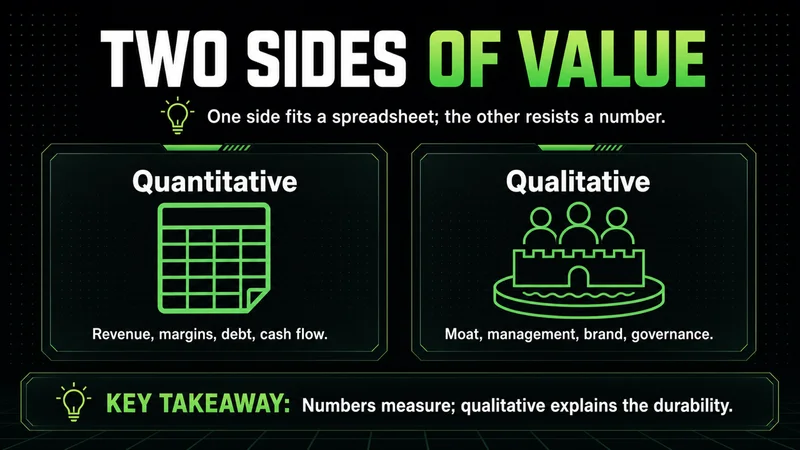
The meaning is simpler than the term suggests. Quantitative analysis measures things you can put in a spreadsheet — revenue, margins, debt, cash flow. Qualitative analysis covers everything that resists a clean number but still drives those figures over time.
The core qualitative factors most analysts weigh are consistent across frameworks:
- Management quality — the track record, capital-allocation discipline, and honesty of the people running the business.
- Competitive advantage — the structural reason a company keeps its customers and margins when rivals attack.
- Business model — how the company actually earns money, and how repeatable that revenue is.
- Corporate governance — board independence, incentive structure, and how minority shareholders are treated.
- Industry conditions — the competitive intensity, regulatory exposure, and demand trends of the market the company sells into.
None of these is a metric. Each one is a judgment, supported by evidence you gather from annual reports, earnings calls, product behavior, and how a management team handles a bad quarter. The judgment is the work.
Why qualitative factors matter more than the screen suggests
Two companies can post identical financial statements and be worth very different amounts. The difference lives almost entirely in the qualitative layer. One has a founder who allocates capital well and a product customers cannot easily replace. The other has a capable quarter and a competitor about to undercut it.
This is where the parallel to active trading is direct. Price action without context is gambling with better vocabulary. A clean chart pattern means little until you know the liquidity and conditions around it. Financial statements work the same way. The ratios are the pattern; the qualitative factors are the context that tells you whether the pattern is likely to hold or break.
Qualitative work is also where catalysts hide. A governance change, a new entrant, a shift in how a company is led — these rarely show up in a ratio until after the price has already moved. Reading them early is the entire point.
How to build a qualitative analysis framework
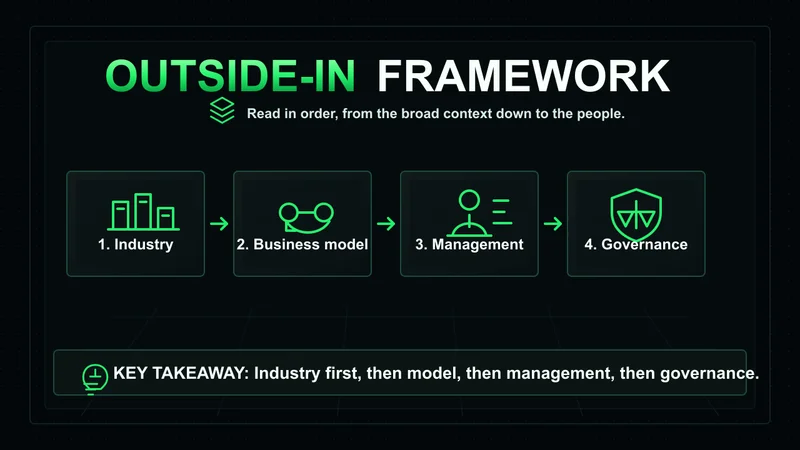
A list of factors is not a framework. A framework tells you what order to read them in and how much each one should move your conclusion. The sequence that holds up under pressure runs from the outside in: industry first, then business model, then management, then governance.
Industry comes first because it sets the ceiling. A disciplined, well-run company in a structurally bad industry usually loses to a mediocre company in a strong one. Start by asking how competitive the industry is, who holds pricing power, and what regulation or technology could reshape it.
Business model comes next. Map how the company earns money, how repeatable that revenue is, and what it would cost a competitor to take it. Subscription revenue with high switching costs is a different animal from one-time project work, even at the same margin today.
Management is third. Read several years of letters to shareholders and listen to how the team discusses a weak quarter. Capital allocation is the tell. A team that buys back stock at high prices and issues it at low ones is telling you something a single year of returns will not.
Governance sits underneath all of it. Misaligned incentives, a captured board, or shareholder structures that favor insiders can quietly erode value no matter how good the business looks on the surface.
A qualitative factors checklist you can actually use
A working checklist forces you to write down a judgment instead of feeling one. Run a company through these questions before you size any position:
- Moat — what specifically stops a competitor from taking these customers, and how long has that held?
- Management — has capital been allocated well across at least one full cycle, including a downturn?
- Incentives — does management get paid for building long-term value or for hitting short-term targets?
- Model durability — what share of revenue recurs, and what would break it?
- Industry trajectory — is the addressable market expanding, flat, or quietly shrinking?
- Governance — are minority shareholders protected, or is the structure built to favor insiders?
- Disconfirming evidence — what is the strongest reason this thesis is wrong, and have you written it down?
The last question matters most and gets skipped most. A checklist that only collects supporting evidence is a confirmation-bias machine. The discipline is in actively looking for the read that breaks your own thesis before the market does it for you.
A worked example of qualitative analysis
Consider two retailers with nearly identical margins, debt levels, and revenue growth. On a screen they are interchangeable.
Read the qualitative factors and they separate quickly. The first owns its supply chain, has a founder-led team that has compounded capital through two recessions, and sells products with genuine repeat demand. The second leases everything, churns executives every few years, and competes only on price in a category where the cheapest seller wins.
The financials say they are equal. The qualitative reading says the first business is far more likely to still be earning those margins in five years, while the second is one aggressive competitor away from a problem the spreadsheet has not priced yet. Same numbers, very different businesses. That gap is the whole reason qualitative analysis exists.
Qualitative factors vs quantitative factors
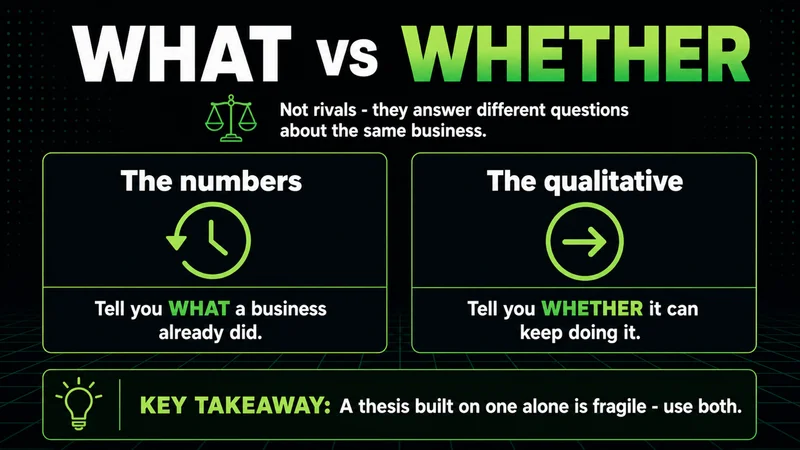
The two are not rivals. They answer different questions, and a thesis built on one alone is fragile.
The numbers tell you what a business did. The qualitative factors tell you whether it can keep doing it. Neither one is optional, and the order you read them in changes the conclusion.
The contrast is easiest to hold side by side:
- Quantitative factors are precise, comparable, and backward-looking. They are excellent at flagging what to investigate and useless at explaining why.
- Qualitative factors are imprecise, hard to compare, and forward-looking. They explain the why and resist any clean appraisal.
The practical workflow is to let the numbers narrow the field, then let the qualitative read decide conviction and size. Quantitative analysis tells you where to look. Qualitative analysis tells you whether to act.
Common qualitative analysis mistakes to avoid
Three errors account for most ruined theses:
- Mistaking a story for evidence. A compelling narrative about a visionary founder is the easiest thing in the world to fall for, and the hardest to size correctly. Conviction should come from process, not from how good the story sounds.
- Anchoring to recent performance. A good year does not prove good management, and a bad quarter does not disprove it. Judge the soft factors across a full cycle, including a downturn, or you are just extrapolating a streak.
- Ignoring disconfirming evidence. Building identity around being right about a company is how investors hold a broken thesis too long.
The market does not care about conviction. Risk exists whether you acknowledge it or not, and the cheapest way to manage it is to write down what would prove you wrong before you commit capital.
When qualitative analysis breaks down
Qualitative reads are at their most reliable when conditions are stable and the time horizon is long. They are at their weakest exactly where a lot of investors lean on them hardest.
In a liquidity-driven or macro-driven environment, the soft factors stop predicting price for long stretches. A superb business can fall with everything else when positioning and rates dominate, and a weak one can run on flows alone. The qualitative thesis is not wrong in those moments; it is simply not what is moving the tape, and confusing the two burns capital.
The framework also breaks down over short horizons. None of these factors tells you what a stock does next week. If your holding period is measured in days, you are trading price behavior and liquidity, not business quality, and a management read will not save a poorly structured entry. Qualitative analysis sets the destination. It says nothing useful about the path or the timing, and pretending otherwise is how a sound long-term thesis turns into a badly sized short-term position.
FAQs
What are qualitative factors in fundamental analysis in simple terms? They are the non-numeric parts of a business that drive its value over time — management quality, competitive advantage, the business model, corporate governance, and industry conditions. They explain why the financial numbers look the way they do and whether that is likely to continue.
How do qualitative and quantitative factors work together? Quantitative factors measure what a business has already done and narrow the field of candidates. Qualitative factors are forward-looking and decide your conviction and position size. The numbers tell you where to look; the qualitative read tells you whether to act.
Can qualitative analysis be wrong? Yes. It is judgment, not measurement, so it is vulnerable to a persuasive narrative and to anchoring on recent results. It is also a poor guide to short-term price, which is driven by liquidity and positioning rather than business quality. Judging the soft factors across a full cycle and actively seeking disconfirming evidence is what keeps it honest.
Where to read next
If you want to connect the soft factors back to the numbers they explain, the natural next steps are fundamental analysis as a whole, financial statement analysis, and how to analyze a stock from the top down. Each one builds on the judgment this article describes — the qualitative layer is the context, and the financials are the pattern that context has to make sense of.
Worth the read?