Cryptocurrencies Explained — A Trader's First Look
Cryptocurrencies explained for new traders: what they are, how they work, how they compare to stocks, the real risks, and how to start with defined risk.

Cryptocurrencies are digital assets that record ownership on a public, decentralized ledger called a blockchain, without a bank or government controlling the record. For a trader, that is the part that matters: there is no central party setting hours, clearing trades, or pausing the tape. The market runs 24 hours a day, seven days a week, and price moves on supply, demand, positioning, and sentiment the same way every other market does. The technology is interesting. The price behavior is what you actually trade.
Most beginner guides treat crypto as something you buy and hope about. That framing skips the part that decides whether you survive. A cryptocurrency is an instrument with structure, liquidity, and risk, and it behaves like one. Treating it as a lottery ticket is the fastest way to learn how unforgiving volatility can be.
Cryptocurrencies meaning, in plain terms
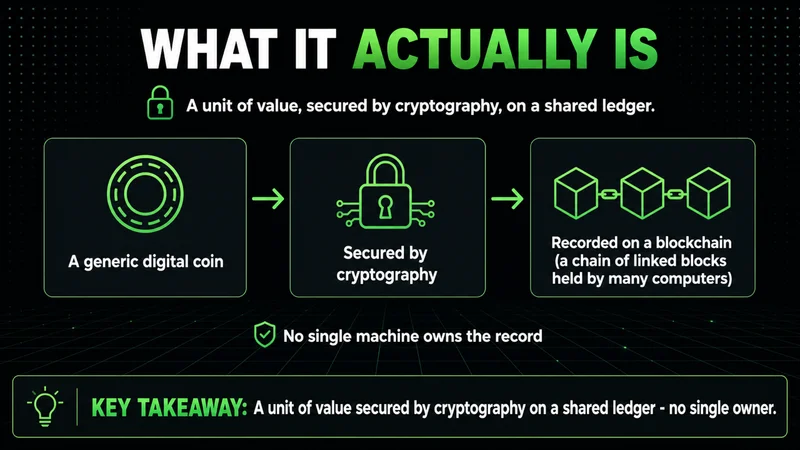
Start with the definition before the hype. A cryptocurrency is a unit of value secured by cryptography and tracked on a blockchain, which is a shared database that thousands of computers maintain at the same time. No single machine owns the record. When you send coins, the network verifies the transaction and writes it permanently, so balances cannot be quietly edited later.
That design produces a few traits a trader should internalize:
- Decentralized. No bank or clearinghouse sits in the middle, so there is no one to call when something goes wrong.
- Permissionless. Anyone with a connection can hold and move the asset.
- Transparent but pseudonymous. Transactions are public; the identities behind the wallets usually are not.
- Final. Once a transaction confirms, it does not reverse. There is no chargeback.
The meaning is simple enough. The implication is the part most people skip: finality and decentralization mean the responsibility for security, timing, and risk sits entirely with you. There is no overnight clearing process quietly fixing your mistakes.
It is worth separating two things that often get blurred together. A cryptocurrency is the asset. The blockchain is the system that records it. People treat the words as interchangeable, but the distinction matters when you trade, because the health of the underlying network is part of what supports the asset's price over time. Its usage, its security, and its development all feed into that. You are not just trading a ticker. You are trading a claim on a network that has to keep functioning for the asset to hold value.
How cryptocurrencies work in financial markets
A cryptocurrency has no price until people trade it. Value comes from what buyers and sellers agree on, moment to moment, on exchanges where orders meet. That is the same mechanism behind equities and futures. The difference is the surrounding structure.
Underneath the price, the mechanics are worth understanding once. The blockchain groups transactions into blocks and links each block to the one before it, so the history cannot be rewritten without redoing everything after it. A network of participants validates new blocks, either by spending computing power or by staking the asset itself, depending on the design. The result is a record that no single party can alter and that anyone can inspect. You do not need to run a node to trade, but knowing the asset settles this way explains why transactions are final and why network conditions can affect how fast and how cheaply you move funds.
Three features shape how crypto behaves on the tape:
- It trades continuously. There is no opening bell and no close. Liquidity thins out overnight and on weekends, and price can move sharply when fewer participants are around to absorb orders.
- It is global. Demand from one region can move price while another region sleeps, so gaps and fast moves often happen outside your local hours.
- It is sentiment-sensitive. A single headline, regulatory comment, or large transfer can shift positioning quickly because much of the market is still driven by retail flow.
None of this makes crypto special. It makes it a market with its own rhythm. The skills transfer: read structure, respect liquidity, define risk before you enter. A trader who already reads equities or futures is not starting over here. The instrument is new; the discipline is not.
The cryptocurrencies market and what moves it
The market is large, but attention concentrates in a handful of assets. Bitcoin and Ethereum carry most of the liquidity, and the rest of the field, the altcoins, tends to follow their lead during major moves. When the leaders drop, weaker assets usually drop faster and recover slower.
Price in this market responds to a familiar set of forces:
- Liquidity and positioning. Large concentrated positions and thin order books amplify moves in both directions.
- News and regulation. Policy decisions, exchange failures, and macro shifts reprice risk fast.
- Supply mechanics. Issuance schedules and token unlocks change how much supply hits the market over time.
- Broader market conditions. Crypto increasingly moves with risk appetite across stocks and rates, so it is not always trading in its own world.
In practice, where the liquidity sits tends to matter more than how strong your opinion is. A confident thesis means little when the order book is thin and a single large seller can run price through several levels before buyers step in. That is why context matters more than conviction. The reaction to a major headline is often not the cleanest opportunity either. Volatility spikes pull traders in emotionally, and the structure that actually holds usually develops a little later, once the initial reaction has cleared.
Cryptocurrencies vs stocks explained
This is the comparison most beginners actually want, because it tells you what changes when you move from one to the other. The instruments rhyme, but the structure around them does not.
| Feature | Cryptocurrencies | Stocks |
|---|---|---|
| Trading hours | 24/7, including weekends | Set exchange hours, weekdays |
| What it represents | A digital asset or network token | Ownership in a company |
| Volatility | Typically higher, faster moves | Generally lower, slower moves |
| Regulation | Uneven and still developing | Mature and well defined |
| Custody | Self-custody possible; you hold the keys | Held by a broker or custodian |
| Liquidity | Concentrated in major assets | Broad across listed names |
The practical takeaway is about risk, not preference. Stocks pause overnight, which gives you time to think. Crypto does not. A position you open Friday afternoon can move against you all weekend while volume is thin and spreads are wide. The same structure that reads cleanly during high-volume hours can mean almost nothing at 3 a.m. on a Sunday, when one order moves price further than it should. If you are used to equities, that is the adjustment that costs people the most.
Cryptocurrencies examples for beginner traders
A few names carry most of the liquidity and are where new traders should focus first. Concentrating on liquid assets keeps spreads tighter and execution cleaner.
- Bitcoin (BTC). The first and largest cryptocurrency. It sets the tone for the broader market.
- Ethereum (ETH). The second largest, and the base layer for a large share of applications and tokens.
- Major altcoins such as Solana, Cardano, and XRP. More volatile than the leaders, with thinner books outside peak hours.
- Stablecoins such as USDC and USDT. Designed to track the dollar, used mostly as a base pair for trading in and out of positions.
For a beginner, the higher-volume pairs are the sensible starting point. They move in ways you can read, and you are not fighting a thin book on every entry and exit. The lower-cap altcoins promise larger percentage moves, but those moves cut both ways, and the thin liquidity that lets them run also lets them collapse with no buyers underneath. There is time to explore the edges of the market later. The leaders are where the structure is cleanest while you are still learning to read it.
Cryptocurrencies account requirements and what you need first
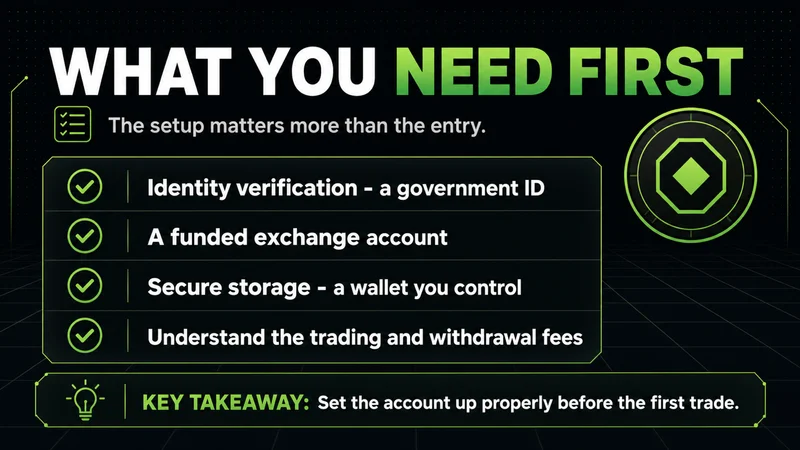
Before any trade, the setup matters more than the entry. Rushing this step is where new traders quietly take on risk they never priced in.
Most exchanges expect a standard set of items:
- Identity verification. A government ID and a basic know-your-customer check.
- A funded account. A bank transfer, card, or another crypto deposit to start.
- A secure wallet. Either the exchange's custody or, better as you grow, a wallet where you control the keys.
- Two-factor authentication. A non-negotiable layer of account security.
Self-custody means full control and full responsibility. If you lose the keys, no support desk can recover the funds for you.
The account is plumbing. It does not make you money. But a sloppy setup, weak security, or funds sitting unprotected can lose money before you place a single trade. Treat the exchange you choose as part of your risk, not just a convenience. Look at how long it has operated, how it handles withdrawals, and what happens if it goes offline. A platform that makes onboarding effortless but is opaque about where your funds sit is a risk you are taking on whether you priced it in or not.
Cryptocurrencies trading basics step by step
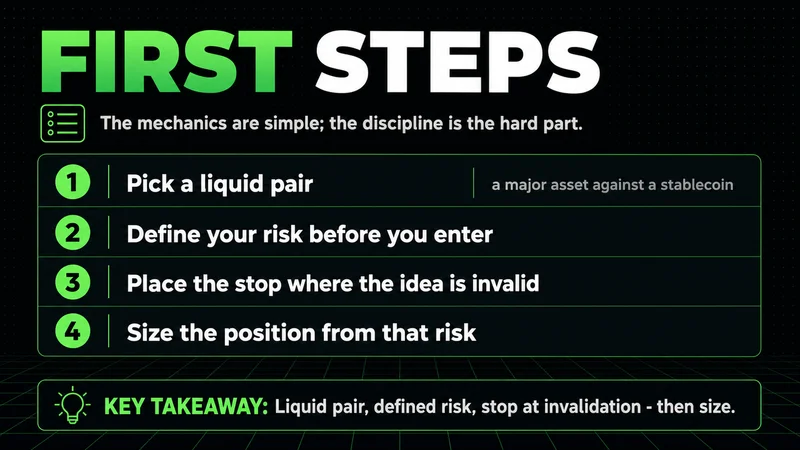
Once the account is ready, the mechanics are straightforward. The discipline around them is the hard part.
- Pick a liquid pair. Start with a major asset against a stablecoin or fiat, where the book is deep.
- Define risk before you enter. Decide where the idea is wrong and how much you lose if it is, before clicking buy.
- Choose an order type. A market order fills immediately at the current price; a limit order fills only at the price you set.
- Size the position to the risk, not the conviction. Your stop distance and account size set the size, not how sure you feel.
- Manage the trade. Let the structure play out or invalidate. Do not move the stop because price is uncomfortable.
- Review afterward. Note what worked, what did not, and whether you followed your own rules.
Notice that only one of those steps is about entering. The rest are about risk and process. That ratio is not an accident. For most new traders, the breakdown is not in the analysis. It is in following the plan once price starts moving, and crypto's speed exposes that gap faster than slower markets do.
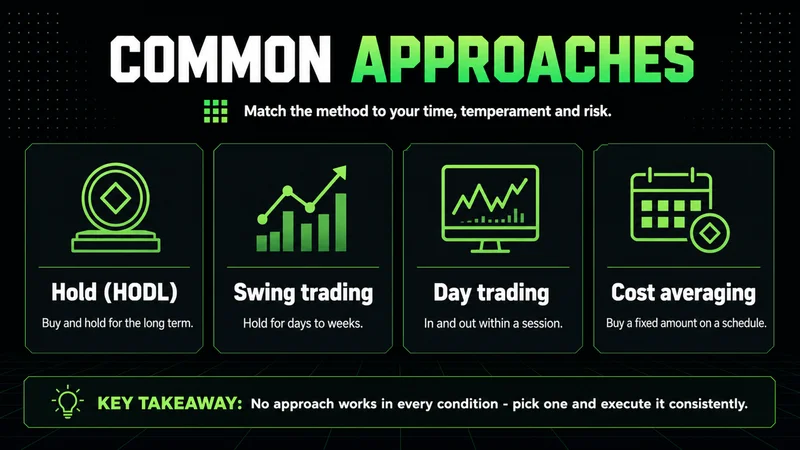
Common approaches new traders start with
There is no single correct way to trade crypto, and no approach works in every condition. What matters is matching the method to your time, temperament, and risk tolerance, then executing it consistently. A few approaches show up repeatedly for beginners:
- Holding for the long term. Buying a major asset and holding through volatility, ignoring short-term noise. The simplest approach, though it still requires the discipline to hold through deep drawdowns without panic selling.
- Dollar-cost averaging. Buying a fixed amount on a schedule regardless of price. It removes the pressure of timing and smooths out an entry over time.
- Swing trading. Holding positions for days or weeks to capture larger moves, using structure to define entries and invalidation.
- Day trading. Entering and exiting within a session to capture short-term moves. This is the most demanding approach and the one where poor risk control does the most damage fastest.
The more active the method, the more it rewards experience and punishes hesitation. The hours spent watching how price actually behaves are what build real pattern recognition, and no course or indicator replaces them. Strategy matters, but that accumulated screen time matters more. Beginners are usually better served by the slower approaches while they build that experience, not by chasing the fastest one.
The main risks of cryptocurrencies trading
The upside gets the attention. The risk is what decides whether you are still trading next year. These are the ones that actually empty accounts.
- Volatility. Double-digit percentage moves can happen in hours. Leverage turns that into account-ending speed, which is why new traders should leave it alone until risk control is automatic.
- Thin overnight liquidity. The same level that holds during peak hours can fail on a weekend when volume disappears, and a stop can fill far worse than where you set it.
- Security failures. Hacked accounts, phishing, and lost keys are permanent. There is no reversal and no support desk that can undo a confirmed transaction.
- Counterparty risk. Exchanges can freeze withdrawals, get hacked, or fail outright. Funds sitting on a platform are only as safe as the platform itself.
- Regulatory shifts. A single policy change can reprice an asset or restrict access overnight, sometimes in a region you trade from.
- Emotional decisions. Chasing a fast move or revenge trading after a loss does more damage than any single bad setup.
Accounts rarely fail on one disastrous trade. They erode through a series of small rule breaks during emotional sessions, compounding quietly until the damage is obvious. Protecting capital is the first objective, not maximizing the good days. A small loss inside the plan is just a cost of doing business; the large losses are the ones that escaped the plan, usually under emotion. The traders who last are not the ones who avoid losing. They are the ones who keep the losses small enough to stay in the game and keep their process intact through the difficult stretches.
How to choose cryptocurrencies for a trading plan
The asset should fit the plan, not the other way around. New traders often pick the most volatile name they can find and then wonder why their risk feels uncontrollable.
A short checklist for new traders keeps the selection honest:
- Liquidity first. Trade names with deep books and tight spreads so your orders do not move price.
- Match volatility to your risk tolerance. A faster asset needs a wider stop and a smaller position.
- Understand what you are holding. Know the asset's basic purpose before you trade it.
- Keep the list short. A few instruments you understand beat a long watchlist you cannot follow.
- Define invalidation per asset. Where is the idea wrong, and what does that cost you?
An entry without context is closer to a guess than a trade. An asset is only worth trading when its behavior fits a plan you can actually execute, with risk you can actually hold through. The mistake new traders make is reversing the order. They fall for a name first, build conviction around it, and then try to force a plan onto an asset that does not suit how they trade. The asset is the last decision, not the first. Decide how you want to trade, what risk you can carry without it affecting your judgment, and how much screen time you can give it. Then pick the instrument that fits.
Are cryptocurrencies good for beginner traders
The honest answer is that crypto is accessible but unforgiving. Low entry barriers and 24/7 access make it easy to start. The same volatility that draws people in punishes poor risk control faster than slower markets do. It can be a reasonable place to learn, on two conditions: small size, and a real process.
The market rewards patience far more than activity. Beginners almost always believe they need more trades. Most need fewer trades, defined risk, and the discipline to wait for conditions they understand. If one losing position is affecting how you make the next decision, the size was too large, regardless of the asset.
If you decide to start, start small enough that the outcome of any single trade does not matter much. The goal early on is not profit. It is learning how the market moves, how you react under pressure, and whether you can follow your own rules when price tests them. Survive long enough to build that experience, and the returns become a question of process. Skip it, and crypto's speed will teach the same lessons at a far higher cost.
FAQs
What are cryptocurrencies in trading? They are digital assets recorded on a decentralized blockchain that traders buy and sell on exchanges to profit from price movement. In trading terms, a cryptocurrency is an instrument with liquidity, structure, and risk, the same as any other market you would trade.
How do cryptocurrencies work in simple terms? Ownership is recorded on a blockchain, a shared public ledger maintained by many computers at once. No bank or government controls it, transactions are final once confirmed, and price comes from buyers and sellers meeting on an exchange.
Are cryptocurrencies good for beginner traders? They can be, with small size and a defined process. The barriers to entry are low, but the volatility is high and runs 24/7, so poor risk control is exposed quickly. Start small and treat risk management as the priority.
What are the main risks of cryptocurrencies trading? Volatility, thin overnight liquidity, security failures, regulatory shifts, and emotional decision-making. The most expensive of these is usually the last one, because rule-breaking during emotional sessions compounds quietly before it shows up as a blown account.
How do cryptocurrencies compare with stocks? Crypto trades 24/7 and tends to move faster, while stocks trade set hours and generally move slower with clearer regulation. The biggest practical difference is that crypto never pauses, so a position can run against you over a weekend when liquidity is thin.
How do I choose cryptocurrencies for a trading plan? Start with liquidity, match the asset's volatility to your risk tolerance, understand what you are holding, and keep the list short. Define where each idea is wrong before you enter, and let that set the position size.
Worth the read?