Day Trading Strategy for Beginners — Start With One
A day trading strategy for beginners is one repeatable setup with defined risk, not a pile of indicators. Run one plan with a hard daily loss limit.

A day trading strategy for beginners is a written set of rules for one repeatable setup: where you enter, where you are wrong, where you take profit, and how much you risk. It is not a collection of indicators or a feeling about direction. It is a process you can run the same way on a green day and a red day, because the rules were decided before the session, not during it.
Most beginners do the opposite. They collect strategies. They watch ten videos, save twelve setups, and end the week with no idea which one they actually trade. The traders who survive their first year usually run one setup with defined risk and a hard daily loss limit. Fewer decisions, made calmly, beat more decisions made under pressure. That is the whole edge early on.
What a day trading strategy actually is
Day trading means opening and closing positions inside the same session, so you hold no overnight risk. A day trading strategy for beginners turns that activity into a rule set. Each setup answers four questions in advance:
- Entry: the specific condition that puts you in a trade.
- Invalidation: the price level that proves the idea wrong and takes you out.
- Target: where you reduce or exit into strength.
- Size: how many shares or contracts, derived from your risk per trade.
If a setup cannot answer all four, it is not a strategy yet. It is an opinion. Opinions are fine for journaling and useless for execution, because they give you nothing to act on when price moves fast and your pulse rises with it.
Notice what is missing from that list: prediction. A beginner strategy does not forecast where the market is going. It defines what you do if a condition appears and what you do if it does not. You are reacting to confirmation, not guessing ahead of it. That single shift, from predictive to reactive, removes most of the emotional weight new traders carry into the screen.
The parts every beginner setup needs
Before naming specific strategies, understand the parts they share. Every workable intraday setup is built from the same components, and a beginner who learns the components can read any setup instead of memorizing dozens.
- A level that matters: a prior high or low, the opening range, a moving average, or the volume-weighted average price. Price reacts at levels because that is where resting orders sit.
- A trigger: the candle or sequence that confirms participation at that level, such as a clean break and hold or a sharp rejection.
- A risk anchor: the nearby structure that defines your stop. The stop is part of the setup, not an afterthought bolted on once you are already losing.
- A reason to exit: a target level, a trailing rule, or a time stop if the move does not develop.
Intraday price action is just these components repeating across the day at different levels. A breakout at the opening range and a pullback into a moving average are the same skeleton with different triggers. Learn the skeleton, and the named strategies below stop looking like separate systems and start looking like variations on one idea.
Five day trading strategies for beginners
These are simple day trading strategies with clear examples. None is secret, and none works in every condition. Pick one, trade it until you understand how it behaves, then judge it on a sample of trades rather than a single result.
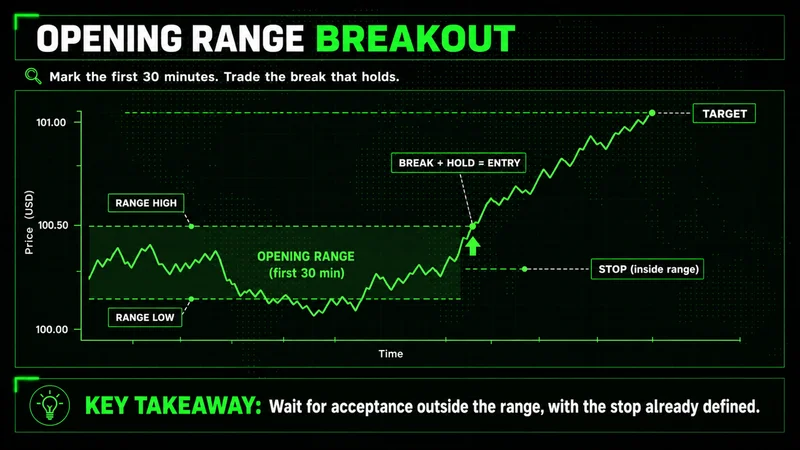
- Opening range breakout. Mark the high and low of the first 15 to 30 minutes. When price breaks and holds above the range high on rising volume, you enter long with a stop back inside the range. The logic is simple: acceptance outside the range shows one side won the early auction.
- Momentum continuation. After a strong move, wait for a shallow pause, then enter in the direction of the trend when price resumes with a clear push. You are joining established order flow, not calling a turn. Your stop sits below the pause low.
- Pullback to support or resistance. In an uptrend, mark the obvious support, wait for price to return to it, and enter on rejection back upward. A day trading strategy with support and resistance lives or dies on the quality of the level, so trade only the levels that are clean and obvious, not every minor wiggle.
- Moving-average or VWAP reversion. When price stretches far from VWAP and then stalls, you fade the extension back toward the average. This works in balanced, range-bound sessions and fails badly in trending ones, which is exactly why context comes first.
- Range scalp. In a defined range with no trend, you buy the lower boundary and sell the upper one, taking small, repeatable gains. The risk is a clean break of the range, so your stop is tight and your size is modest.
Each of these is reactive. You are waiting for a level to be tested and for price to confirm, then acting with a stop already defined. That is the difference between a setup and a guess.
Day trading versus swing trading
Beginners often pick day trading without knowing whether it fits them. Day trading and swing trading solve the same problem on different timeframes, and the right choice depends on your schedule and temperament more than on which is more profitable.
Day trading closes every position by the session's end. It needs screen time during market hours, fast decisions, and tolerance for a high number of small outcomes. Swing trading holds positions for days or weeks, accepts overnight gap risk, and asks for patience between entries rather than constant attention. Neither is superior. A day trading strategy for beginners suits people who can watch live price during the session and stay disciplined through frequent decisions. If you cannot sit with the market in real time, swing trading may protect your results better than forcing intraday trades around a job.
Building a day trading plan around one setup
Most beginner guides stop at the strategy list. The harder, more valuable step is turning one setup into a written day trading plan you actually follow. A plan is not a paragraph of intentions. It is a short document that removes decisions from the live session, where decisions are expensive.
A workable beginner plan specifies the following:
- The one setup you trade this month, written as entry, invalidation, target, and size.
- The hours you trade, usually the first one to two hours when liquidity and movement are highest.
- The instruments you trade and nothing else, so you build pattern recognition on a small, familiar set.
- Your risk per trade as a fixed percentage of account, and your hard daily loss limit, after which you stop for the day.
- A short note on the conditions where you do not trade at all.
That last line matters more than it looks. Knowing when not to trade is part of the plan, not a gap in it. Forcing trades during low-quality conditions is one of the most common ways new accounts bleed out slowly. A plan that defines the no-trade state protects you from your own boredom.
Day trading risk management for beginners
Risk management matters more than entries. A mediocre entry with controlled risk survives. A perfect entry with oversized risk eventually destroys the account. For a beginner, the entire job in the first months is to still be trading in month six, and that is a risk problem before it is a strategy problem.
Keep the rules simple enough to follow under pressure:
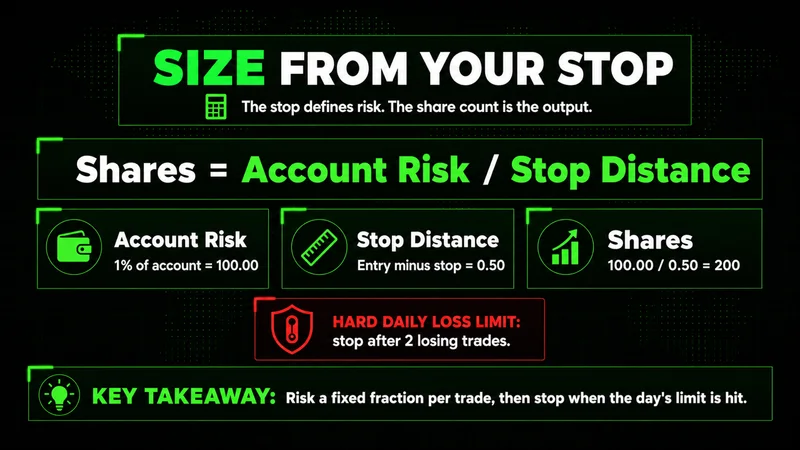
- Risk a small, fixed fraction of your account per trade, commonly 1 percent or less, so no single loss is emotionally heavy.
- Size the position from the stop distance, not the other way around. The stop defines risk; the share count is the output.
- Set a hard daily loss limit, for example two losing trades or a fixed dollar amount, and stop when you hit it. A losing day does not require immediate recovery.
- Never widen a stop because price is moving against you. The level that invalidated the idea still invalidates it.
If one losing trade affects your next decision, the position was too large. Most beginners carry oversized positions without realizing it, and they read the resulting emotional swings as a psychology problem when it is really a sizing problem. Fix the size and much of the emotion settles on its own.
When these strategies stop working
Here is what most beginner guides leave out. None of these setups works in every market condition, and knowing where they break is part of trading them. A breakout strategy reads cleanly in a liquid, trending session; in thin, choppy conditions the same break fails repeatedly as price slices back through the level and stops you out. VWAP reversion works while the session stays balanced and inverts the moment a real trend develops, turning every fade into a fight against order flow. Range scalping survives until the range breaks, and when it breaks it usually does so fast.
Macro-driven days are their own category. Around major economic releases, the first move after the news is often the least reliable one, because volatility spikes before structure forms. Many beginners lose money reacting emotionally to that spike instead of waiting for the market to settle into a readable state. The fix is not a better entry. The fix is recognizing the regime and standing aside until your setup's conditions actually exist. A strategy is only an edge inside the conditions it was built for; outside them, the same rules quietly become a liability.
Common mistakes beginners make
Most new day traders do not have a strategy problem. They have a discipline problem. The analysis is rarely the thing that drains the account. The repeated small rule-breaks are. These are the patterns that show up again and again:
- Trading too many setups at once, so no single edge ever gets a fair sample.
- Sizing by conviction instead of by a fixed risk rule, which turns a strong feeling into a large loss.
- Moving or removing stops mid-trade to avoid being wrong, converting a small operational loss into a large emotional one.
- Revenge trading after a loss, which is ego trying to recover control rather than a real setup.
- Trading through fatigue, when execution quality falls faster than most people notice.
None of these is solved by a new indicator. They are solved by fewer trades, defined risk, and the discipline to stop when the day is done.
Where to take this next
A day trading strategy for beginners is the starting structure, not the finish line. Treat the first months as a process of narrowing: one setup, defined risk, a written plan, and an honest journal of every trade. From there, the useful next steps are practical and sequential.
- Trade your one chosen setup in a simulator or at minimum size until the rules are automatic.
- Journal each trade against the plan and review whether you followed it, separately from whether it won.
- Study how your setup behaves in different regimes, so you learn the conditions where it works and the ones where it does not.
- Add complexity only after the simple version is consistently executed, never before.
Consistency is built by surviving the difficult stretches, not by maximizing the easy ones. Start with one setup, protect your capital, and let screen time do the slow work that no strategy list can shortcut.
Worth the read?