Designated Market Maker — What the Role Actually Does
A designated market maker is the NYSE firm obligated to keep a listed stock tradable — quoting both sides, running its auctions, and absorbing imbalances.
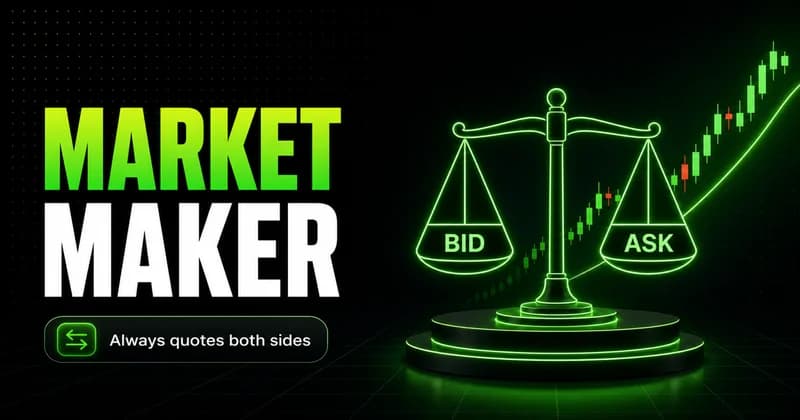
A designated market maker is the single firm the New York Stock Exchange assigns to each listed stock, contractually obligated to maintain a fair and orderly market in it — quoting both sides, running the opening and closing auctions, and committing capital when buyers and sellers fail to meet. That is the definition. The part most explanations skip is what the obligation does not cover, and that gap is where traders misread the role.
The designated market maker is not there to defend a level, protect your position, or steer price toward anything. It is there to keep the quote functioning. Once that distinction is clear, most of the mythology around the role — the manipulation theories, the stop-hunt complaints — stops surviving contact with how the job actually works.
What a designated market maker actually does
Every stock listed on the NYSE is assigned to exactly one designated market maker, or DMM. The designation is the meaning of the term: a regular market maker chooses to quote a stock and can walk away from it, while a designated market maker signs up for obligations it cannot drop when conditions get uncomfortable.
Those obligations are set by the exchange and monitored continuously. In practical terms, the DMM has to:
Maintain a two-sided quote — a bid and an offer — within a defined distance of the best national price, for a required share of the trading day.
Open the stock each morning and close it each afternoon by running the auctions that set the official opening and closing prints.
Commit its own capital to offset order imbalances, buying when sellers overwhelm bids and selling when buyers overwhelm offers.
Reopen the stock in an orderly way after halts, including volatility pauses.
The role in markets, then, is structural rather than directional. The DMM does not care whether the stock goes up or down. It cares that the path between prices stays tradable — that the spread does not blow out, that the open is not chaotic, and that a halt does not turn into a vacuum.
That is also why the role survives in an electronic market. Most volume moved to machines years ago, but auctions and dislocations still need a counterparty with an obligation rather than a preference.
Designated market maker vs. market maker — the difference that matters
Every DMM is a market maker. Almost no market makers are DMMs. The comparison comes down to assignment, obligation, and scope.
A standard market maker quotes wherever it sees an edge. It can quote a thousand symbols across a dozen venues, widen its spreads when volatility expands, and turn off entirely when the risk stops being worth the spread. Its presence is a business decision, refreshed every second.
A designated market maker:
Is assigned to specific NYSE-listed stocks and is the only DMM in each of them.
Operates under exchange rules on quote width, displayed depth, and time spent at the inside price.
Must participate in the opening, closing, and reopening auctions for its names.
Is evaluated by the exchange and by the listed companies, which have a say in which firm receives the assignment.
The economics differ too. A regular market maker is paid by the spread alone. A DMM earns the spread plus exchange incentives tied to meeting its obligations — which is the honest answer to why a firm would accept forced participation in conditions everyone else can avoid.
The vocabulary also stops at the NYSE's edge. Nasdaq-listed stocks trade through competing market makers with no single designated firm, and ETFs on NYSE Arca use lead market makers — a related role with lighter obligations. When someone says "the market maker" in a stock as if there were only one, the DMM model is usually what they are half-remembering.
How a designated market maker works at the open and close
The auctions are where the DMM stops being invisible. During the continuous session, the firm is one liquidity provider among many. At 9:30 a.m. and 4:00 p.m. Eastern, it is the single point of accountability for the print.
Before the open, orders accumulate in the book — market-on-open, limit-on-open, and the overnight backlog. The DMM's job is to find the price at which the most shares pair off, publish indications when the imbalance is large, and commit capital to bridge whatever gap remains. The same mechanics run in reverse at the close, where market-on-close and limit-on-close orders from funds dominate the flow. On index rebalancing days, that closing flow can dwarf everything the stock traded during the session, and the DMM's pairing job becomes the main event of the day.
For a trader, the useful part is not the definition — it is the data the process produces. Exchanges publish imbalance feeds ahead of the close, showing how much buying or selling pressure remains unpaired. Reading that feed tells you whether the auction is likely to print away from the last traded price. Watching how price behaves into a large published imbalance is a cleaner read on institutional positioning than most indicators, because the orders behind it are real and committed.
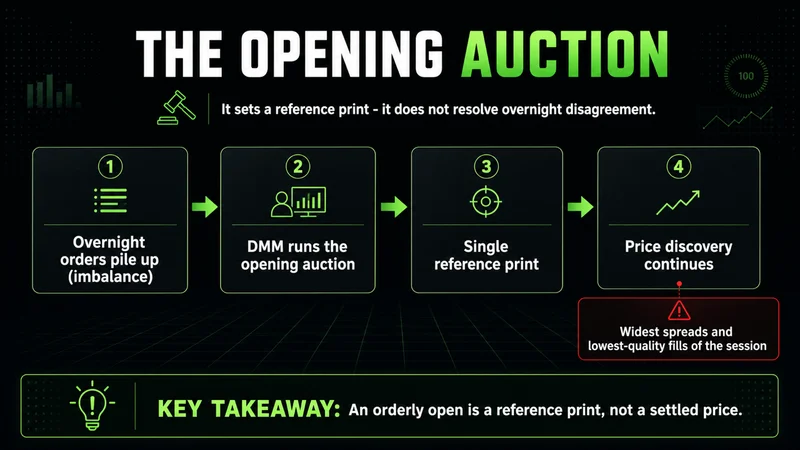
The first minutes after the open deserve the same respect. The DMM's auction sets a single reference print, but it does not resolve the disagreement that built up overnight. Price discovery continues — usually with the widest spreads and the lowest-quality fills of the session. An orderly open is not the same thing as a stable one, and treating the opening print as a settled price is a common way to donate money in the first 15 minutes.
From specialists to designated market makers — a short history
The DMM is the successor to the NYSE specialist, a role that ran the floor for more than a century. The specialist did everything the DMM does now — manual auctions, two-sided quotes, capital commitment — with one enormous difference: the specialist could see the entire order book for its stocks, including who was behind the orders, at a time when nobody else could.
That information advantage became indefensible. Electronic trading distributed quotes to everyone, regulation pushed exchanges toward open competition, and a series of enforcement cases in the early 2000s — specialists trading ahead of customer orders — burned through whatever trust remained. In 2008 the NYSE retired the specialist model and replaced it with the designated market maker.
The redesign kept the obligations and removed the privileged view. A modern DMM sees materially the same market data as other professional participants and competes with every other liquidity provider during the continuous session. What survived the transition was the accountability: one firm, named in advance, responsible for the auction and the quote in each listed stock. The floor presence survived too, in reduced form — DMM staff still work at the point of sale, which is most visible on IPO days.
Designated market maker examples on the NYSE
The DMM business is concentrated. A handful of firms — Citadel Securities, GTS, and Virtu Americas among them — hold the assignments across NYSE-listed stocks, each responsible for hundreds of names.
A concrete example of the role at work is a new listing. When a company goes public on the NYSE, its DMM runs the first auction the stock has ever had — gathering indications, publishing preliminary price ranges, and deciding when supply and demand are matched well enough to open. That first print can take an hour or more after the bell. The delay is not dysfunction; it is the DMM declining to open a stock into a one-sided book.
The same accountability shows up on ordinary days in less visible ways: a reopening after a volatility halt, a closing print on rebalancing day when index funds need to move size, a quote held together in a listed name that trades by appointment. None of it is glamorous. All of it is the job.
Why designated market makers matter for investors
For a long-term investor, the DMM matters at exactly two moments: when you transact, and when the market prints the prices your portfolio is marked against.
The closing auction is the clearest case. It is routinely the largest liquidity event of the trading day, because index funds and institutions concentrate their flow there to receive the official closing price. The quality of that print — how well it reflects paired supply and demand rather than a thin last trade — depends on the auction process the DMM runs. Anyone holding index products has a stake in that mechanism whether they know it or not.
This is also where a broader point about markets shows up. Liquidity drives price more than opinions do, and the closing auction is the cleanest daily demonstration: the largest prints of the day are set not by anyone's view of the company but by the mechanical pairing of committed orders. Positioning decides; the narrative arrives afterward.
For active traders, the practical benefits are narrower but real:
Tighter spreads and a managed quote in less liquid listed names, where a voluntary market maker might simply leave.
A single accountable auction price at the open and close, instead of a scramble across venues.
Orderly reopenings after halts, which limit — though never eliminate — the air pockets that follow a pause.
None of this changes what a setup looks like. It changes the quality of the fills around the events where execution is hardest.
Where the model breaks down — designated market maker risks
The honest version of this topic includes the limits, because the obligations are minimums, not guarantees.
The first limit is capital. A DMM is required to maintain a quote, not to hold a level. In a fast, macro-driven selloff, the firm can meet every obligation it has — two-sided quote, required width, auction participation — while price travels a long way in minutes. The model dampens noise. It does not absorb direction, and it was never designed to. Expecting a DMM to stop a falling stock misreads the job: the mandate is order, not outcome.
The second limit is coverage. The DMM exists during NYSE market hours, in NYSE-listed stocks. The overnight session in index futures, the pre-market in equities, and most after-hours trading run without anything like it. Structure reads cleanly in the regular session with a DMM behind the quote; the same price action overnight, on thin liquidity with no obligated counterparty, means much less. Traders who carry regular-session assumptions into those hours tend to pay for the lesson.
The third limit is history's warning about incentives. The specialist era ended partly because privileged position plus weak oversight produced abuse. The current model is far more constrained — the SEC's oversight and the exchange's own surveillance are built around that lesson — but the structural tension between making markets and trading profitably never fully disappears. It is managed, not solved.
And for index futures traders specifically, the DMM model is mostly background. NQ and ES have no designated market maker; their liquidity is voluntary, layered, and capable of thinning out exactly when it is needed most. What transfers from this topic is not the institution but the habit of asking who is obligated to be on the other side of your trade — and noticing the sessions where the answer is nobody.
FAQs
What is a designated market maker in simple terms? It is the one firm the NYSE assigns to a listed stock with a contractual duty to keep that stock tradable — quoting a bid and an offer through the day, running the opening and closing auctions, and using its own capital to smooth imbalances.
How does a designated market maker make money? Two ways: the spread between the prices where it buys and sells, and incentive payments from the exchange for meeting its quoting obligations. The incentives exist because the obligations force participation in conditions a voluntary market maker would avoid.
Is a designated market maker the same as a specialist? It is the successor role. The NYSE replaced specialists with DMMs in 2008. The auction and quoting duties carried over; the specialist's privileged view of the order book did not.
Can a designated market maker stop a stock from falling? No. The obligation is to maintain an orderly quote, not to defend a price. In a heavy selloff a DMM can meet every requirement while the stock drops substantially. The role reduces chaos in the path; it does not change the destination.
How does a designated market maker affect day trading? Mostly through the auctions. The open and close in NYSE names are single accountable prints rather than a scramble, and the published imbalance data ahead of the close is a genuine execution input. During the continuous session the DMM is one liquidity provider among many, and its presence is hard to distinguish from the rest of the book.
What mistakes do beginners make about designated market makers? The common ones: blaming the DMM for stop runs it has no reason to engineer, treating "market maker" as shorthand for manipulation, and assuming the opening print settles price discovery. The less obvious mistake is ignoring the role entirely — the closing imbalance feed is public, useful, and mostly unread by retail traders.
What to take away from the designated market maker model
The designated market maker is an accountability mechanism: one firm, named in advance, obligated to keep each NYSE-listed stock tradable and to run the auctions that produce its official prices. It is not a guardian, not an adversary, and not a prediction engine.
What deserves a trader's attention is narrower than the definition. The auctions matter — they are the deepest liquidity events of the day, and they publish their imbalances in advance. The limits matter — the obligations are minimums, and they vanish entirely outside regular hours and outside listed equities. Keep those two facts, and the rest of the mythology around the role can be safely ignored.
Worth the read?