Scalping Trading Strategy for Beginners — Why Most Fail
A scalping trading strategy for beginners means many small, risk-defined trades on a fast chart. Most beginners lose to costs and discipline, not weak setups.
A scalping trading strategy for beginners means taking many small, risk-defined trades on a 1- or 5-minute chart, holding each position for seconds to a few minutes to capture a thin slice of a move. The setups are not the hard part. Most beginners lose at scalping because the costs and the discipline it demands quietly stack against them long before any single trade goes wrong.
That is the uncomfortable starting point. Scalping looks simple from the outside: spot a level, click, take a few ticks, repeat. In live conditions it is one of the most demanding ways to trade, because every edge you think you have is competing against the spread, the commission, and your own reaction time on every entry. This guide walks through how scalping works, a simple setup you can study, how to size risk, and the conditions where the whole approach stops working.
What a scalping strategy actually is
Scalping is a short-term trading strategy built on frequency and tight risk. Instead of holding for a large move, a scalper takes a small, defined piece of price action and exits quickly, then looks for the next one. A position might last 15 seconds or three minutes. The goal is a high number of small, controlled outcomes rather than a few large ones.
The logic rests on three things working together:
- A liquid market where you can enter and exit fast without heavy slippage.
- A repeatable trigger, such as a reaction off a clear level or a short momentum push.
- A stop that is small in absolute terms but defined before the entry, never after.
Scalping is reactive, not predictive. You are not forecasting where price will be in an hour. You are responding to how price behaves at a level right now, taking the trade when the reaction confirms, and standing aside when it does not. That distinction matters more than any indicator, because it decides whether you are trading structure or guessing.
How a single scalp trade works, start to finish
A clean scalp follows the same sequence every time. Skipping a step is where most beginner trades fall apart, so the process matters more than the speed.
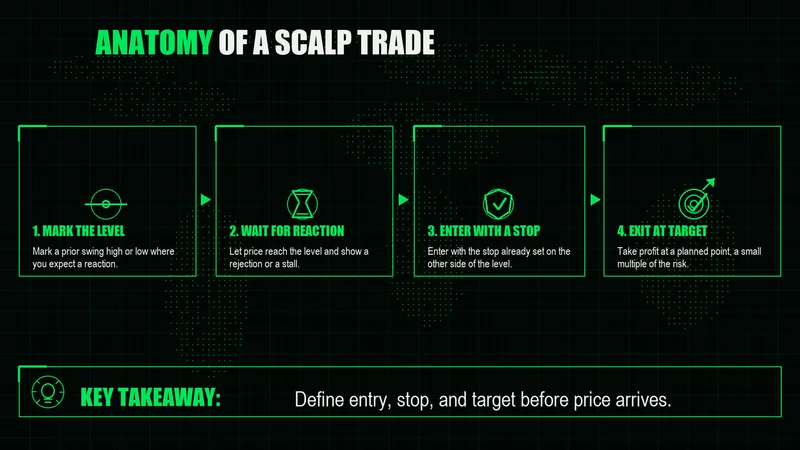
The order is fixed. First, mark the level where you expect a reaction, usually a prior swing high or low, an opening range edge, or a session high. Second, wait for price to reach that level and show a reaction, such as a rejection wick or a stall in momentum. Third, enter with the stop already defined on the other side of the level, so your risk is set before you are filled. Fourth, take profit at a pre-planned point, typically a small multiple of the risk or the next minor level.
The whole point of writing the steps down is that scalping leaves no time to decide mid-trade. On a 1-minute chart, hesitation is the cost. If you have not defined the entry, stop, and target before price arrives, you are improvising under pressure, and improvisation is where a small loss turns into a large one.
The best timeframe for scalping beginners
Most scalping happens on the 1-minute and 5-minute charts, but they are not equally forgiving. For a beginner, the difference between 1 minute scalping and 5 minute scalping is mostly a difference in noise and reaction speed.
The trade-off between the two is consistent:
- The 1-minute chart produces more signals, but a larger share of them are noise. Patterns form and fail quickly, the spread eats a bigger proportion of each move, and you have very little time to read the reaction before acting.
- The 5-minute chart produces fewer signals, but each one is more reliable, the levels are cleaner, and you get a few extra seconds to confirm before committing.
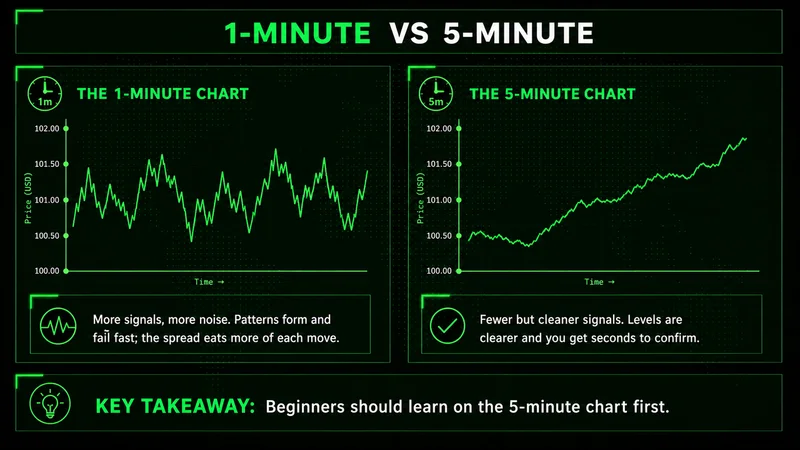
The practical path is to learn on the slower chart first. Beginners build pattern recognition and discipline on the 5-minute, where there is room to think, and only move to the 1-minute after the process is consistent on a demo account. Starting on the 1-minute is the most common way new scalpers overwhelm themselves: more decisions, less time, and a thinner margin against costs, all at once.
A simple scalping setup with support and resistance
You do not need a complicated system to start. A clean scalping setup with support and resistance is enough to study the mechanics, because the levels give you a defined point to act against and a defined point to be wrong.
The setup is straightforward:
- Mark a clear support or resistance level from recent price, ideally one that price has already respected once.
- Wait for price to return to that level on your trading timeframe.
- Take the trade only when price reacts, a rejection at resistance to sell, or a hold at support to buy.
- Place the stop just beyond the level, so a clean break invalidates the idea immediately.
- Target the next minor level or a fixed multiple of your risk, and take it without waiting for more.
The reason support and resistance suits beginners is that the invalidation is obvious. If you sell a rejection at resistance and price reclaims and holds above it, you are wrong, and the stop is already there to take you out. Clear structure, defined risk, and a disciplined exit will outperform a complex indicator stack for most new traders, because the edge in scalping comes from execution quality, not from finding a secret setup.
The market rewards patience far more than activity. Most beginner scalpers do not need more setups; they need fewer trades, tighter risk, and the discipline to wait for the level to do its job.
Risk management is the whole strategy
In scalping, risk management is not a section of the strategy. It is the strategy. The setups are interchangeable; survival comes from how you size and where you stop. A mediocre entry with controlled risk survives. A perfect entry with poor sizing eventually destroys the account.
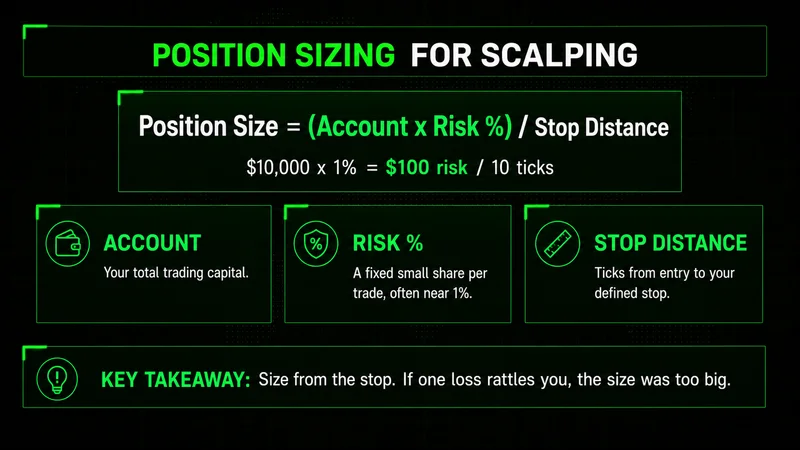
A few rules carry most of the weight in scalping risk management:
- Risk a fixed, small percentage of the account per trade, so no single loss matters. Many traders cap this near 1% and rarely above 2%.
- Define the stop before the entry, in ticks or points, and size the position from that distance, not the other way around.
- Know your costs per trade and require a target that clears them with room to spare.
- Stop trading for the session after a set number of losses, because frequency under frustration is how scalpers compound damage.
There is a simple test for whether your size is right. If one ordinary loss changes how you take the next trade, the position was bigger than you could handle. That signal shows up faster in scalping than in any slower style, because you face so many trades in a single session.
The cost math beginners never run
Here is the part most beginner guides skip. Every scalp pays the spread and any commission on the way in and the way out. When your target is only a handful of ticks, those costs are not a rounding error. They are a structural headwind on every single trade.
Run the math once and it changes how you trade. Suppose your average winner is 6 ticks and your average loser is 6 ticks, a clean 1-to-1. If the spread plus commission costs you the equivalent of 2 ticks round-trip, your real winner is 4 ticks and your real loser is 8 ticks. The trade you thought was 1-to-1 is actually losing money at any win rate below the high fifties. Nothing about the chart changed; the cost did.
This is why market selection matters so much in scalping. You need a liquid instrument with a tight spread, because the edge lives in the gap between your target and your total cost. On a wide-spread instrument, the same setup that works on a tight one becomes unprofitable, not because the pattern failed, but because the math never allowed it to win.
When a scalping strategy stops working
Every approach has conditions it cannot handle, and scalping is more sensitive to its environment than most. The setups that read cleanly in normal liquidity can invert the moment conditions shift, and a beginner who does not recognize the shift keeps trading a strategy that no longer has an edge.
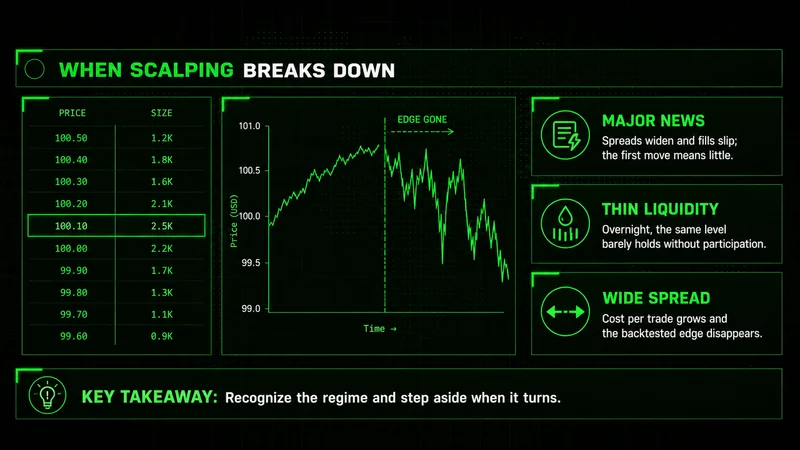
Three conditions break a scalping strategy quickly:
- Major news. The first move after a release is rarely the cleanest opportunity. Spreads widen, fills slip, and the reaction off a level means almost nothing while volatility is spiking.
- Thin liquidity. A setup that fills instantly during active cash-session hours can leave you stuck on a partial fill overnight, where the same level barely holds because there is no participation behind it.
- A widening spread. The instant your cost per trade grows relative to your target, the edge you backtested in calm conditions disappears, even though the chart pattern looks identical.
This is the honest limit of any scalping approach. The structure that works in a deep, liquid, normal-volatility market can mean nothing in a thin or news-driven one. Recognizing the regime you are in, and stepping aside when it turns against the strategy, is part of the job, not a failure of it.
Scalping versus day trading explained
Scalping and day trading are both short-term trading strategies, and both close positions within the day, but they are not the same job. The difference is holding time, trade count, and how much each individual trade is asked to do.
The split comes down to a few clear differences:
- A scalper takes many trades a day, holds each for seconds to minutes, and aims for a thin slice of a move on every one.
- A day trader takes fewer trades, holds for minutes to hours, and lets each position capture a larger part of the move.
- Scalping demands faster decisions, tighter risk control, and far more screen time, because the frequency leaves no room to recover from sloppy execution.
Day trading gives you more time to think per trade, which is one reason it suits beginners better as a starting point. A quick trade strategy sounds appealing precisely because it promises fast results, but the speed is exactly what makes scalping unforgiving for someone still building discipline.
Common scalping mistakes beginners make
Most beginner scalping failures are not analysis problems. They are discipline problems, and they repeat in predictable ways.
- Trading on the 1-minute chart before the process is consistent on a slower one.
- Sizing positions too large, so one normal loss breaks emotional control.
- Ignoring the spread and commission, then wondering why a winning-looking system bleeds money.
- Forcing trades in low-quality conditions instead of waiting for a clean level.
- Revenge trading after a loss, taking the next setup to recover rather than because it qualified.
- Moving or removing the stop mid-trade, which turns a defined small loss into an undefined large one.
Every item on that list is a decision made under pressure, not a flaw in the chart. Scalping magnifies these mistakes because you face the decision dozens of times a session. Fixing the process, not finding a new indicator, is what separates beginners who survive from those who do not.
FAQs
What is a scalping trading strategy in simple terms? It is a short-term trading method built on frequency and tight risk. You take many small trades on a fast chart, usually 1-minute or 5-minute, hold each for seconds to minutes, and aim for a thin, defined slice of a move rather than one large gain.
Is scalping good for beginner traders? It is one of the harder styles to start with. The setups are simple, but the fast decisions, tight risk control, cost sensitivity, and screen time make it demanding. Most beginners are better served learning structure and risk on a slower timeframe first, then testing scalping on a demo account.
What is the best timeframe for scalping as a beginner? The 5-minute chart. It produces fewer but more reliable signals than the 1-minute, the levels are cleaner, and it gives you a few extra seconds to confirm a reaction before committing. Move to the 1-minute only after the process is consistent.
How do you manage risk when scalping? Risk a small, fixed percentage of the account per trade, define the stop before you enter, and size the position from that stop distance. Account for the spread and commission in every target, and stop for the session after a set number of losses to avoid compounding damage.
Worth the read?