Swing Trading Strategy for Beginners — Built on Risk
A swing trading strategy for beginners is a rules-based plan for multi-day trades, where the edge is risk control and defined invalidation, not the entry.

A swing trading strategy for beginners is a rules-based plan for holding a position across several days to a few weeks, entering only where price structure gives you a defined level that proves you wrong. Most guides sell it as the relaxed way to trade. The truth is narrower: swing trading is easier on your schedule and harder on your patience, and the edge lives in risk control, not in the entry.
That distinction matters more than any pattern you will learn. Beginners lose on swing trades for the same reason they lose anywhere else. They size positions emotionally, hold through invalidation, and confuse a multi-day chart with a safer one. The chart is not safer. It just moves slower, which hides the mistake for longer.
What a swing trading strategy actually is
Swing trading sits between day trading and long-term investing. A day trader closes everything before the session ends. An investor holds for months or years and ignores the noise. A swing trader works the space in between, capturing one leg of a move while structure stays intact, then stepping aside.
The core idea is simple. Price rarely travels in a straight line. It pushes, pauses, pulls back, and pushes again. Each of those pushes is a swing. A swing trading strategy tries to participate in one of them with a defined entry, a defined invalidation, and a defined target, then lets the position work without constant supervision.
What separates this from gambling is context. An entry only matters when it aligns with the broader trend, a key level, and the current condition of the market. Without that alignment, you are not trading a strategy. You are reacting to a candle and calling it one.
For a beginner, the appeal is real and worth stating plainly:
- You do not need to watch screens all day. Positions are reviewed once or twice per session, not monitored tick by tick.
- The decision window is longer, so you are not forced into split-second execution.
- A smaller account can participate, because you are not paying for the speed and tooling day trading demands.
- The slower pace gives you time to journal, review, and actually learn from each trade.
None of that makes swing trading easy. It makes it accessible. Those are different words, and the gap between them is where most beginner accounts quietly bleed out.
Swing trading also does not work equally well everywhere. It needs an instrument that moves enough to deliver a multi-day leg, with enough liquidity that your stop fills near where you placed it. A beginner does not need an exotic market. A liquid index, a major equity, or a heavily traded commodity gives you cleaner structure and fewer nasty surprises than a thin, low-volume name that gaps on every headline. Match the strategy to a market that actually swings, and half the difficulty disappears before you place a single trade.
The timeframe you read the chart on is part of the strategy, not an afterthought. Swing trading is usually built around two or three timeframes working together:
- The higher timeframe sets direction and context. The daily chart is the common anchor; it shows the trend you are trading with or against.
- The trading timeframe is where you find the level and time the entry. The four-hour or one-hour chart is typical here.
- The lower timeframe is optional, used only to refine the entry once price reaches your level. It is a scalpel, not a map.
Reading direction on the higher timeframe and executing on the lower one keeps you aligned with the larger move while still getting a tight, defined entry. Beginners who trade a single timeframe usually lose this context. They see a clean setup on one chart and never check whether the larger trend agrees with it.
How swing trading works, and how long trades last
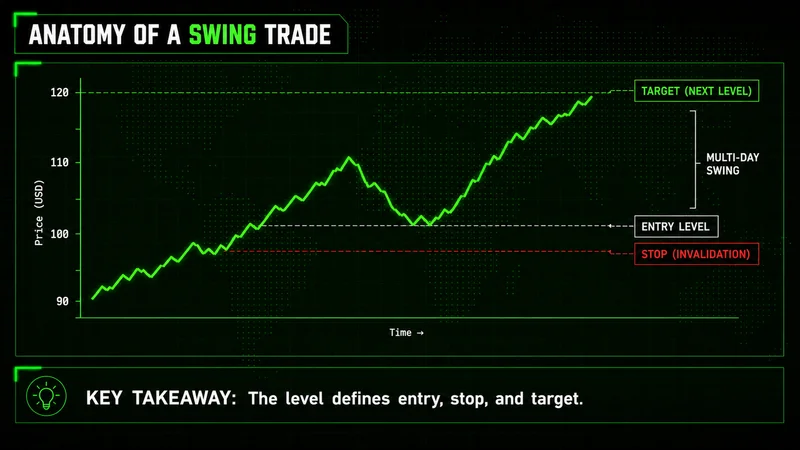
A swing trade has a clean life cycle. You identify a market that is trending or coiling, wait for price to reach a level that matters, confirm that buyers or sellers are reacting there, and enter with a stop placed where the idea would be wrong. From there you manage the position until price reaches your target or violates your level.
Most swing trades last two days to two weeks. Some resolve in three or four sessions. A few stretch toward a month when a trend keeps delivering and structure never breaks. The holding period is an output of the trade, not an input. You do not decide in advance to hold for ten days. You hold until the level that defined the trade is either reached or invalidated.
This is the part beginners rush. They want a fixed answer to how long a swing trade should last, and there is no fixed answer. The level decides. If price respects your structure, you stay. If price reclaims the level you built the trade around, you are out, regardless of how many days have passed.
Here is the standard sequence a swing setup follows:
- Read the trend. Mark the higher-timeframe direction first. You want the wind at your back, not in your face.
- Find the level. Locate the support, resistance, or trendline where price is likely to react.
- Wait for the reaction. Let price reach the level and show acceptance or rejection before committing.
- Define invalidation. Place your stop where the setup is structurally wrong, not at a round number that feels comfortable.
- Set the target. Identify the next logical level where the move is likely to stall.
- Manage the position. Hold while structure holds. Exit when the level breaks or the target prints.
Follow that sequence and the holding period takes care of itself. Skip a step, and you are improvising with real money.
Swing trading versus day trading
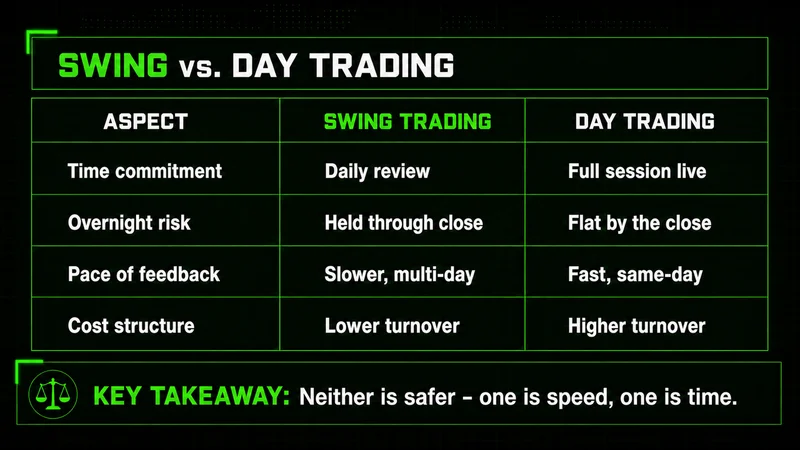
The honest comparison is about temperament and time, not about which one prints more. Day trading compresses everything into a single session. Decisions come fast, the feedback is immediate, and the screen demands your full attention while the market is open. Swing trading spreads the same decisions across days and asks for patience instead of speed.
The trade-offs run in both directions:
- Time commitment. Day trading needs live screen time during market hours. Swing trading needs a focused review once or twice a day.
- Overnight risk. Day traders carry nothing into the next session. Swing traders hold through the close, which means gaps are part of the job.
- Pace of feedback. Day trading teaches fast because outcomes resolve same-day. Swing trading teaches slower, so discipline has to carry you between results.
- Cost structure. Frequent intraday trading stacks commissions and spread. Fewer swing positions keep transaction costs lower.
Neither is safer. Day trading exposes you to speed. Swing trading exposes you to time and the gaps that come with it. A beginner usually adapts to swing trading more easily, because the slower clock leaves room to think. That same slow clock is what lets a bad position sit untouched for days, so the easier pace cuts both ways.
A single risk-defined entry framework
Most beginner content hands you a menu of named strategies and leaves you to guess which one to use. Trend following, breakout, pullback, reversal, mean reversion. The list grows, the clarity shrinks. In practice, the good entries all share the same skeleton, and learning the skeleton beats memorizing the menu.
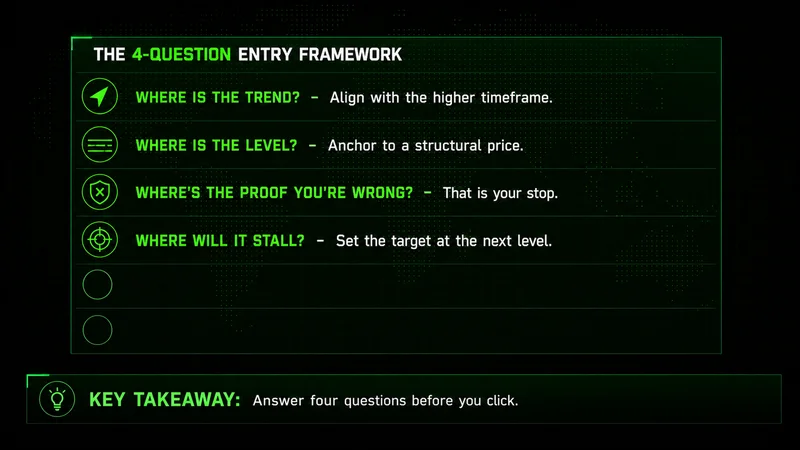
Every swing entry worth taking answers four questions before you click:
- Where is the trend? Align with the higher-timeframe direction, or have a specific reason not to.
- Where is the level? Anchor the trade to a structural price, not a feeling.
- Where is the proof you are wrong? Define the exact level that invalidates the idea. That is your stop.
- Where is the move likely to stall? Set the target at the next logical level, not at an arbitrary profit figure.
Answer those four and the named strategies become variations on one theme rather than separate systems. A trend continuation entry and a breakout entry use the same skeleton. So does a pullback. The label changes; the discipline does not.
This is also where simplicity earns its keep. A clear structure with defined risk outperforms a complicated system for almost every beginner, because the complicated system adds decisions without adding edge. Indicators are tools, not decision-makers. The framework above does the deciding; the indicators only describe what price is already telling you.
A few indicators do earn a place in a swing trading strategy, as long as you treat them as description rather than instruction:
- Moving averages map the trend and act as dynamic levels where pullbacks often find support. A simple pair, one faster and one slower, is enough to read direction.
- Volume confirms conviction. A breakout on strong volume is a different event from one on quiet volume, and the difference often decides whether the move continues.
- Relative strength helps you spot when a push is overextended or when momentum is fading, which is context for timing rather than a standalone signal.
That is a complete toolkit for a beginner. Notice what is missing: a dozen overlapping oscillators all saying the same thing in different colors. Stacking indicators feels like rigor, but it usually just manufactures the illusion of certainty in a market that offers none. The chart, the level, and the trend carry the decision. The indicators only annotate it.
Trend and pullback entries, step by step
Two entries cover most of what a beginner needs. Trend swing trading rides an established direction. Pullback swing trading waits for that trend to pause before joining it. Both sit inside the same framework; they differ only in timing.
For a trend entry, you are joining strength that is already visible:
- Confirm the higher timeframe is making higher highs and higher lows for longs, or the reverse for shorts.
- Wait for price to push through a prior swing level with clear momentum and no immediate rejection.
- Enter on the continuation, with your stop below the most recent higher low that anchors the trend.
- Target the next structural level where the move is likely to meet supply.
For a pullback entry, you are buying a discount inside that same trend:
- Establish the trend exactly as above. The pullback only counts when the larger direction is intact.
- Wait for price to retrace into a prior level, a moving average, or a clear support zone.
- Look for a reaction at that level — a rejection wick, a slowing of the pullback, or a shift back in the trend's direction.
- Enter on confirmation, with your stop just beyond the level that should hold. If the level breaks, the pullback has become something else, and you want no part of it.
The pullback entry is usually the cleaner of the two for beginners, because it offers a tighter, better-defined invalidation. You are buying near the level that proves you wrong, so your risk is small and measurable. Chasing a trend after an extended push does the opposite. It places your entry far from any level, which forces a wider stop and a worse trade.
A concrete example makes the difference clear. Say a liquid stock has been trending up on the daily chart, printing higher highs and higher lows, and it stalls near a prior swing high around $100. Instead of chasing the breakout candle, you wait. Price pulls back over two sessions into a rising moving average near $94, an area that lined up with prior support. There, the pullback slows, a rejection wick forms, and the next candle pushes back up. You enter near $94 with a stop just below $92, where the level and the trend's last higher low would both be broken. Your risk is roughly $2 per share, defined and small. Your target is the next structural level above the prior high. That is the entire trade, and the small, measurable risk is exactly what the framework was built to produce.
The breakout entry is the same skeleton with different timing. Rather than buying the pullback, you wait for price to clear a well-defined level, the top of a multi-week range or a prior swing high, on convincing momentum, then enter the continuation with your stop back inside the range. The discipline is identical. What separates a clean breakout entry from a chase is that you are entering at the level as it gives way, not a full leg later, after the move has already run and any sensible stop has become uncomfortably wide.
Most failed breakouts and chased trends come from the same impulse — entering emotionally instead of structurally. The fix is not a better indicator. It is the willingness to wait for price to come to your level instead of paying up to meet it.
Risk management for swing trading beginners
This is the part that actually decides whether you survive. A swing trading strategy with mediocre entries and disciplined risk control will outlast a strategy with perfect entries and sloppy sizing. The market removes the second trader eventually. It is not close.
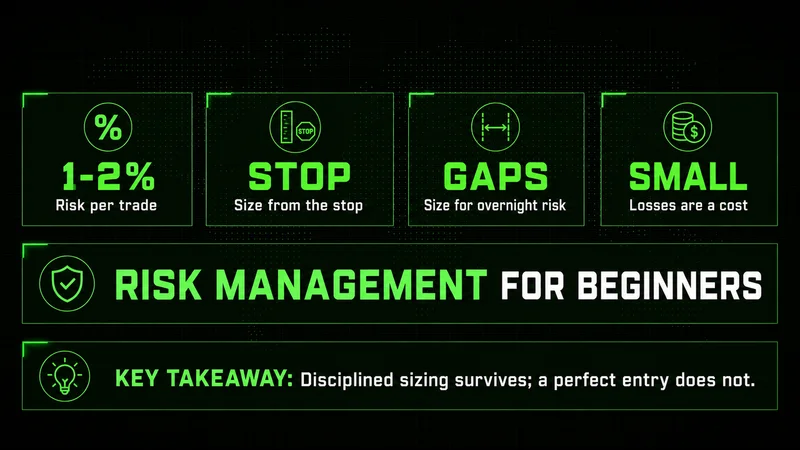
Start with position size, because that is where most accounts break. Risk a small, fixed percentage of your capital on any single trade, commonly one to two percent. The exact figure matters less than the consistency. If a single losing trade affects your next decision emotionally, your position was too large. That is the clearest signal of overleverage there is, and most beginners are overleveraged without realizing it.
Build every trade around these rules:
- Define risk before entry, never after. The stop is part of the setup, decided when you are calm, not adjusted when you are losing.
- Size from the stop, not from the account. Your share count comes from the distance to invalidation and your fixed risk percentage, not from how confident you feel.
- Accept the gap. Holding overnight means price can open past your stop. Size small enough that a gap against you is a bruise, not a wound.
- Take small losses as a cost of business. A small loss is an operational expense. A large loss is almost always an emotional decision that you let run.
- Do not add to a loser. Increasing size to recover a losing position is how manageable drawdowns become account-ending ones.
Managing the position after entry is its own discipline, and beginners tend to either smother a trade or abandon it. A few principles keep that in check:
- Let the level do the work. Once the stop is set, leave it. The reason to exit is a broken structure or a reached target, not a nervous afternoon.
- Move the stop only to reduce risk, never to increase it. Trailing a stop up to lock in profit as structure builds is sound. Sliding it down to avoid a loss is the cardinal mistake.
- Take partial profit at structure if it suits you. Scaling out at the first target and holding the rest with a stop at break-even is a reasonable way to bank progress without capping the move.
- Honor the time stop. If a trade has gone nowhere for far longer than your setups usually take, the thesis has quietly expired. Closing a dead position frees capital and attention for a live one.
There is a quieter point underneath all of this. Most traders do not have a strategy problem. They have a discipline problem. The rules above are not complicated, and almost everyone who blows up knew them. What they lacked was the willingness to follow the rules during a drawdown, when following them is hardest and matters most.
When a swing trading strategy stops working
No strategy works in all conditions, and swing trading has two environments where it quietly stops paying. Knowing them in advance is worth more than another setup.
The first is choppy, range-bound tape. Swing trading needs price to travel, to push from one level to the next and let a position breathe into profit. In a tight, directionless range, those legs never develop. Price stalls, chops, and stops you out on noise before any real move begins. The same trend-following logic that reads cleanly in a trending market means almost nothing when there is no trend to follow. In those conditions, the highest-quality decision is usually to stand aside. Forcing trades through low-quality conditions is one of the most expensive habits a beginner can build, and it rarely feels like a mistake while it is happening.
The second is the gap. Because swing positions are held through the close, you are exposed to everything that happens while you are out of the market — an earnings release, an overnight headline, a macro print before the open. Price can open well past your stop, and the stop you placed so carefully does not protect you from a gap. It only triggers after price has already jumped. This is structural, not a flaw in your plan. The only real defense is size. A position small enough to absorb an adverse gap survives it. A position sized for a perfect world does not.
There is a third, subtler failure that has nothing to do with the market. It is fatigue and frustration after a string of losses, pushing you to trade your way back to even. A losing stretch does not require immediate recovery. The market does not owe you a green week to close out a red one, and the attempt to force one is how small drawdowns compound into large ones. Stepping away from the screen is sometimes the highest-quality decision available, and it is almost never the one a frustrated beginner wants to make.
Common mistakes beginners make
The errors below show up again and again, and every one of them is a discipline failure dressed up as a strategy question:
- Oversizing. The single fastest way to turn a normal losing trade into an account problem. If a loss stings emotionally, the size was wrong.
- Moving the stop. Widening a stop because price is approaching it turns a defined risk into an open-ended one. The stop was the plan; honor it.
- Trading without a trend. Taking trend setups in a range, where the legs never develop, and donating to the chop.
- Chasing extended moves. Entering far from any level after a big push, which forces a wide stop and a poor trade.
- Ignoring the overnight gap. Sizing as if the position will behave while you sleep, then getting surprised by an open that jumps your stop.
- Revenge trading. Trying to recover a loss immediately, which is about ego reclaiming control, not about the setup in front of you.
- Overcomplicating the chart. Stacking indicators in search of certainty that does not exist, instead of reading structure and managing risk.
Notice that almost none of these are about picking the wrong pattern. They are about execution and emotional control. That is the real curriculum of swing trading, and it is the part no indicator can teach you.
A swing trading strategy for beginners works best when it stays boring. Define the level, define the risk, wait for the reaction, and let the trade either reach its target or prove you wrong. The traders who survive are not the ones chasing more setups. They are the ones taking fewer, cleaner trades and protecting their capital while the impatient ones learn the expensive way.
FAQs
What is a swing trading strategy in simple terms? It is a rules-based plan for holding a trade across several days to a few weeks, entering at a level that matters and exiting when price either reaches your target or breaks the level that proves the idea wrong. The whole point is to capture one leg of a move while structure stays intact.
How long do swing trades usually last? Most last from two days to two weeks, though some resolve in a few sessions and others stretch toward a month. The holding period is decided by price, not by the clock. You hold while your structure holds and exit when the defining level is reached or invalidated.
Is swing trading good for beginners? It suits beginners better than day trading for one reason: the slower pace leaves room to think and learn. It is accessible, not easy. The same slow clock that gives you time to decide also lets a bad position sit untouched for days, so it still demands discipline.
How much money do I need to start swing trading? Less than day trading requires, because you are not paying for speed and intraday tooling. The amount matters less than your risk per trade. If you risk a small, fixed percentage of capital on each position, a modest account can participate while you build experience.
What is the most important skill in swing trading? Risk management, by a wide margin. A mediocre entry with disciplined sizing survives; a perfect entry with poor sizing eventually does not. For most beginners, the missing piece is not analysis but the discipline to follow their own rules when a position turns against them.
Worth the read?