Gross Domestic Product — What Traders Read in GDP
Gross domestic product is the broadest economic indicator, but traders read the expectations gap, not the headline. Here is what GDP signals and where it fails.
Gross domestic product is the total market value of all final goods and services a country produces over a set period, usually a quarter or a year. That is the textbook gross domestic product meaning, and it is accurate. For a trader, though, the number itself is rarely the point. The market has usually priced in the expectation long before the release, so what moves price is the gap between what was forecast and what actually printed.
GDP is a backward-looking measure. By the time the figure is published, the quarter it describes has already ended, and the first estimate gets revised twice. So the value of GDP to a trader is not prediction. It is context. It tells you which regime you are operating in, and it shapes how central banks behave, which is where the real positioning happens.
How gross domestic product is calculated
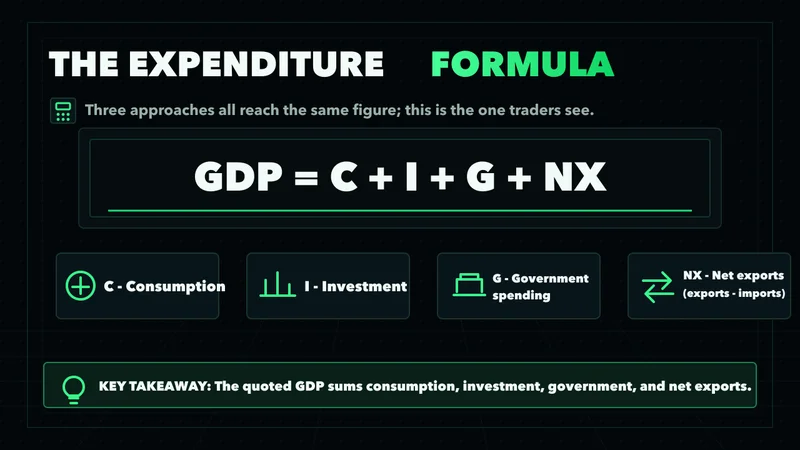
There are three approaches to the gross domestic product calculation, and in theory they all arrive at the same figure:
- Expenditure approach — the one most traders see quoted. It sums consumption, investment, government spending, and net exports (exports minus imports).
- Income approach — adds up wages, profits, rents, and taxes earned in producing those goods and services.
- Output approach — totals the value added at each stage of production across every industry.
The expenditure breakdown matters most for reading the market reaction. A headline beat driven by inventory buildup is not the same as one driven by consumer spending, and the components tell you which it was. Strong consumption with weak investment reads very differently from the reverse.
You will also see two versions of the figure. Nominal GDP measures output at current prices. Real GDP strips out inflation so growth is not just rising prices wearing a disguise. When a release surprises, check whether the move came from real output or from the deflator — the distinction changes what the print actually says about the economy.
Why GDP works as an economic indicator
GDP is the broadest gross domestic product economic indicator available, which is exactly why it carries weight and why it lags. It aggregates the whole economy into one figure, so it confirms a trend rather than calling it early. Faster data — payrolls, purchasing manager surveys, retail sales — moves first. GDP arrives later and validates what those higher-frequency series already suggested.
That lag is the feature, not the flaw. A trader does not use GDP to time an entry. The release confirms which broad regime is in force: expansion, slowdown, contraction, or recovery. Once you know the regime, you know roughly how the central bank is likely to lean, and rate expectations are what actually price across equities, bonds, and currencies.
The market does not trade the number. It trades the distance between the number and what everyone already assumed.
Reading the gross domestic product report like a trader
The gross domestic product report is not one event. In the United States it lands in three stages for each quarter: an advance estimate, a second estimate, and a third estimate, each spaced about a month apart. The advance figure moves markets the most because it carries the largest information surprise. By the third estimate, most of the content is already priced.
When the release crosses, the sequence that matters is straightforward. The forecast was set days earlier. Price reacts to the deviation from that forecast, not to whether growth was positive. A 3% print against a 3.4% expectation can sell off even though the economy grew, because the number disappointed the bar that was already set.
This is where the gross domestic product trading signal actually lives — in the expectations gap, not the absolute level. A few practical reads:
- A beat that lifts rate-hike odds can pressure rate-sensitive equities even as it signals a stronger economy.
- A miss that raises the odds of easing can lift risk assets, because cheaper money tends to support valuations.
- A figure that lands on forecast often produces the smallest move, since the surprise that drives volatility is missing.
How GDP affects stocks and other assets
The gross domestic product impact on stocks runs mostly through two channels: expected corporate earnings and expected interest rates. Stronger growth points to higher earnings, which supports equity prices. But stronger growth can also pull forward rate hikes, which raises the discount rate applied to those earnings and works against valuations. The two forces often pull in opposite directions, and which one dominates depends entirely on where the cycle sits.
The reaction is rarely uniform. Cyclical sectors — industrials, consumer discretionary, financials — tend to respond more to growth surprises than defensive sectors do. In currencies, a strong print can firm the domestic currency on expectations of tighter policy. In bonds, hot growth data usually pressures prices as yields adjust to a more hawkish path. None of this is mechanical, and the same headline can produce opposite reactions in two different rate environments.
How GDP differs from the consumer price index
Traders frequently track the gross domestic product vs consumer price index pairing because the two answer different questions. GDP measures how much the economy produced. The consumer price index measures how fast prices are rising for a basket of consumer goods. One is an output measure; the other is an inflation measure.
They interact through monetary policy. A central bank weighs growth against inflation, so a strong GDP figure paired with hot CPI argues for tighter policy, while strong growth with contained inflation gives a central bank room to stay patient. The combination of the two carries more signal than either one alone. Watching GDP without watching inflation alongside it gives you half the picture the central bank is actually working from.
The limitations every trader should respect
The gross domestic product limitations are real, and ignoring them is how traders get caught. The figure is heavily revised — an advance estimate can shift meaningfully by the third reading, so building conviction on the first print is fragile. GDP also says nothing about distribution, debt quality, or the composition of growth. An economy can post a strong headline while the underlying mix deteriorates.
There is a sharper limitation for anyone trading the release itself. The first move after major macro data is often not the cleanest opportunity. Liquidity thins around the print, spreads widen, and the initial spike frequently reverses once the full report is digested and the components are parsed. The framework that says "strong GDP lifts equities" holds over a regime. In the first ninety seconds after the number crosses, liquidity and positioning override it, and a clean fundamental read can be exactly the wrong thing to act on.
This is why the disciplined approach treats GDP as context for positioning rather than a trigger for execution. The number defines the regime. It does not define your entry.
FAQs
What is gross domestic product in simple terms? It is the total market value of everything a country produces in final goods and services over a period, usually a quarter or a year. It is the broadest single measure of economic activity, which is why it is watched closely and why it lags faster data.
Does a high GDP figure always lift the stock market? No. The reaction depends on what was already expected and on how the figure shifts interest-rate expectations. A strong print can pressure stocks if it pulls forward rate hikes, and a weak print can lift them if it raises the odds of easier policy.
Why do traders care about GDP revisions? Because the first estimate is the least reliable. The advance figure gets revised twice, and the change between readings can be material, so conviction built on the initial number is fragile. The revision schedule is one of the main limitations traders weigh.
What GDP is good for and what it is not
Gross domestic product is the cleanest read on which economic regime you are trading inside, and that context is genuinely useful for positioning. It frames how central banks are likely to behave, and central bank expectations are what price across markets. Used that way, it earns its place in a process.
It is not an entry signal, and it is not a forecast. It is lagging, it is revised, and in the minutes around the release liquidity matters more than the fundamentals. Read the expectations gap rather than the headline, weigh it against inflation, and let the number shape your context instead of your execution. The traders who survive macro releases are usually the ones reacting to how price behaves around the print, not the ones predicting the print itself.
Worth the read?